
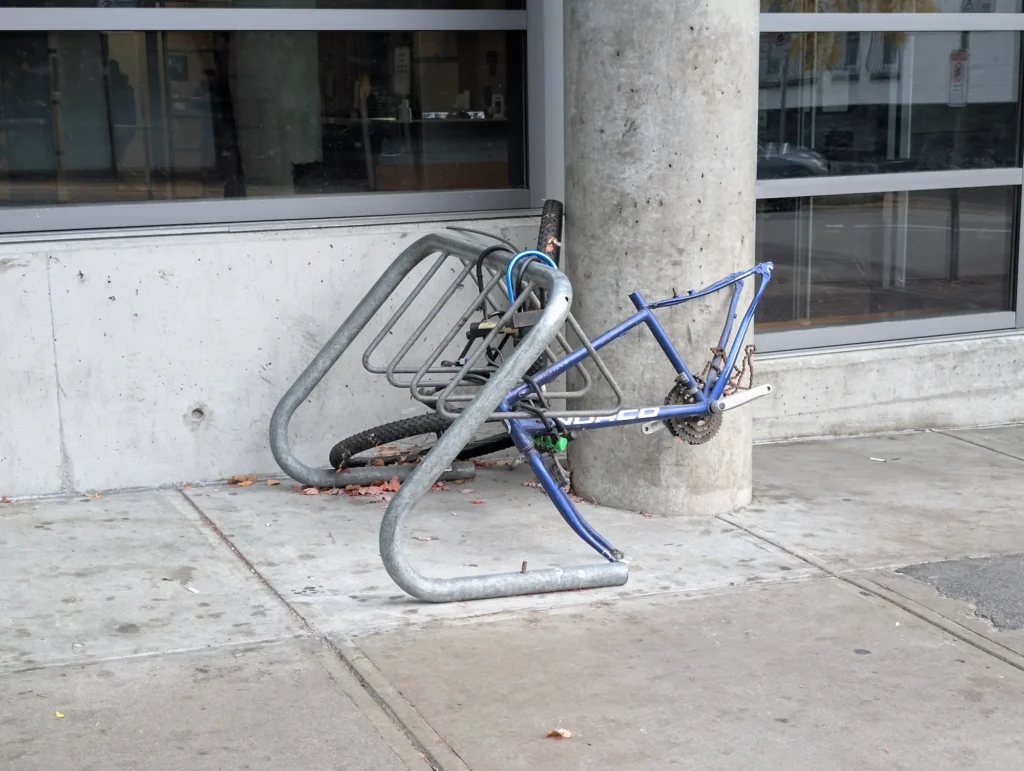
Camber Isaac had sold his car and bought an e-bike, using it to get to the SkyTrain for work. On 11 July 2024, he returned to the bike parkade at Lafarge Lake–Douglas Station in Coquitlam to find the bicycle gone and his lock cut. It was the sort of facility designed to make combining biking and transit practical.
Vancouver has spent years encouraging people to cycle, and its recorded bicycle thefts have fallen sharply. But getting someone onto a bike is only half the undertaking. They need to be able to get off it, leave it somewhere and expect to ride home.
Speaking to Daily Hive after the theft, Isaac described being careful about parking and frustrated by the wait for security footage. Transit Police said the footage request was underway and the investigation remained open. The loss had cast doubt on his commute despite the precautions he had taken.
The decline is real in the police records
Vancouver’s reputation for bicycle theft has outlasted a substantial fall in the recorded count. An analysis of the VPD’s GeoDASH records finds 3,064 bicycle-theft entries in 2015, 884 in 2024 and 793 in 2025. The decade-long reduction is about 74 per cent.
These records cover incidents known to police and classified as bicycle theft. They cannot count losses nobody reports, and investigations can change an entry later. Nor can the totals tell a rider the odds of losing a bike during a particular half-hour outside a shop. That would require knowing how many bicycles were parked, where and for how long.
A stream of missing-bike posts cannot establish that the whole city is getting worse. A lower annual count offers little comfort to someone weighing the risk of losing the bicycle they need for work.
The City promotes free registration through 529 Garage, which helps owners record identifying details and police match recovered bikes to people. Registration gives a bicycle an identity that can survive a change of hands. It is useful work, particularly for an object whose appearance can be altered by swapping components.
The fall does not tell us how much to credit to each measure. For a cyclist choosing somewhere to park, the more immediate question is what protection is available before a bike disappears.
A stolen bike can travel farther than its owner knows
On 6 March this year, a special municipal constable near Main and Cordova encountered two people in possession of a valuable Specialized road bike. It was not registered with 529 and had not been reported stolen. A retailer’s serial-number records helped the constable trace the owner, who did not yet know it had been stolen from a North Vancouver home.
The recovery helps explain why the Downtown Eastside figures in theft complaints from elsewhere. The place where a bicycle is taken, and the place where it turns up can be different municipalities.
In another documented recovery on East Hastings, officers found a man taking bicycles apart on the sidewalk on 25 June. A serial-number check established that one had been stolen only hours earlier. Police contacted the owner and tried to put it back together. That day they also arrested a man riding an $11,000 Ghost near BC Place after its owner spotted it, and recovered a $10,000 e-bike on Main Street that had been stolen in Yaletown.
There is enforcement here, down to the unglamorous work of trying to reassemble somebody’s transport. The account is less complete once the bicycle has been handed back. An owner’s good news can reach the headlines without explaining who supplied a seller or how the investigation progressed. Recovering property and disrupting the business behind its theft are separate accomplishments.
The bike comes back. What happens to the person holding it?
Getting a stolen bicycle back can leave an owner with an unfinished grievance. Someone had their property. A claim of having bought it from another person appears to end the conversation. The owner wants to know what prevents another bicycle from disappearing tomorrow.
Police do not have to catch someone cutting a lock to pursue a criminal case. Under Section 354 of the Criminal Code, knowingly possessing stolen property is itself an offence. A person can face prosecution even if they were not the original thief. Saying they bought the bicycle does not automatically protect them.
The difficulty is establishing what that person knew. A serial number can identify the stolen bicycle without proving that its current possessor knew it was stolen. Deliberately avoiding an answer can also amount to knowledge: the Supreme Court calls this wilful blindness. It requires recognizing the need to inquire and deliberately choosing not to, rather than simply being a careless buyer.
In B.C., police investigate and decide if there is enough evidence to recommend charges. Crown counsel then assess the prospect of conviction and the public interest in prosecuting. The evidentiary standard is a substantial likelihood of conviction. A case can stop before anyone appears before a judge.
Those requirements explain why recovering a bicycle may be easier than securing a conviction. They do not answer how thoroughly a particular theft was investigated. An owner questioning the response has reason to ask what evidence police pursued beyond identifying the bike, if charges were recommended and, if they were declined, why.
Returning the bicycle resolves the owner’s immediate loss. It leaves the source of that bicycle, and the prospect of another theft, worth investigating.
DTES residents lose bicycles, too
The Downtown Eastside appears in police accounts as a place where bicycles stolen elsewhere are recovered. It is also home to people who rely on bicycles, lose them to theft and describe being treated as suspects simply for riding them.
In Jeanette Steinmann’s reporting for The Tyee in 2021, five men living in the DTES described how cycling fitted into their lives. For Steve Nelson, collecting recyclables by bike was work he could manage despite physical limitations. “I can ride my bike a hundred miles a day, but I can only walk a couple blocks,” he told her.
The men described inexpensive repairs, replacing stolen bicycles and, in one case, being allowed to pay later for a tube. For someone collecting recyclables, losing a bicycle can also interrupt the work that would help pay for its replacement.
Some of Steinmann’s interviewees described being met with suspicion because they were poor and cycling. Their accounts show the harm in treating a poor rider as a suspect before establishing who owns the bicycle.
Repair work also has a legitimate place on these streets. Our Community Bikes runs free clinics at Oppenheimer Park for bicycles and mobility aids. Investigating stolen bicycles requires establishing where they came from and who owns them. Poverty, tools, and second-hand parts cannot answer those questions.
The destination is part of the route
The public advice is familiar: keep the serial number, register the bike, and use a better lock. These are reasonable precautions. They also leave the owner trying to solve a problem that depends in part on the parking area provided.
Vancouver put that responsibility into its own Transportation 2040 plan, adopted in 2012. The plan recognized theft as a deterrent to cycling and called for higher-security parking, including a downtown bike centre. The principle has been on the books for nearly fourteen years.
HUB Cycling’s Vancouver/UBC committee identifies destination parking and theft as barriers to riding. The City installs public racks, while TransLink provides controlled-access parkades and individual lockers. These services make it easier to combine bicycle travel with other modes of transportation. Their location determines which journeys they can serve.
TransLink’s parkades cost $1 a day, capped at $8 a month. They use registered Compass access and CCTV, although the agency disclaims responsibility for theft. In November 2022, CityNews reported Transit Police figures showing 22 parkade thefts between January and August, against 15 during all of 2021. The comparison describes that earlier period, not today’s risk, but demonstrates that theft has occurred inside access-controlled facilities.
CCTV can help reconstruct a theft after it happens. It does not necessarily put anyone beside the rack while a lock is being cut. For the rider who chose the facility because it looked protected, that distinction can arrive too late.
This summer, TransLink tested staffing at the Main Street–Science World parkade from 27 July to 4 September. Customers continued to enter with registered Compass cards. Staffed valets offer a different arrangement: a person accepts the bike and returns it against a claim ticket. TransLink’s seasonal valet programme included Vancouver City Centre and a Sunday service in Gastown.
That model needs scrutiny, too. BEST’s Bike Valet service publishes a programme-wide stolen-bike rate below 0.002 per cent. That is the operator’s own figure, without an independent comparison against ordinary racks. Its customer guidance also warns that a bicycle will be released to anyone presenting a valid claim ticket. Having staff present adds protection, but the handover still depends on how the service operates.
For a customer buying groceries or a worker starting a shift, the useful question is what happens to their bicycle while they are elsewhere. A facility at a station cannot automatically serve a destination several blocks away. A summer service cannot cover the rest of the year. The promise of secure parking has to hold through the hours someone actually needs it.
Permanent provision would cost money and occupy space, and a staffed facility needs hours that justify its expense. A worker who finishes after the valet shuts down needs another arrangement, as does a rider whose cargo bike does not fit. Opening hours and physical design decide which trips the facility makes possible. So do entry controls and the care taken when returning a bicycle to its owner.
Other cycling cities have something to teach
In Utrecht, leaving a bicycle while spending an evening in the city centre is supported by guarded parking that stays open late. The Stadhuis facility lists closing time as 4 a.m. on Thursday, Friday and Saturday nights. The first 24 hours are free. A rider can stay for dinner without the parking service ending before the evening does.
The municipal parking network serves the city centre as well as the station area. Its operating terms require supervision through regular checks and cameras where present, with a matching label and bicycle sticker scanned on each visit. They also provide conditional compensation for a missing bicycle, capped at €750 and reduced with its age. This is limited cover, subject to documentation and other requirements, rather than a promise to replace any bicycle at full value.
For Vancouver, those details offer a useful specification for permanent staffed parking: hours that cover the visit, a check linking the person collecting a bicycle to the one left there, and published terms explaining what happens after a loss. A year-round downtown pilot could test that service near shops and workplaces. Its results should include the trips people felt able to make, alongside use and thefts.
Cambridge, England, has combined parking improvements with action against repeat offenders. At Queen Anne Terrace, an upgrade completed in November 2025 added an access-controlled area with 36 spaces, available for a £30 annual subscription, as part of broader improvements to lighting, cameras and cycle parking. Access-controlled parking alone would be familiar to a TransLink user. The wider programme also includes marking bicycles and court orders restricting individual offenders.
In March, Cambridge City Council reported that cycle theft had fallen 70 per cent since 2019, crediting the combined effort. The figure does not isolate the contribution of cameras, registration or enforcement. Its council minutes describe orders that can restrict an offender from possessing a bicycle without proof of ownership. Those are targeted British court measures, rather than a general requirement imposed on every cyclist.
Vancouver’s own recorded decline is substantial. Cambridge’s example points to a more specific task than chasing a better percentage: addressing repeat offending while improving the places bicycles are left. Here, the City, TransLink and police could evaluate a permanent parking pilot together, tracking losses and investigation outcomes while asking riders which journeys the service made practical. That would connect the recovered bicycle to the next trip its owner needs to make.
The places a bicycle stops taking you
A participant in UBC’s 2025 evaluation of B.C.’s e-bike rebates described a limitation that no motor or battery could overcome: “It’s hard to run errands in downtown Vancouver without feeling like it will be stolen.”
The researchers found that concerns about parking insecurity were associated with participants avoiding certain trips or areas. These people had acquired the bicycles the Province wanted them to use. Fear of losing them was narrowing their usefulness.
That is a different consequence from the replacement bill. A bicycle can remain in its owner’s possession while becoming a less practical way to get around. The rider has to choose destinations partly by where the machine can be left, how long it will be unattended and the cost of losing it. An errand that should be straightforward acquires a security calculation.
Actual theft can change travel more decisively. In a 2024 study of 1,821 people who had experienced bicycle theft, Achituv Cohen and colleagues found that 45 per cent reported cycling less or stopping afterwards. Occasional cyclists were more vulnerable to reducing their riding than frequent cyclists. Recruitment through a registry and other networks, including targeted outreach in California, means those percentages cannot be applied to Vancouver. The study nevertheless documents people retreating from the form of transport cities are trying to encourage.
Vancouver’s falling recorded theft count is welcome. It does not measure the shopping trip made another way because the rider distrusts the rack outside. Nor does it tell us how freely a person will use the replacement for a stolen bike. Those are transport outcomes, alongside the police figures.
There is something unreasonable about promoting cycling as an ordinary activity while treating the ability to leave a bicycle as an exceptional convenience. People need to work, buy groceries and spend time with other people. The bicycle has to wait somewhere while they do. A transport policy that gets riders safely to a destination has further work to do if they are unwilling to stop there.
Isaac had already chosen an alternative to driving. After the theft, he told Daily Hive that even a replacement would not make him comfortable using SkyTrain again. Buying another bicycle would leave the parking problem unresolved.

Glenn is dedicated to scrutinizing government actions affecting the Downtown Eastside and holding those in power accountable for their commitments. With a focus on transparency and policy analysis, his writing aims to expose gaps between promises and outcomes, pushing for meaningful changes that benefit the community.

Leave a Comment