
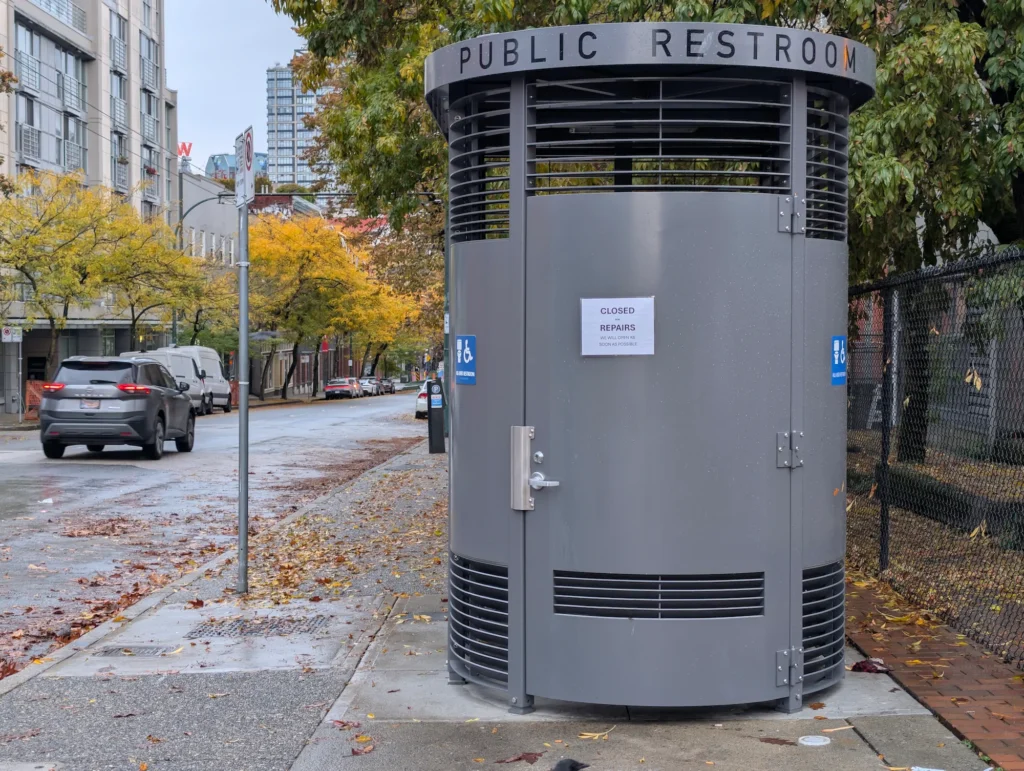
Vancouver spent $446,145 replacing the public toilet at Main and Powell, where the previous facility had been closed for more than two years. The new Portland Loo opened on 8 June. By 28 October it was out of service, and anyone arriving with the ordinary expectation of using a toilet would have to find somewhere else.
The reported problem involved a lock. In Global News’s account of the closure, the City was still determining if a component or the whole locking system needed replacement, and could not confirm which budget would cover it. It put annual maintenance at approximately $95,000 and did not expect a large repair bill. An expensive toilet with an unusable door makes a readily understood spending story. Less visible is the history of nearby washrooms that Vancouver has repeatedly found money to keep open, without settling how to sustain them.
That history reaches back to 2020. It runs through pandemic trailers, attendants hired from the communities they serve, and government grants that ended even as the work remained needed. At Oppenheimer Park, the next municipal reprieve came with a proposal for fewer operating hours. The question extends beyond repairing one door: how did an everyday service become something Vancouver keeps funding as a temporary response?
The emergency revealed an older shortage
On 27 May 2020, city manager Sadhu Johnston told the mayor and council that installation of three temporary washroom trailers had begun. Each had five stalls, two urinals and four sinks. WISH would monitor the facility at its Alexander Street drop-in around the clock. The Overdose Prevention Society and RainCity Housing would oversee the other locations on different schedules. The City was supplying sanitation in a pandemic, but it was also arranging for people to be present while others used it.
Within weeks, WISH’s Mebrat Beyene was explaining why the service ought to survive the event that had brought it into existence. Speaking to CityNews in July 2020, she described sex workers depending on McDonald’s and 7-Eleven for washroom access. The trailers offered a different relationship: facilities operated by outreach workers people trusted. The need had existed before COVID, she said, and would remain after it. “Our hope for sure is we don’t return to the previous normal.”
The business community was making a related argument. In the same report, Downtown Vancouver Business Improvement Association representative Charles Gauthier said the shortage predated COVID and advocated peer staffing at automated toilets to respond to overdoses. The two organisations arrived at the service from different directions: outreach for sex workers, and the needs of downtown businesses.
Federal emergency money allowed the response to grow. It covered more than washrooms. A February 2021 memo from acting city manager Paul Mochrie described $4.9 million in funding through Reaching Home, covering two new washroom trailers, extended hours at City facilities, and renovations at a new 60-bed shelter. The money helped build a response that crossed ordinary municipal categories: washroom access alongside shelter provision, with non-profit operators doing much of the daily work.
The job beside the toilet
At Pigeon Park, the City eventually applied that approach to a machine it already owned. Its automated toilet had been out of operation for two years before an attendant program began. By October 2023, City staff were reporting that it had operated without closure since the program’s introduction, with fewer repair and maintenance requests than other automated toilets. They identified Main and Powell as a priority for possible expansion. Before buying the new Loo, Vancouver had considered putting attendants beside the old toilet at that corner.
The description of the job was more substantial than the word “attendant” suggests. An August 2022 agreement with the Overdose Prevention Society anticipated two peer positions, supervising toilet users and working with community members and Outfront staff during servicing, with City sanitation support as needed. The scheduled service ran from 9 a.m. to 9 p.m., seven days a week. The agreement also specified a place for the workers. The City would provide a kiosk, with a tent for weather protection until it was installed.
City records show actual Pigeon Park attendant program spending at $275,575 in 2023. Comparing it directly with the new Loo’s reported annual maintenance allowance would misstate what was purchased: the attendant arrangement included scheduled staffing and supervision, alongside coordination around upkeep. The staff assessment cannot establish if attendants would have prevented Main and Powell’s lock problem, or prove they caused the improvement at Pigeon Park. It does describe a useful result under an operating model the City was considering for expansion.
Getting to the next washroom
The case for those services becomes clearer when “another washroom nearby” is examined from the position of the person expected to reach it. In Michelle Gamage’s February 2024 reporting for The Tyee, OPS general manager Trey Helten described the painful condition known as “street feet”. For someone living unhoused and struggling with it, a six-block walk to the Evelyne Saller Centre, he said, “feels like walking 100 miles”. His account concerned hygiene access well before the present closure. It makes the walk between facilities a question of physical capacity as well as geography.
A toilet at home was no guarantee either. The Downtown Eastside Women’s Centre describes women avoiding shared washrooms, including in SRO housing, because they fear assault. A bathroom inside a building where someone lives can therefore fail to provide the privacy and safety ordinarily associated with having a home. Beyene’s account of trusted outreach workers addresses a part of this problem that installing another enclosure does not automatically resolve.
A 2025 study led by Melody Wise examined the trailer program through 47 interviews with users, peer staff and operators in 2023–24, identifying gender-related safety barriers and the potential benefit of combining sanitation facilities with accessible anti-violence and harm-reduction support. The interviews concern experiences within the program. They cannot establish how many assaults a particular attendant program prevented, or rank its sites by cost-effectiveness.
The City’s own replacement notice for Main and Powell promised wheelchair accessibility, an initial round-the-clock schedule, and three daily cleanings. Those commitments describe a different service from Pigeon Park’s historically scheduled twelve hours with attendants. A replacement could improve wheelchair access and overnight availability while leaving the question of personal assistance to a separate operating decision.
When the grant runs out
The uncertainty was built into the early Pigeon Park arrangement. Its 2022 amendment allowed the broader OPS agreement to run to March 2023 if further funding arrived. Without it, the expiry would be the end of October 2022. The City was to notify the contractor about that funding by 31 October. The notice was due on the possible expiry date.
By autumn 2023, City staff were asking council to seek $3.8 million from the Province for a year of continued and expanded services, with a package covering trailers, extended comfort-station hours and attendant programs. It was a funding request, not an approved expenditure. The report recognised that pandemic restrictions had lifted while housing and overdose crises continued.
In July 2024, Vancouver found internal budget savings to continue the Pigeon Park and Oppenheimer attendant programs after one-time senior-government funding ran out. The City said those facilities would otherwise face closure without attendants to provide maintenance and security. OPS found a community partner for the washroom at 144 East Hastings. The City had not found funding for the Astoria trailer’s washroom operation, although separately funded overdose-prevention services would continue.
Guy Felicella welcomed the reprieve while warning against its repetition. Speaking to CityNews reporter Hana Mae Nassar, the harm-reduction and recovery advocate called for permanent funding and challenged the prospect of having the same argument a year later. His objection concerned the repeated possibility of withdrawing a service people needed every day.
Astoria subsequently found another source of support. A February 2025 City update said Astoria’s operators had secured Vancouver Coastal Health funding to continue operations through March 2026. Engineering supported Pigeon Park through June 2025, with the extension contingent on funding, while Oppenheimer’s attendants were funded through that year. Services had found ways to continue. The update recorded different funders and deadlines for services that had begun as part of the same emergency response.
Who pays for the attendant?
Vancouver has an explanation for seeking help beyond its own budget. In the washroom framework council approved in January 2026, staff distinguished ordinary daytime access, supplied through a network of public facilities and businesses, from attended services in places such as the Downtown Eastside. The latter involve health, housing and outreach needs that intersect with provincial responsibilities. The City’s stated position is that it can provide suitable facilities while provincial funding supports the more intensive operations and staffing.
The Province was already supporting some washroom access. In its July 2024 statement, the City acknowledged more than $4 million per year in renewed BC Housing support for the integrated services at 390 Main and the Food and Wellness Hub at 320 Alexander, both of which offer washrooms among other services. That was funding for broader operations, not an allocation solely for toilets. The dispute concerned sustaining specific attendant programs alongside existing provincial support and should be understood in light of those existing contributions.
The framework does not propose attendants everywhere. It calls for assessing the Main and Powell Loo for other priority locations, while developing short-term strategies to continue attendants at Pigeon Park, Oppenheimer and other sites. This is an attempt to match services to different circumstances. It also leaves the operating model already credited with keeping facilities usable dependent on further arrangements, even as the City studies where to install the next machine.
Another year, with less promised
At Oppenheimer, the renewal question had already produced a concrete proposal to reduce the service. In a November 2025 grants report, staff said attendants had been in place since 2020, following misuse, damage and closure. Federal grants had supported the program from 2021 to 2024. A year of City funding sustained it in 2025. Staff had still not identified an ongoing funding source.
They recommended another one-year grant, this time with a scaled-back monitoring model, basic cleaning and oversight, and reduced operating hours. The report did not specify the revised hours. It proposed up to $270,000 for Atira Women’s Resource Society. Council approved the grant on 26 November.
The grant’s endpoint was 31 December 2026. By then, Oppenheimer’s attendant program would have been in place for six years. Another extension could follow, so that date cannot be treated as a closure announcement. It marks how far Vancouver’s emergency approach has travelled since Beyene hoped the city would avoid returning to the old normal: into another year of service, with fewer hours proposed and the next funding decision still ahead.

Denise is a long-time advocate for affordable and dignified housing in the Downtown Eastside. Having lived in SROs and volunteered in homeless shelters, she brings a personal understanding of the housing crisis and its impact on the community. Her work reflects years of lived experience, frontline work, and commitment to creating better living conditions for DTES residents.

Leave a Comment