
On November 5, 2025, a Vancouver council committee took up a staff report with a plain request. The Vancouver Police Department wanted $5 million in one-time money for Task Force Barrage, its Downtown Eastside crackdown. The report was candid about the timing. The VPD had deployed on call-out from the task force’s start in February “until the end of September,” and the overtime had already been worked. The bill would come out of the city’s General Stabilization Reserve. Council adopted the committee’s recommendations that day. The task force was nine months old.
Three councillors voted against that item: Pete Fry, Sean Orr and Lucy Maloney. Fry went on to defeat Mayor Ken Sim on October 17, and Orr and Maloney now sit beside him on the new council. COPE, one of the parties on it, promised in its platform to “push for democratic community oversight and an audit of the VPD.”
That promise runs into a sentence the city’s own auditor wrote two years ago. In his 2024 report on the VPD, Auditor General Mike Macdonell put it this way: “my right of access to audit the VPD is not automatic – I must first be invited by the Board.” The Vancouver Police Board is separate from council, and the province appoints most of its members. The new council holds the money and the City crews that clear Hastings Street. It does not hold the invitation.
The vote came last
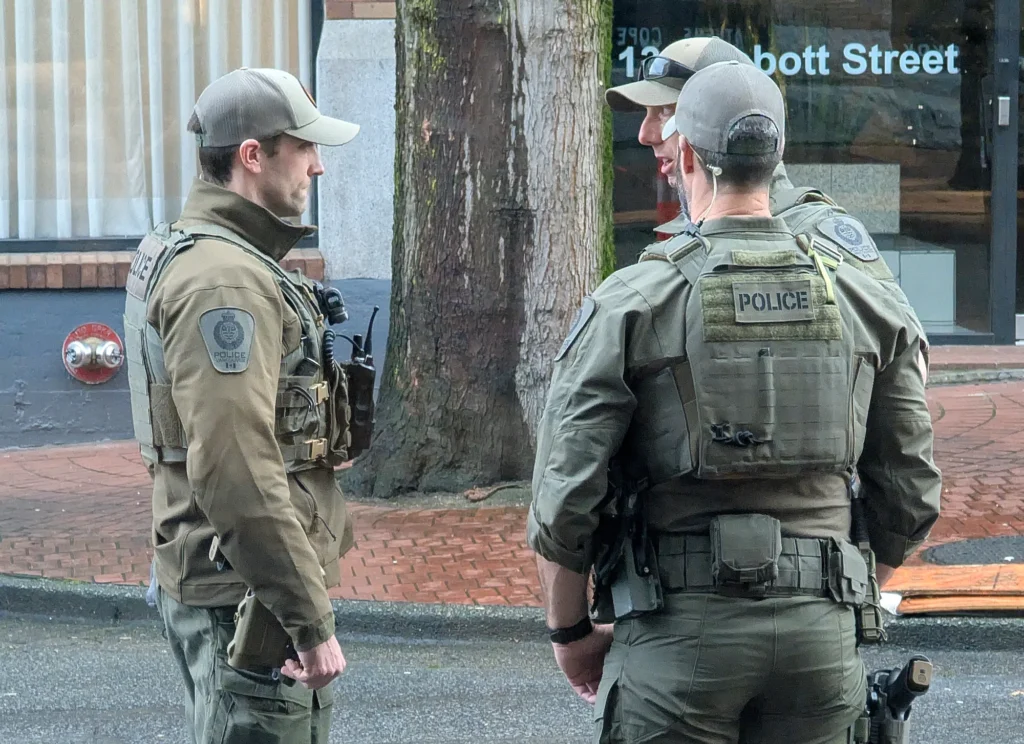
The announcement came first. On February 13, 2025, Sim and then-chief Adam Palmer presented the plan together: $5 million added to the VPD budget for a crackdown built on a “surge capacity” of patrol officers, and a promise to clean up the area “literally and figuratively.” The name Task Force Barrage came with it. Sim said he would take the cost to council later in the year.
The police say it is working. On October 21 the VPD released figures to support its claim that the city is “safer than it’s ever been,” including a key crime measure at an all-time low last year.
Others who would later weigh in on the money learned of it with everyone else. The Police Board, which helps build the police budget, was not part of the approval process, and its chair said the board learned of the $5 million at the mayor’s press conference. Opposition councillors, including Fry, found out at the same time as the public. In May, Sim could not say how the money had been approved, and critics called it a backroom decision.
When the vote came, the overtime was already on the books. The November report requested $17.0 million more for the VPD in 2025: $2.2 million for fringe benefits, $1.9 million for protest policing, $5 million for the task force, and $7.9 million for forecast shortfalls. CTV News counted it as $17 million in police overspending approved by council. Fry, Orr and Maloney were outvoted by the ABC councillors and then-independent Rebecca Bligh. The Tyee has argued that councillors outside ABC and the board “were left out of the funding decision for nine months, contrary to B.C. policing legislation.”
What the money bought
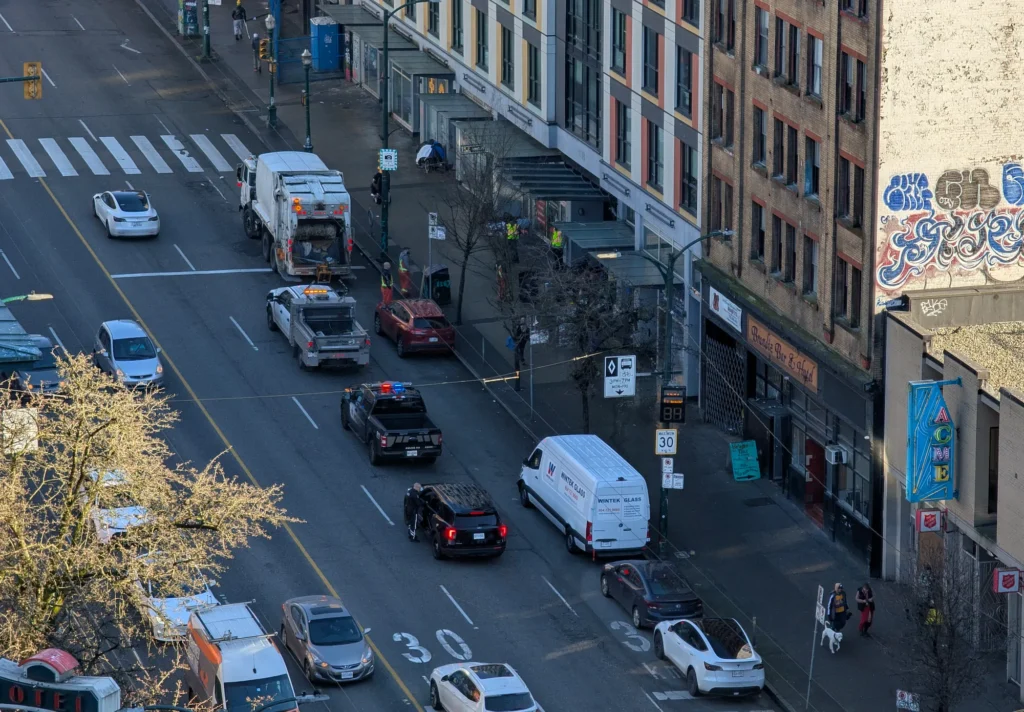
The report says more about the task force than its price. It “included the City’s Integrated Response Teams (IRT) program,” which brings together the VPD, fire and rescue, “bylaw officers, sanitation crews, and engineering teams from the City” to keep the sidewalks of Hastings Street clear. The $5 million appears as one overtime total. The report does not break it down by activity, so the public record does not show how much went to the crews who move people and belongings off the street.
The City calls that work routine cleanup, and says people do not have to leave an area if their belongings stay mobile and pose no safety concerns. VPD Sgt. Adam Donaldson says the Hastings Street patrols have run daily in their current form since 2022.
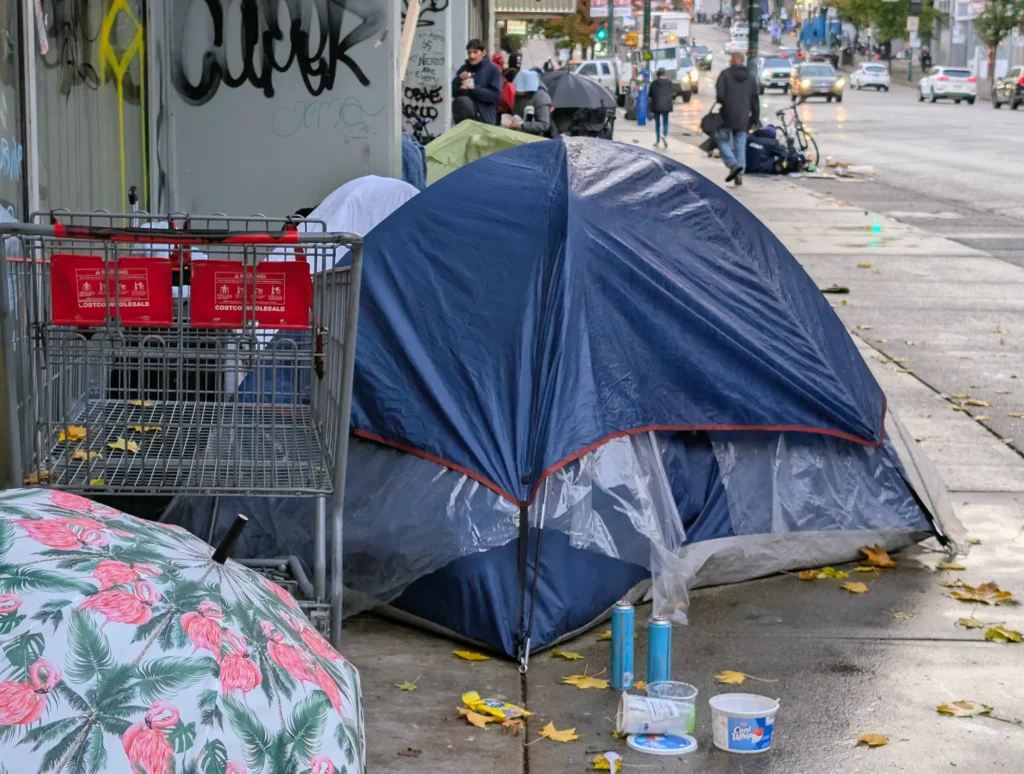
Research that followed unhoused people measured what happens next. A study in PLOS Medicine, published September 24, followed 154 unhoused people who use drugs between June 2023 and May 2025. Of 121 reports of forced displacement, 119 included no offer of housing. Two of the authors belong to the community research group P.O.W.E.R., which the paper discloses. P.O.W.E.R.’s own report, announced in its Dispatch #12, counts 71 incident reports from Vancouver between January 2024 and July 31, 2026. It says 24 described police seizing belongings and 76 per cent described harm to mental health.
The neighbourhood’s policing is also changing shape. The VPD’s training academy opened in September in the former London Drugs space at Woodward’s, and the City paid $4 million toward it and the new District 5, $2.8 million of that to establish the district. The Police Board’s request for 2026 describes District 5 as a move toward making the Downtown Eastside its own policing district. Its list of 13 new priorities does not name the district, and the report says the deployment and its costs “are currently being assessed.”
Two sets of numbers, no referee
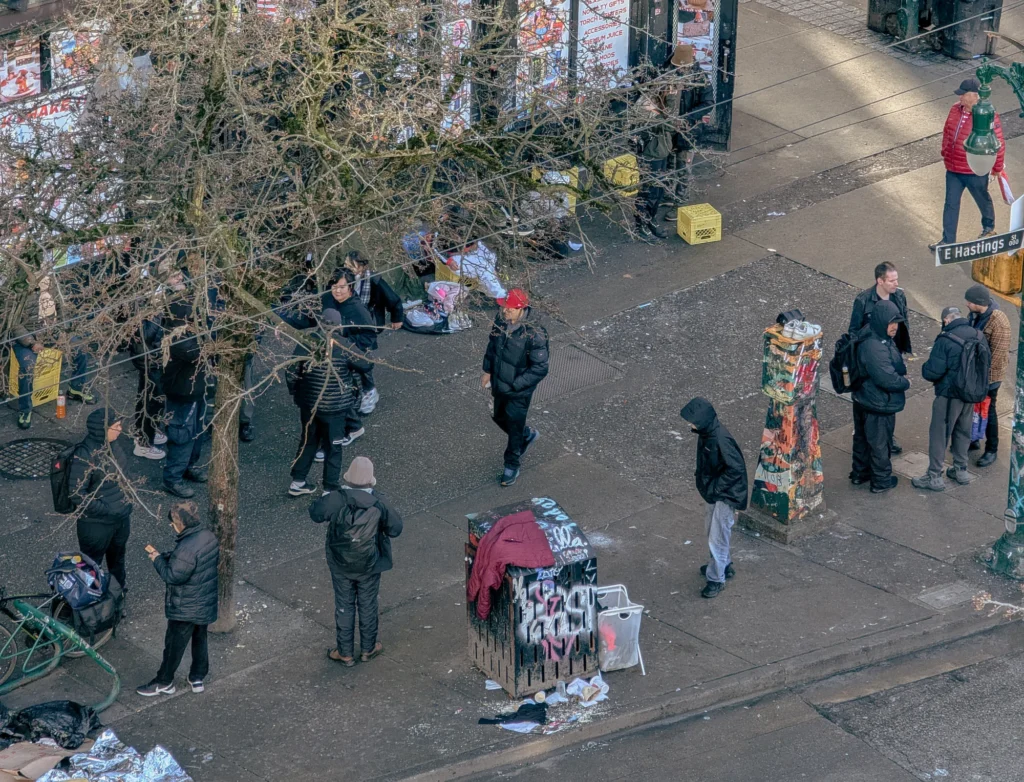
The same argument runs over drugs. On March 26, 2024, the VPD said it had made “no possession seizures under 2.5 grams” in the first nine months of the decriminalization pilot. A study in BMC Public Health, published online on September 5, says the department counted only incidents in which possession was the most serious offence. Among 490 people who use drugs, its authors found that quarterly rates of police seizure without arrest were 0.8 to 2.1 per cent before the pilot and 1.1 to 4.1 per cent during it.
The study also points to province-wide police data analyzed by the B.C. government, which recorded 27 possession seizures under 2.5 grams between February 2023 and April 2024, and 61 regardless of weight. Those counts cover the province, not Vancouver alone, and the authors say such figures sit uneasily with what people who use drugs report. P.O.W.E.R.’s report adds a longer series. It cites survey data in which police seizure of drug-use equipment rose from 1.2 per cent of participants in mid-2022 to 5.81 per cent in the second half of 2025.
Neither side’s figures settle the other’s. The studies rest on what people who use drugs told researchers. The police numbers rest on the department’s own records, and testing them would require access to those records. Access is the one thing the City’s auditor does not have by right.
Who can open the door
Macdonell has audited the VPD twice. The first audit, released in December 2023, examined how the board governs enterprise risk management and how the department approaches it, and left day-to-day operational risk aside. The second, released on October 31, 2024, examined how the board and the department manage performance. It found the VPD had “no prioritized, finite list of KPIs to report against,” and it made four recommendations, one for the board and three for the department. It covered a department with a 2023 budget of just over $401.8 million, 20.4 per cent of the City’s operating spending.
The board did not escape the findings. It “carried out many of the oversight responsibilities outlined in its manual,” the report says, “but had not provided guidance, direction, or worked with the VPD on defining KPIs.” Its manual called for quarterly reporting against the strategic plan. What it received were quarterly public safety indicators, not comprehensive performance reports, alongside routine financial variance and overtime reports.
The board can still fairly say it welcomes scrutiny. The performance audit happened “at the request of the Vancouver Police Board.” The board agreed with its recommendation, and Chair Frank Chong and Chief Constable Palmer signed a pledge to “work together on an implementation plan.” By the auditor’s December 2025 follow-up, dated November 27, the board had approved a performance framework for the VPD on November 20, and the department’s first annual performance report was due in the first quarter of 2026. Every outstanding risk-management recommendation remained only partially implemented. City management supplied those status updates, and the auditor’s team did not verify them.
The audit’s reach was narrow. It covered January 1, 2022, to July 31, 2023, long before Task Force Barrage, and it listed “testing the quality or integrity of the data that the VPD used for performance-related information” as out of scope. The auditor’s 2026 plan lists another VPD audit as “Topic TBD,” to be set “subject to invitation by the Board.” It adds that “the choice of audits remains entirely mine.”
The province’s handbook for police boards describes the design behind that arrangement. A board “stands separate and distinct from council,” it says, and operations belong to the chief constable alone. Council cannot choose for him. Coun. Colleen Hardwick said when the office published its first plan that “Council cannot direct the [office] as to what audit areas they pursue.” The province has its own route: section 40 of the Police Act mandates that the Police Services Division audit municipal departments. Council can ask the board for an invitation. The board decides.
What a council can force
Money is the lever council does hold. The board must submit a provisional budget to council before November 30 each year. Council must include it unless it disagrees with specific items, and then either side can apply to the province’s Director of Police Services for a ruling. City staff describes the law as one that “materially constrains the City’s discretion over the policing budget.”
Council has pushed on that limit before. In December 2020, it froze the police budget, and the provincial government overturned the freeze. Of the five councillors and then-Mayor Kennedy Stewart who voted for the cut, only Fry remains. A related dispute over almost $6 million of the VPD’s 2021 request, which council had declined to fully fund, went to the Director of Police Services for a ruling.
Five months earlier, on July 22, 2020, councillors voted unanimously to ban street checks, and Stewart, who chaired the board at the time, said only the board could abolish them. The VPD’s own annual audit of the practice reached the board on February 18, 2021, and showed checks down more than 94 per cent. It also showed that Indigenous people made up 2.2 per cent of Vancouver’s population and 23 per cent of street checks, though more than half of the checks involving Indigenous people were wellness checks.
Provincial changes have since ended the automatic mayoral chair. Boards now pick their own chair, and councils name one representative. In both past cases, the final decision sat outside council, and the new rules move the board further from the council table.
Two dates
The first is November 30, when the board’s 2027 provisional budget is due. Its 2026 request was $497,111,657, up $50,013,567 from the restated 2025 budget. Of that, $27.9 million was adjustments, led by $25.7 million for a collective agreement, and $22.1 million was the increase itself: $12.7 million to maintain service and $9.4 million for new priorities.
The second is the auditor’s calendar. His 2026 plan schedules a follow-up report on earlier recommendations for December. The topic of the next VPD audit, and whether the board invites one on overtime, the task force or street enforcement, will show how far the board will let outside eyes go.
The parties differ on what to do with that. On election night, COPE, the Greens and OneCity hold 10 of 11 seats, including the mayor. The Greens promised “regular independent performance reviews,” The Tyee reported, and an analysis by Mo Amir says Fry has not committed to budget cuts or reallocation without an independent audit. COPE promised to “challenge the legal structures which handcuff the city to unelected police boards.” Both promises meet the same first test on November 30, when the board’s budget reaches the council that made them.

Glenn is dedicated to scrutinizing government actions affecting the Downtown Eastside and holding those in power accountable for their commitments. With a focus on transparency and policy analysis, his writing aims to expose gaps between promises and outcomes, pushing for meaningful changes that benefit the community.


Leave a Comment