
At Woodward’s, a space where people once picked up prescriptions now trains police officers. London Drugs closed its store on February 1, citing persistent safety problems and operating losses. In September, the Vancouver Police Department opened its training academy in the former retail space.
The academy gives the building a new use. The people who relied on the store have had to make other arrangements. Hastings Crossing’s business association described the closure as the loss of a place to fill prescriptions and buy everyday necessities close to home. For those customers, the neighbourhood had become harder to use.
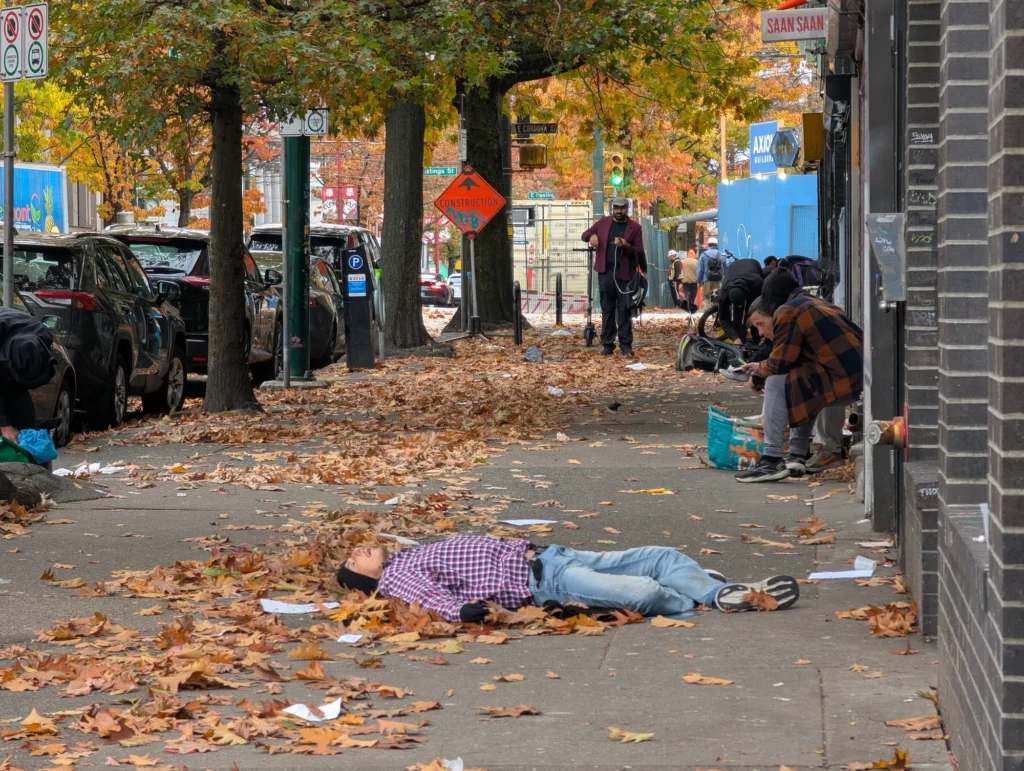
That loss belongs in any honest discussion of compassion in the Downtown Eastside. So does the person in medical distress on the sidewalk, and the worker expected to get through a shift amid threats and disorder. The neighbourhood should be able to keep people alive and make life possible around them. Its residents are entitled to more than the chance to survive the next emergency.
The cost of staying
Ordinary businesses matter to people whose lives already require extraordinary help. A pharmacy serves people who are ill. A grocery store feeds people receiving support as well as those providing it. A customer does not stop needing these places because they live in supportive housing or use an overdose prevention service. Their continued presence belongs in the neighbourhood’s idea of care.
The London Drugs announcement included an uncomfortable detail: the company said targeted patrols and other police efforts had helped reduce violence against staff, but customers had not returned. It offered help transferring prescriptions. A business could acknowledge an improvement and still conclude that staying was no longer sustainable.
The dispute over what should replace it was more complicated than a contest between public safety and community needs. In February, the Gastown Residents Association backed a police academy as a way to bring activity and stability to the building. Hastings Crossing’s business association wanted the former store considered for affordable retail, entrepreneurship and other active uses. Both were responding to a loss. They differed over how the neighbourhood might recover from it.
A shopkeeper has a narrower decision to make. Rent, wages and repairs must be paid while the larger argument continues. Sympathy does not replace a damaged door, and a business should not have to become an informal crisis service to justify its place on East Hastings.
In Allen Abel’s October National Post feature, the owner of New Town Bakery described customers having food and phones taken from their tables. Asked whether most Vancouverites cared about the area, she answered: “Only we in this area suffer it.”
Her answer carries the frustration of someone with a business to keep open. It cannot speak for every Vancouverite. It does describe the distance between discussing the Downtown Eastside and having to open a door there every morning. People whose work and homes are here cannot always withdraw from the conditions that others encounter briefly, condemn and leave behind.
That helps explain why the language of compassion can sound so hollow to someone asking for protection. A person reporting a threat is entitled to a response to that threat. They should not have to settle the politics of addiction before receiving one. The same protection belongs to someone living in a shelter or a residential hotel. Safety cannot be a benefit reserved for the people best able to leave.
Improvement is not permission
A serious account also has to make room for businesses that open and conditions that improve. The City’s 2026 storefront inventory put vacancy in Hastings Crossing at 19.2 per cent, against 9.4 per cent citywide. The local rate had fallen. Fifteen businesses filled vacancies, while six vacant units were demolished for development. Some of the improvement therefore came from removing empty units from the inventory.
The spring inventory covers street-facing storefronts across a business district, rather than every tenant inside Woodward’s. It describes a district under considerable pressure, with evidence of renewal inside it. Declaring the whole area finished would erase the people still investing their work there. Treating a lower vacancy rate as a satisfactory condition would ask them to accept too little.
The same discipline applies to crime. In its September comparison, VPD recorded 68 violent offences in District 5, compared with 81 in the same month of 2025. One month cannot establish a lasting trend. It can record an improvement while still leaving people exposed to substantial violence. A demand for safety can acknowledge both.
For someone repeatedly threatened at work, an improvement in the surrounding district does not decide whether the next shift is tolerable. For a person living nearby, wanting a usable sidewalk and protection from violence is a reasonable expectation. The argument for better conditions should not require a record-breaking crime rate.
Vancouver’s own administration recognizes needs that public debate sometimes treats as competing concerns. Its 2025 Downtown Eastside actions report describes a weekday programme collecting human waste from public property, alongside street cleaning, housing work and basic services. The City is already paying people to deal with what disgusts passersby. Paying for cleanup is necessary. Allowing the neighbourhood’s ambition to end with the next collection round would be a miserable standard of public service.
That requires public toilets people can actually use, somewhere appropriate to rest and reliable help for someone who is unwell. Cleaning remains necessary. So does enforcing access to entrances and sidewalks. Asking for these things together should be unremarkable. It is difficult to defend a public realm that humiliates someone who needs a toilet while leaving someone else to clean the result from a doorway.
The life after rescue
The person on the sidewalk is entitled to the same seriousness. Public exhaustion becomes dangerous when a visible state of distress is treated as a complete account of a person: their diagnosis, what they are capable of and what their future must be. None of those can be settled by looking down a block.
The BC Centre for Disease Control warned in January that changes in the unregulated drug supply, including medetomidine mixed with opioids, could cause prolonged sedation. It also warned that non-fatal poisoning can cause brain injury through lack of oxygen. A person who looks frighteningly unwell needs an assessment of what is happening to them. Their appearance cannot tell an onlooker whether the problem is a temporary drug effect, an injury, a psychiatric emergency or some combination requiring different kinds of care.
A falling death count cannot describe all of that harm. The First Nations Health Authority’s first-half 2026 figures recorded 140 First Nations deaths from toxic-drug poisonings, down 6.7 per cent from the same period in 2025. Paramedic-attended poisonings rose 50.2 per cent, to 1,971. These are provincial First Nations figures, not a Downtown Eastside total, and the same person can experience more than one event.
Preventing a death matters. Continuing to be poisoned matters too. Compassion has to be interested in the life a person is able to lead between emergencies, including their physical health, relationships and ability to have some control over the day.
There are services already trying to make those connections. Directly above Insite, Onsite provides stabilization and recovery care. PHS describes 12 short-term stabilization beds and 18 longer-term supportive-recovery beds, with clinical support and planning for further care. Entry requires completion of acute withdrawal management. It is an existing route onward. Someone still needing acute withdrawal care cannot assume this is where they can start.
The Province has also reported shorter waits through Road to Recovery Vancouver: an urgent median of one day, and routine waits reduced from an average of 26 days to approximately eight, over the period from October 2023 to December 2025. A person seeking help elsewhere cannot take those waits as a provincial guarantee.
These are reasons to expand expectations of care. A system that can shorten a wait should be pressed to make appropriate help reliably accessible. People should be able to seek it without having to survive another crisis first. Dismissing every existing service as a failure would discard the work on which a better response has to build.
The obligation need not end when the crisis team leaves. Vancouver Coastal Health’s July update on its expanded crisis teams records subsequent connections to community care, including a three-month follow-up measure. Being connected is not the same as being well, but it is a more useful starting point than pretending nobody looks beyond the initial call. The next responsibility is to establish whether those connections provide the treatment and continuing support a person actually needs.
A destination worth offering
Leaving someone in a state of severe illness can be an abandonment of responsibility. There must be a response for a person unable to protect themselves. Intervening starts a clinical obligation that continues through assessment, treatment and whatever comes after discharge. Declaring an intention to intervene is the easy part.
B.C. already has powers for involuntary admission under the Mental Health Act. They involve clinical examinations and specified conditions concerning mental disorder, required treatment, deterioration or protection, and the unsuitability of voluntary admission. A passerby’s alarm does not establish that an individual meets those conditions. Neither does a blanket commitment to autonomy answer the needs of everyone who does.
The evidence also demands more care than the promise that confinement will fix addiction. A 2023 McMaster Health Forum synthesis found mixed outcomes across different compulsory-treatment systems, including concerns about harm after discharge. Completion of a programme and sustained improvement are different outcomes. That evidence does not decide every case of involuntary psychiatric care; it does make a universal promise of recovery through compulsion indefensible.
Housing choices deserve equal scrutiny. Being offered an apartment away from an open drug market can be valuable. That does not establish that everyone will do better in an isolated unit, or that recovery requires excluding anyone who continues to use substances.
A 2017 Somers-led randomized trial in Vancouver found that both scattered apartments and congregate Housing First improved housing stability compared with usual care. Tenancy was not conditional on compliance with addiction treatment. Some additional outcomes favoured the congregate model against usual care. The study does not provide a universal prescription for today’s neighbourhood; it shows why the details of support and setting cannot be reduced to a slogan about where people should live.
These distinctions matter to a person being asked to accept help. An offer of housing ought to include a clear account of the home and the support available there. An offer of treatment ought to include a serious prospect of care afterward. Asking someone to trust an institution carries a responsibility to explain what they are being asked to trust.
The practical obligation is to offer a place suited to the person, with ongoing support. That means paying attention to the apparently minor arrangements on which an offer depends. The next appointment needs to be explained, transport needs to be arranged, and somebody needs to take responsibility for following up if it is missed. These are obligations for the institutions making the offer, not a test that a person must pass to deserve help. An available bed and a workable route into care are related promises. The second requires someone to see the journey through. Some people will want to return to a home community. Others will have relationships and reasons to stay in the Downtown Eastside. Expanding the choice of safe places to live is different from requiring people to disappear so that a street looks better.
The public image of the Downtown Eastside can overwhelm the lives within it. Moving a person out of a photographed block can change the picture without establishing that they have somewhere safer to live. An acceptable response has to follow them beyond the point where they cease to trouble someone else’s view.
The neighbourhood is owed a day
In September, a Nuu-chah-nulth Tribal Council outreach worker described to Ha-Shilth-Sa how they helped a woman who had been sleeping in a tent enter withdrawal care in Vancouver. The woman was then heading to treatment near her home community on Vancouver Island. The account was of an individual reaching another stage of care, not a guarantee of recovery. It was nevertheless a concrete destination that somebody had helped make possible.
The same seriousness should extend to people staying here. The Province and health authorities should be answerable for access to suitable care and its continuity. The City should be answerable for public facilities and accessible streets. Police and the justice system should protect people from violence and exploitation. These responsibilities meet in one neighbourhood, however separately they appear in an organizational chart. A resident should not have to sort out which institution is failing before asking for a response. Nor should a small business have to accept that every agency has completed its part while the conditions outside its door remain intolerable. A public service has to be judged at the point where somebody needs it.
Vancouver has long had language for combining prevention, treatment, harm reduction and enforcement. Its Four Pillars strategy dates to 2001. Repeating those commitments is easier than ensuring that a person can obtain help, a resident can use a street safely, and a shop can keep its doors open. The neighbourhood is where the promises have to work together.
The people who maintain businesses should not be asked to finance the shortfall indefinitely. Hastings Crossing’s vandalism relief grant offers eligible members up to half the cost of physical damage, capped at $750 per incident and two claims a year, subject to available funds. Stolen goods are excluded. To seek that help, a business must supply a police file number and proof of damage, such as photographs or repair receipts.
There is nothing abstract about those costs. A public commitment to the neighbourhood should take them as seriously as the cost of responding to a medical emergency. The demand is modest: care that fits, protection from violence and the ability to get through an ordinary day. People in the Downtown Eastside are entitled to expect all of it. Vancouver should be embarrassed that this still needs to be said.

Kris has been at the forefront of Downtown Eastside initiatives for over 15 years, working to improve the neighbourhood. As a consultant to several organizations, he played a key role in shaping harm reduction strategies and drug policies. A strong proponent of decisive action, Kris’s work focuses on driving tangible change and advocating for solutions that address the complex challenges facing the community.



Leave a Comment