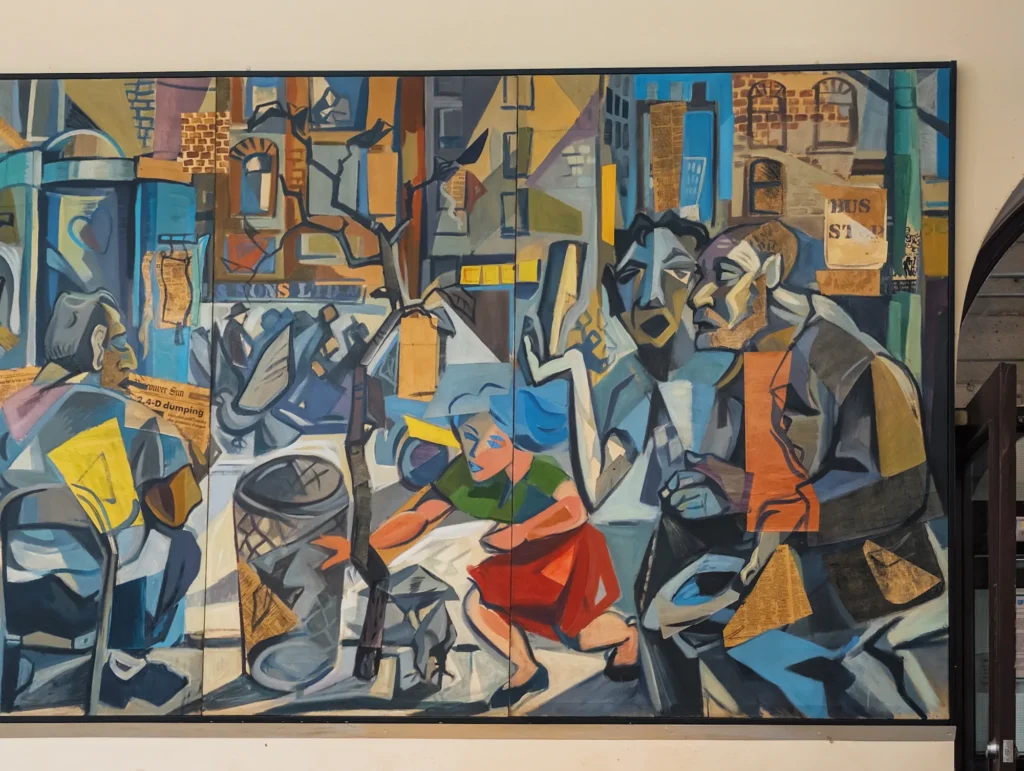
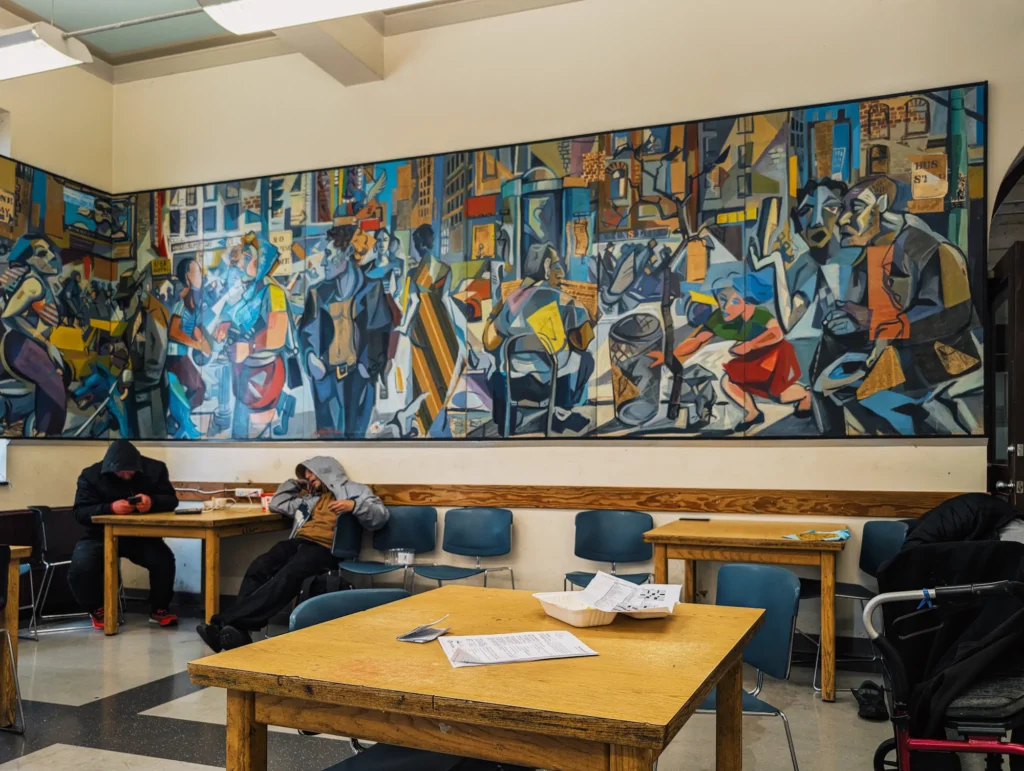
A low-brimmed hat hides one face. Windows and signs crowd the space above the others. Richard Tetrault painted the people he saw around Main and Hastings into Summer City Street in 1979, working newspaper and cigarette packs into its canvas panels. The six-by-24-foot mural has been displayed at Carnegie since 1980. On 30 October, it gets a celebration of its own.
The Downtown Eastside Heart of the City Festival will mark the mural’s entry into Vancouver’s public-art collection. According to the festival announcement, the work will remain at Carnegie. It is an occasion to look again at something that has been here for decades.
That invitation runs through this year’s programme. A screening from Sid Chow Tan’s video archive brings back images made through community television, while an exhibition drawn from a summer of art-making in Andy Livingstone Park adds work made here now. The festival calls its theme Belonging. These projects give the word something to attach to: pictures of local life, made by people who took the time to record it.
A Street Made from Everyday Materials
Tetrault made Summer City Street in his Powell Street studio in 1979, drawing on people he saw around Main and Hastings. It was first exhibited at the Helen Pitt Gallery before going on loan to Carnegie the following year. Its angular figures make a busy company, with the buildings pressing close behind them. There is little breathing room in this picture.
Tetrault continued to use neighbourhood street sketches as starting points for paintings and prints. Summer City Street belongs to that practice of looking closely, then making choices about what gets into the picture. The collage gives those choices a physical texture, adding scraps of printed material to the painted crowd.
Keeping the mural has involved work as well. In 2011, Tetrault took it down, cleaned and reframed it, and repainted elements of the collage. By then, it had already spent more than 30 years at Carnegie, displayed in the library and later the main-floor lounge.
The festival’s celebration is in the theatre. Tetrault will discuss his Eastside murals, including the collaborative Walls of Change project from 1998. It gives visitors a chance to connect the familiar work at Carnegie with a much longer practice across the neighbourhood, and to hear from the artist who made it.
Rewind to Community Television
The mural has had a public wall. Tan’s recordings needed machines capable of playing them.
Tan, who died in 2022, worked in community television from 1986 onward. Alongside producing and reporting, he gave himself the title “head of mystic relations.” His involvement in the campaign for Chinese Head Tax redress shaped both his organizing and his recordings. He had a position, and he put it to work with a camera.
He also helped put the means of making television inside Carnegie itself. In 2016 testimony to the CRTC, Tan said he had started Carnegie TV in October 2005 so people could use equipment and learn in a place where they felt welcome. He wanted media production available through community centres and libraries. His case was for residents to have the tools to make their own programmes.
His collection at the City of Vancouver Archives contains more than 1,200 videocassettes. In March, the Archives announced that 224 tapes had been digitized in a first phase, with Western Front handling part of the work. The digitized material includes a record of Stephen Lytton performing at the first Fearless Festival in Pigeon Park in 2007. The stage and the campaign shared space in Tan’s record of local life.
Preserving that record takes equipment that can still play the old formats. A screening begins with the less glamorous work of getting the pictures off the tapes.
For Heart of the City, his collaborator Byron Peters has compiled a programme combining recently digitized tapes with older favourites. Peters has presented selections at earlier editions of the festival, too. Each selection is another act of editing: deciding which parts of a large archive should be presented to an audience. At Carnegie, that audience will be watching work made in and around the neighbourhood where the screening takes place.
The Record Is Still Being Made
There is a temptation, with a decades-old mural and an archive, to treat the neighbourhood’s culture as an inheritance already complete. Art in the Park gives this year’s programme a present tense.
The exhibition grew from a summer-long creative residency in Andy Livingstone Park, led by Carnegie Elders-in-Residence Marr Dorvault and Les Nelson, working with artists Lisa Marr and Paolo Davanzo and people who use the park. The summer sessions offered free supplies and snacks and met twice a week at Keefer Place and Taylor Street. The resulting work will be shown in Carnegie’s third-floor gallery, with an artist talk bringing the collaborators together to discuss the project.
It is a different way of depicting a place. Tetrault worked from people he observed; Tan recorded movements he helped organize. In the park, people could join in the making. A visitor to Carnegie can follow those different relationships between an artist and a subject without having to accept any one work as the definitive picture of the Downtown Eastside.
These projects are a small route through the 23rd festival, produced by Vancouver Moving Theatre with Carnegie Community Centre. The organizers advertise more than 100 events across 30-plus venues between 30 October and 7 November 2026, with theatre and music alongside workshops, films and neighbourhood walks. Most events are free. Some require tickets or registration, so choosing a few things in advance is worth the trouble.
Visiting Carnegie During the Festival
The Summer City Street celebration takes place on Friday, 30 October, from 6 to 8 p.m. From the Archives of Sid Chow Tan screens on Thursday, 5 November, from 5 to 7 p.m. Both are free and take place in Carnegie’s Theatre at 401 Main Street.
Carnegie’s ramp entrance is through the patio on the Main Street side, with a call button for the gate. There is elevator access to the third-floor gallery. For priority seating or a support person, the festival directs visitors to boxoffice.heartfestival@gmail.com. Consult the current festival programme for registration requirements and any changes.
Art in the Park’s free artist talk is on Wednesday, 4 November, from 1 to 2:30 p.m. in the gallery. The exhibition remains there until 29 November, leaving time for another visit after the festival has finished.

Teresa is a dedicated storyteller rooted in the Downtown Eastside, reporting on local art, cultural events, and community initiatives. Her work highlights the creativity and resilience of the neighbourhood, amplifying voices that often go unheard. Believing in the power of art to connect and inspire, Teresa focuses on the people and projects that shape the vibrant DTES community.


Leave a Comment