
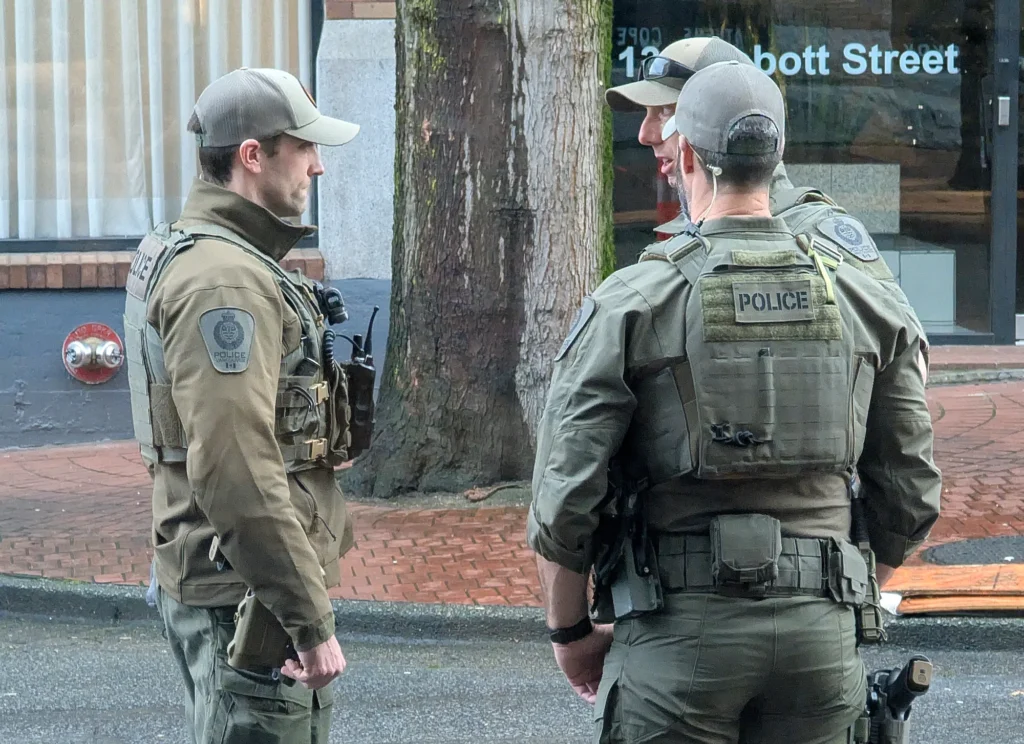
The Conservatives have promised British Columbia 750 more police officers. Delivering that increase will take more than 750 hires.
Officers will retire while recruits are being trained. Experienced members will move between departments, making one force larger without adding anyone to policing in the province. Some of the people hired will replace colleagues who have already left. The government can announce a succession of graduating classes while the increase available to communities grows much more slowly.
For the Downtown Eastside, the distinction concerns the help people can expect when they call, and the officers available to investigate what happened afterwards. Lorne Doerkson won an election promising a stronger response to crime and street disorder. His government now inherits a recruitment effort that was expanding before the vote, a national force repairing its hiring process, and a public entitled to expect that “more” will mean an addition they can recognise.
The price is there. The division is missing.
The Safe Streets commitment combines 250 police recruits with 500 RCMP officers, along with civilian staff, sheriffs, prosecutors, and a push for more trial judges. Its full platform gives the grouped public-safety measures an eventual annual operating allocation of $178 million. New spending starts at $18 million in 2027–28, rises to $80 million and then $134 million, and reaches full cost in 2030–31.
That is a public costing, though it leaves the division among commitments unexplained. It cannot tell Vancouver how many officers it will receive or what share of their employment the province intends to pay. Nor can its phased spending be read as a schedule showing when each officer will arrive. Existing budgets remain in place during the expansion.
The strongest case for adding police deserves to be taken seriously. Someone dealing with repeated theft or violence needs a response, and an overstretched service has less time to provide one. The National Police Federation, representing RCMP members, entered the campaign asking for 300 additional officers over three years, together with investment in equipment and staff well-being. Vice-president Chris Voller’s argument concerned the resources needed to support the people doing the work, as well as the number of people doing the work.
The Conservative commitment answers that demand with a larger force. It becomes harder to assess when recruitment totals are allowed to stand in for the increase. B.C. needs replacements even if the government adds no positions at all.
The officers who leave
An August 2025 Union of B.C. Municipalities update recorded what RCMP representatives had told local governments that spring: annual attrition in B.C. was approximately 250. That historical figure is not a forecast for the next five years. It establishes the size of a replacement task that a new recruitment promise has to accommodate.
The promise of 500 additional RCMP officers must sit above that ordinary work of replacing departures. Subtracting every retirement from the campaign number would misread a commitment to growth. Counting every replacement towards it would be equally misleading.
Movement between forces creates another complication. The same UBCM account reported that, over the preceding four years, about 60 per cent of Surrey Police Service officers had come from other B.C. police agencies. Those transfers could strengthen the receiving department while leaving another employer looking for a replacement. A hiring announcement can describe an important local gain without describing a provincial one.
England and Wales offer a particularly clear demonstration. Their government set out to add 20,000 officers. In its 2023 assessment of the recruitment programme, the National Audit Office reported an increase of 20,951, bringing the total number of recruits to 46,505 officers. Replacing people who left accounted for much of the difference between those numbers.
The programme reached its staffing target. The auditors nevertheless questioned the allocation of officers, citing an outdated funding formula, and warned about the demands that a much younger workforce placed on experienced colleagues responsible for training them. Recruitment at scale brought work of its own.
B.C. cannot borrow the British figures as a forecast. It can borrow the distinction that made the result intelligible: how many people joined, how many left, and how much larger each force became. A promise to increase the workforce should be reported with all three.
Before the academy
There is a more immediate warning in Canada’s own recruiting system. A federal audit tabled in March found that the RCMP had set recruitment targets below its staffing needs and then failed to recruit as many officers as planned. Successful applications took an average of 330 days to process by September 2025. Only 18 per cent of cadet classes during the audit period were filled to capacity.
Applicants experienced the delay personally. In the auditors’ survey, the length of the process was often their biggest frustration. The system could attract interest and still leave training places unfilled while people waited to learn if they could join.
B.C.’s position was better than the national picture. Its September 2025 vacancy rate in front-line Contract and Indigenous Policing was 2.4 per cent, below the RCMP’s seven-per-cent critical threshold. That snapshot is neither a current vacancy count nor a measure of every officer available for duty. It rules out portraying B.C. as one of the worst-staffed divisions in that audit.
The RCMP accepted the findings. Commissioner Mike Duheme’s March response outlined recruitment changes and a goal of reducing application processing to 6 months by 2028–29. That is an improvement the force intends to achieve, rather than a speed the incoming provincial government can assume today.
Doerkson’s RCMP promise therefore depends on decisions beyond Victoria. Funding positions is one part. Getting suitable applicants through screening, training them and assigning them where the province needs them involves a national employer with other staffing demands. Expanding B.C.’s municipal police academy does not solve this part of the promise. RCMP cadets train at Depot in Regina, through a separate programme.
The expansion already underway
The Conservatives also inherit more municipal training capacity than B.C. had a year earlier. The Justice Institute of British Columbia increased its academy to three annual cohorts of 144 in May, providing capacity for 432 recruits. Its actual May intake was 128. Available seats and the number of people arriving to fill them were already different.
JIBC’s account of its July graduating class supplies a detail easily lost in the debate about academy space: police departments hire their recruits before they attend. Creating more seats expands the range of uses for employers. It does not create the funded jobs, select the applicants, or ensure that every place is occupied.
The NDP was expanding recruitment too. In May, its public-safety minister reported that 256 RCMP positions supported by an earlier $230-million investment had been filled. That government statement does not settle the question of the force’s adequacy. It does establish work that predates the new government’s promise.
Vancouver’s own academy makes the inherited timetable visible in the Downtown Eastside. At 351 Abbott Street, in Woodward’s, the first 40 recruits began training in September. The VPD says they are scheduled to complete it and start city work on June 25, 2027. Another 40 are scheduled to begin in January.
As our earlier account of the DTES services Doerkson inherits explained, these recruits were already on their way before the election. Their graduation will be welcome news for a department needing officers. Establishing the new government’s contribution requires knowing what it adds beyond that existing recruitment, and how many departures occur along the way.
There is also a geographical limit to the headline number. Vancouver operates its own municipal police force. The Conservatives’ October announcement directs the RCMP expansion towards rural and regional communities. Those communities have claims on the promise of their own. The 500 RCMP positions cannot be read as 500 reinforcements for Vancouver, and the municipal-recruit commitment does not specify Vancouver’s share.
The ordinary funding responsibilities differ too. Municipalities with their own forces bear their policing costs; RCMP contracts have different arrangements. A provincial expansion can change the assistance offered, but the campaign’s grouped allocation does not specify the new terms. The local budget still has to meet the local employer’s obligations.
Who answers the next call
Even an accurate headcount raises another question: what work do those officers perform?
The VPD’s 2025 report on its operations says liaison nurses reviewed approximately 5,700 mental-health calls and diverted 36 per cent of those away from patrol. Those are the department’s figures for a selected group of calls, not 36 per cent of all emergency calls. They do not establish a corresponding reduction in crime or an equivalent number of extra officers.
They do show why the response matters to the staffing argument. A clinician helping resolve a call can leave an officer available for other work. A resident can receive attention without a police dispatch. The value of that arrangement depends on appropriate care and on the circumstances of the call, not just on the patrol time it saves.
The opposite pressure appears when police take someone to hospital. The same VPD report describes ongoing work with health agencies to improve transfers and reduce wait times. Municipal governments have pressed for changes to the rules governing officer attendance. More apprehensions can mean more demands at the receiving end, as well as on the street.
That matters to a government proposing stronger intervention under the Mental Health Act. Police already have conditional authority to apprehend someone for examination. Clinical certification is a separate decision. New powers would still be subject to the availability of clinicians and suitable care, while officers could remain occupied during a transfer. An increase in intervention needs receiving services able to handle it.
For the DTES, where the government’s policing and drug-policy promises meet, these are competing uses of the same officers’ time. The person reporting an assault and the person in a psychiatric crisis can both need prompt assistance. Recruitment, clinical response, and hospital arrangements affect how much help is available to each.
A bigger force, beyond graduation day
Doerkson takes over as training capacity grows and the RCMP is already attempting to repair its hiring process. Those efforts give him something to build on. They also give the incoming government a starting point against which its own contribution can be measured.
The recruits at Woodward’s already have a date to start work. By then, the department will also have departures to account for. Replacing officers who leave can restore capacity, even when it adds little to the total workforce.
For someone waiting for assistance on East Hastings, an officer replacing a departed colleague can be as valuable as one filling a newly created post. Both can bring help. Doerkson has committed to hiring enough people to do the replacement work and then make the force larger. England and Wales reached their target by recruiting more than twice the increase they wanted. B.C.’s promise comes with a replacement bill of its own, payable throughout the five years.

Glenn is dedicated to scrutinizing government actions affecting the Downtown Eastside and holding those in power accountable for their commitments. With a focus on transparency and policy analysis, his writing aims to expose gaps between promises and outcomes, pushing for meaningful changes that benefit the community.



Leave a Comment