
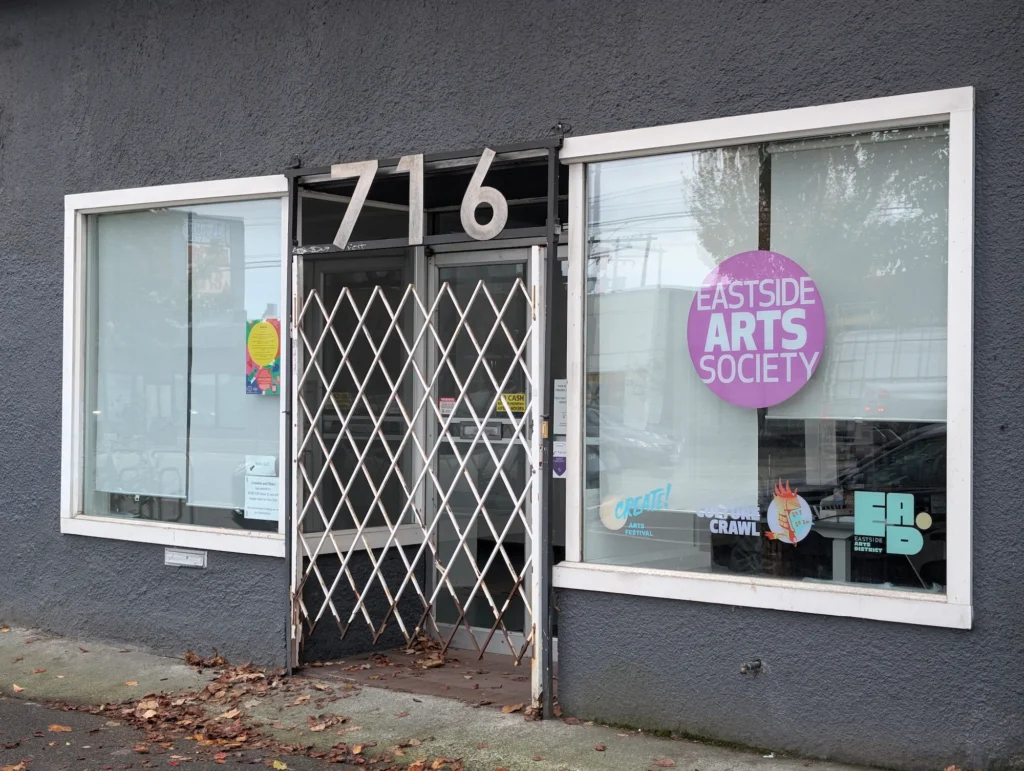
At 716 East Hastings, the Eastside Culture Crawl is preparing to put work by 75 artists under one roof. Its anniversary preview, P.A.R.T.Y., opens on 5 November, two weeks before visitors begin finding their way through the Eastside’s studios. The society doing the inviting says it now owns the building.
The Crawl asks artists to turn their workplaces into public venues for four days. Its organiser, the Eastside Arts Society, has also taken on the much longer task of keeping space available for making art. This November, visitors can see those two parts of its work meet at Hastings.
The 30th edition runs from 19 to 22 November, with the organiser announcing more than 525 participating artists. There will be paintings and pottery, furniture and glass, and people available to explain how the things in front of you were made. At Hastings, the celebration also offers a look at what the society has been building between festival weekends.
Before There Was a Crawl
The event grew out of artists inviting people into their working spaces. The society’s history starts with a four-artist fundraiser at Paneficio in 1994. The following year, 25 artists at 1000 Parker Street held a Show and Sell. Separate openings began to join up, giving visitors a reason to continue to another studio.
The organisation grew around those encounters. The festival’s timeline records its registration as a society in 2003. Now called the Eastside Arts Society, it also runs a summer arts festival and Studio 101, which brings schoolchildren into artists’ studios for free workshops. An invitation that once depended on knowing about a particular building became something a much wider public could accept. Children could try making art in the places where adults did it for a living.
Space eventually became an explicit subject of the programming. In 2019, the Crawl presented an exhibition and forum on displacement alongside its research into the loss of artist studios. The society was asking people to visit working artists while also highlighting the difficulty of maintaining their workplaces.
That history gives the purchase at Hastings a particular weight. The society has worked at the address since 2015. It has secured a home it already knows.
A Building to Keep
In January, Vancouver council approved a $2.665 million grant to help the society buy the 5,980-square-foot building. The money comes from a reserve for affordable non-profit industrial and cultural production space.
The grant carries a condition: a Community Use Agreement on title must secure the property for non-profit art production, presentation and programming for the building’s life or 20 years, whichever is longer. It gives the public investment a purpose that extends beyond this November’s exhibition.
Ownership brings bills, too. The society is responsible for the building’s ongoing operation, maintenance, and future capital costs. Buying the property gives it greater control over the address, along with the obligation to keep the place running.
For visitors, the first invitation is P.A.R.T.Y.: Pushing Art diRectly To You. Crawl artists Eri Ishii, Hugh Kearney and Paul de Guzman developed the curatorial concept and title. The society describes a salon-style exhibition that brings work together to be seen in company. Before committing to a route across the Eastside, you can find something you want to spend more time with, then seek out its maker during the Crawl.
The Studios Beyond Hastings
Downtown Eastside painter Jeff Wilson’s studio invitation takes visitors further east. The Scottish acrylic artist is taking part at Portside Studios, at 150 McLean Drive near Powell Street. A visit there leads beyond the DTES, into another part of the festival’s working geography.
Portside offers a reminder of what supports an open studio. For its anniversary party in May 2025, the studio put artworks on sale for $160. A fundraiser notice published by Wilson explained that the proceeds would help cover an impending rent increase, participation in the Crawl, and ongoing expenses.
Those sales were intended to help pay for the space in which art could be made. The artworks had a job to do before they left the studio. The society’s purchase secures one address within a festival assembled from many of them.
Some artists cannot offer a public address at all. The Crawl’s home-based artist pop-up gives people who cannot open their homes another place to show their work. The organiser says this year’s edition will be at the Sunfire Studios Atrium, 1275 Venables Street. Visitors still get to meet the artists without having to turn their homes into public venues for four days.
The open-studio format gives those meetings the time they need. Participating artists are required to be present throughout the festival’s opening hours. You can ask about a material or technique, or how a piece began. A map with hundreds of names can suggest a weekend spent hurrying. There is no admission charge to recover by seeing everything. Choose a few places and allow an artist to interrupt the itinerary.
VISIT the Eastside Culture Crawl
The Eastside Culture Crawl opens studios on Thursday and Friday, 19 and 20 November, from 5 to 10 p.m., and Saturday and Sunday, 21 and 22 November, from 11 a.m. to 6 p.m. Admission is free. Use the official artist listings and the building map to plan a few stops, and check access information for each venue.
The preview at 716 East Hastings runs until 28 November, with its opening reception on Thursday, 5 November, from 6 to 8 p.m. You can start the anniversary there, then return during the Crawl to seek out an artist whose work stayed with you.

Teresa is a dedicated storyteller rooted in the Downtown Eastside, reporting on local art, cultural events, and community initiatives. Her work highlights the creativity and resilience of the neighbourhood, amplifying voices that often go unheard. Believing in the power of art to connect and inspire, Teresa focuses on the people and projects that shape the vibrant DTES community.

Leave a Comment