
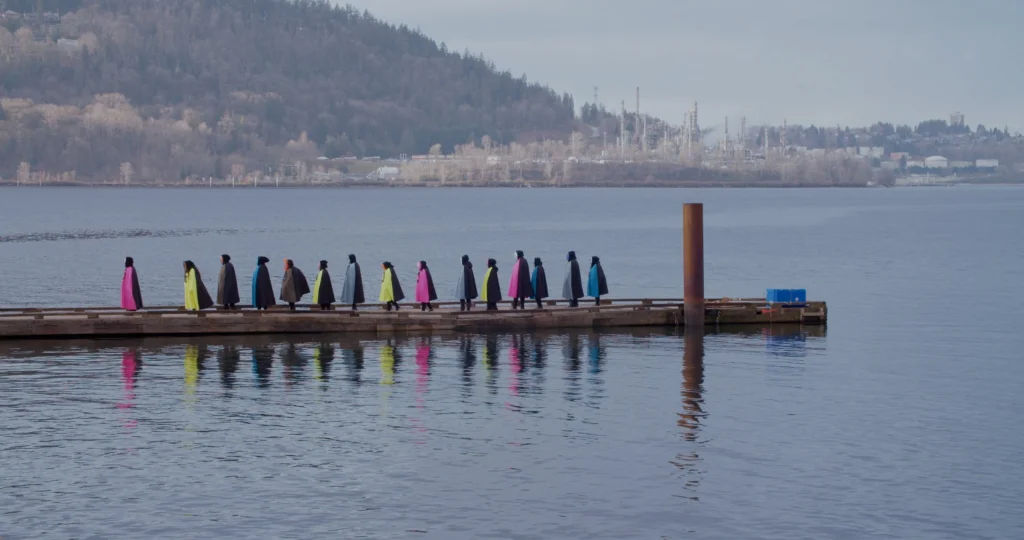
n a published still from Time Freed (Beyond Capture), a line of caped figures stands on a dock. Pink and yellow from their costumes catch in the water, with an industrial shoreline across the inlet. One of the women who helped make the film, Leah, has a particular reason to like her costume. “My mask is so beautiful, half wolf, half human,” she says in the project’s account of its making.
The film brings work by 15 women who have experienced incarceration to Gallery Gachet at 9 West Hastings. It is one of three video installations The Circle Project is presenting at this year’s Downtown Eastside Heart of the City Festival. Elsewhere in the programme, women take on Shakespeare’s characters and men perform the comic figures of commedia dell’arte. There are costumes to invent and parts to inhabit.
The invitation has a pleasure of its own. Someone whose life has been defined by a prison record can choose a character with an entirely different history. Leah can make a mask she likes. The person looking at it can begin there.
A mask of her own
The Circle Project began in 2019, created by filmmaker Brenda Longfellow and restorative justice advocate Brenda Morrison. It brings professional artists together with people who have experienced incarceration, making work through workshops and collaboration. The group is explicit about wanting alternatives to the violence and dehumanisation of prison. Its art grows out of that position, through choices about what to make and how to make it.
For Time Freed, Vancouver artist Jin-me Yoon worked with the women on masks, costumes and movement. The filming took place at Whey-ah-Wichen, also known as Cates Park, on Tsleil-Waututh land in North Vancouver. The work comes to the DTES from elsewhere, bringing the collaboration into a neighbourhood gallery.
The masks allow the makers to decide how they will appear. A wolf-human hybrid has possibilities a conventional portrait does not. It can be strange, beautiful or funny without having to explain an offence. It gives its maker an imaginative decision to make before the viewer arrives with an interpretation.
The participants’ published comments stay close to the experience of doing the work. Pam describes a welcome change from conferences and Zoom calls, a chance to be more creative and to be closer to other people. Tasha speaks of reconnecting with a part of her creativity she had neglected. These accounts make the project sound recognisably like making art with others: absorbing work, shared time, and the satisfaction of seeing an idea take form. Prison is part of the collaboration’s history. It does not supply every subject of conversation.
Jess chose Shakespeare
An earlier Circle Project collaboration began without a settled script. Women met in talking circles and studio workshops, trying out what the work might become. According to the project’s account of those sessions, a participant named Jess suggested A Midsummer Night’s Dream.
That choice became What Fools These Mortals Be, made with artist Adad Hannah and 14 women. The participants helped construct sets, props, and costumes, then performed the play’s characters as tableaux vivants, or living pictures. A stage comedy became a video installation assembled from posed scenes. The work was first presented at SFU in 2022 and returns to the neighbourhood for this festival.
Shakespeare arrived through a participant’s suggestion. The women were involved while the project was still deciding what kind of work it wanted to be. That is a substantial part to have in a collaboration, well before anyone puts on a costume or appears on camera.
Cathee Porter, who portrayed Puck, described what the role change offered. Her account from the project’s making-of film is reproduced in India Rael Young’s 2023 BlackFlash essay: it “lets us be somebody else” and allows the women to leave prison, parole and everyday stigma behind for a time.
There is a difference between inviting someone to explain a past and inviting them to imagine a part. Porter describes the relief of the second invitation. Fiction gives her something to do beyond being the person an audience already thinks it recognises. A character can have desires and mischief of her own. The performer gets to work out how to embody them.
The production also depended on ordinary working arrangements. Hannah told Young that funding allowed the participants to be paid an hourly wage. They had busy lives, he said, and helped with the building and painting as well as costumes and props. That payment belongs in the account of how the art happened. Someone had to give the project time, and the project could pay for it.
Comedy inside the walls
The next collaboration with Hannah took place inside William Head, a federal men’s institution on Vancouver Island. The Circle Project worked with William Head on Stage, whose theatre-making inside the prison long predates this film. The festival lists nine incarcerated performers as collaborators on Harlequino’s Folly.
Here the dramatic source was commedia dell’arte. During six weeks of workshops, the collaborators developed a work populated by its comic types, including a pompous doctor, a wealthy old man and a boastful captain. The project’s description identifies a series of lazzi, comic routines, rather than a continuous plot. The performers had a theatrical tradition full of appetites and foolishness to draw on.
It is a different kind of public appearance from a documentary interview. A man can perform a ridiculous captain without having to make his own biography the entertainment. The comedy requires choices about a character and the presentation of a joke. The artist’s experience of prison sheds light on the circumstances under which the work was made, while the work asks him to exercise other abilities.
The location still matters. This collaboration was carried out in custody, with the practical constraints that filming in a federal institution entails. Its account credits William Head on Stage’s experience with helping the production through that work. The freedom of a comic part existed inside those limits. A costume did not remove the walls around the workshop.
The comedy asks an audience to encounter the men through something they have helped invent. Their experience of custody remains part of the production, alongside the ability to make a character ridiculous. A performer gets to offer something an institutional record could never contain: his own interpretation of the fool.
Meeting the makers
Heart of the City brings these works into a festival already giving an audience to the neighbourhood’s art and memory. The Circle Project invites a look beyond the biographical fact through which its participants are introduced. A prison record can tell an audience something consequential about a life. It cannot tell anyone what sort of mask that person would design, or which character she might want to play.
For visitors, the exhibitions offer a route between three DTES venues. Time Freed has a free opening reception at Gallery Gachet, 9 West Hastings, at noon on Saturday, October 31. The reception for What Fools These Mortals Be and Harlequino’s Folly follows from 2 to 4 p.m. at KW Atrium Studio, 110–351 Abbott Street. Those two installations are advertised there from October 31 to November 7, and all three works are presented during the festival.
On Saturday, November 7, the programme culminates in a free screening and community sharing circle at Carnegie Community Centre Theatre, 401 Main Street, from noon to 3 p.m. Consult the current festival programme and venue information for exhibition hours and access arrangements before setting out. The Carnegie event invites people to spend time with the works and the community that made them. It leaves room for a conversation that begins with a character, a costume or the decision to become half a wolf.

Teresa is a dedicated storyteller rooted in the Downtown Eastside, reporting on local art, cultural events, and community initiatives. Her work highlights the creativity and resilience of the neighbourhood, amplifying voices that often go unheard. Believing in the power of art to connect and inspire, Teresa focuses on the people and projects that shape the vibrant DTES community.


Leave a Comment