
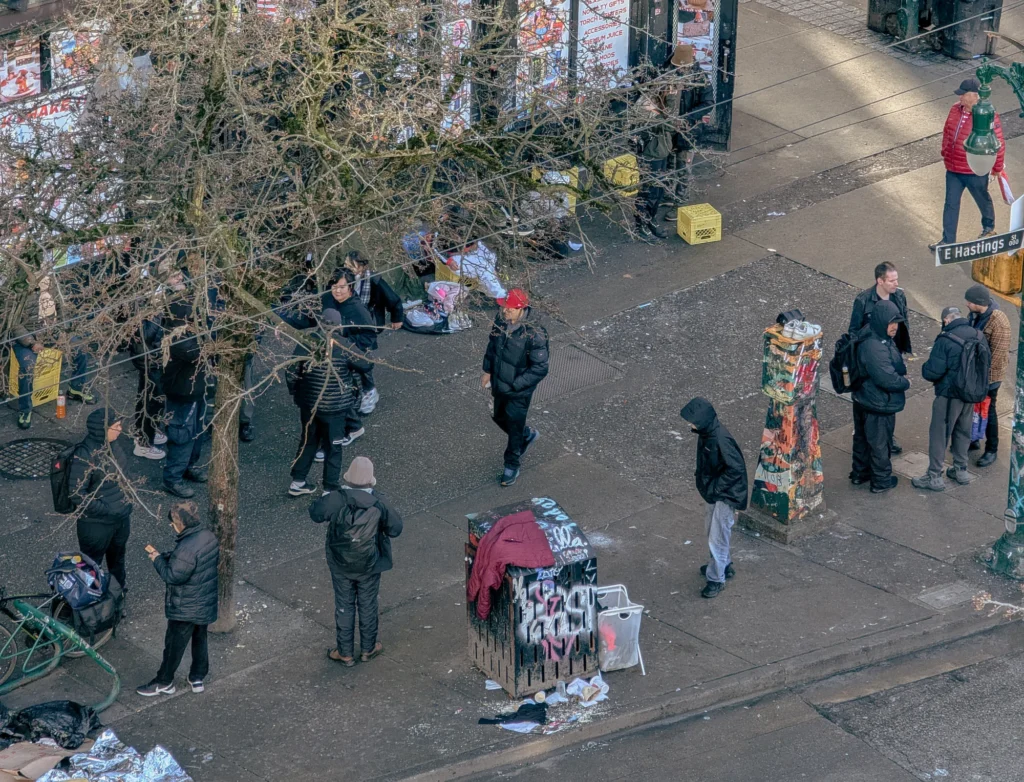
A worker in the Downtown Eastside drug trade could be surrounded by drugs and still be kept close to withdrawal. The boss controlled how much the worker received. That was the leverage a participant, Dyani, described to researchers in 2016: “They only give them enough just to keep them wherever they want them.”
The account appears in a study published this September, after the researchers had promised to hold back the market findings for approximately ten years to protect participants. It describes a form of control that makes the familiar street transaction harder to read. The person handing over the drugs might also owe the supplier.
That debt could turn selling into an obligation enforced through threats. Trying to avoid withdrawal could tie a worker more closely to the person demanding repayment. An effective response to the drug market has to distinguish the people exercising that power from those caught within it, including people who sell drugs themselves.
Working someone else’s stock
Anke Stallwitz, Martin Bouchard and Alissa Greer’s study draws on interviews with 23 people who used drugs, 17 of whom had selling experience. Recruited through peer networks associated with the Vancouver Area Network of Drug Users, they described a market with bosses and shifts, alongside people trading independently. Some worked on the street. Others sold from hotels or through telephone delivery services.
The interviews belong to 2016, when fentanyl was already entering the supply. They cannot provide a current inventory of the neighbourhood’s dealers or territories. Related findings from the same project appeared in 2021. What the newly published market analysis offers is a detailed account of relationships that are easily missed when everyone on the selling side of a transaction is treated as interchangeable.
A person working a shift might be paid partly in drugs. The stock and proceeds belonged to someone else, who expected an accounting. That arrangement gave the worker access to the substances they used, while leaving them responsible for anything missing. The same packet could be merchandise for the boss and a source of relief from withdrawal for the person entrusted with it.
Earlier research by Will Small and colleagues described freelancers obtaining their own stock, while a go-between could connect a buyer with a seller and receive a small share of the drugs. Participants moved between arrangements with different degrees of independence and exposure to violence. Selling was a position within a set of relationships, rather than a complete explanation of someone’s life.
Police researchers have encountered a similar range of motives. A 2022 University of the Fraser Valley report, drawing on interviews with 25 people from 15 policing agencies, described recruitment through addiction or debt alongside willing participation for income, status or gang connections. Its scope was provincial, not a count of DTES sellers. It nevertheless complicates a blanket explanation from either direction: vulnerability was one route into the trade, and profit was another.
When the stock becomes a debt
Participants in Stallwitz and colleagues’ study described drugs being provided on credit, a practice known as fronting. For someone without money, it could make the next purchase possible. For someone selling, it could provide stock without an initial payment. The obligation came due later.
The danger grew when a worker consumed drugs intended for sale, lost them, or had them stolen. The supplier still expected repayment. Participants described debts being enforced through beatings and threats, or through demands for further dealing or sex work. A person could be required to keep generating money for the same supplier they now feared.
Withdrawal gave that relationship another means of enforcement. Dyani’s account described bosses controlling workers through the drugs they needed. A worker short of money could therefore depend on the supplier for both the means to avoid becoming sick and the opportunity to earn enough to repay them. Refusing another shift could carry an immediate cost.
People knew these dangers and sometimes tried to avoid particular arrangements. Small’s study, based on interviews conducted in 2010, included a woman who declined an offer to sell for suppliers known for violence. She anticipated that her own consumption would leave her owing them. The same woman acknowledged assaulting someone who had tried to steal from her, explaining that she feared further theft if she let it pass. Her account describes someone who both fears and inflicts harm within the trade.
The newer paper contains a similarly disturbing account of rules. Aria described male bosses paying women to punish other women. A prohibition on a man striking a woman could coexist with violence being ordered and carried out. Having a code of conduct did not make the conduct humane.
The supplier worth calling
Fear was not the only reason to maintain a relationship. Nellie recalled a dealer who promised, “I’ll never let you be sick.” Credit meant help was available when money was not. Nellie also made clear that the debt was repaid. Reliability ran in both directions.
Aria, who described violence elsewhere in the market, spoke warmly of a boss who bought food and soft drinks for workers. This boss allowed drug use during a shift, although Aria said she tried to wait until afterwards because using affected her thinking. She had her own rules for getting through work and reasons to appreciate the person who employed her.
There were second chances, too. Mia told the researchers about a boss who repeatedly hired a worker who would disappear with the drugs he was meant to sell. She called the worker “Three-pack-wonder” because he would run off with his third package. When Mia found him employed by the same boss again, she asked which package he was on. He was about to receive the third. According to Mia, he disappeared with it again. Workers could deceive their bosses as well as be controlled by them.
That creates a difficulty for anyone arriving with the instruction to stop seeing a supplier. They may be asking someone to abandon a contact who answers, extends credit, and supplies something they depend on. Understanding that attachment is part of understanding the work required to replace it.
Even taking a bad purchase back depended on the relationship. Researchers studying a DTES drug-checking service in late 2018 and early 2019 heard from people who could return unwanted drugs to suppliers. Two participants lower in the hierarchy reported that they could not. Some sellers also described using test results to inform customers about potency. These accounts came from people who were already using a testing service.
Still, the distinction is useful. Information about an unwanted substance is more practical to someone able to take it back than to someone whose supplier refuses to accept a return. Knowledge and the power to act on it are separate advantages.
The authors of the September paper argue for building on trust and mutual care to reduce harm. Those are resources worth taking seriously, especially when people already rely on one another. Their interviews, however, do not establish the effectiveness of an exit programme, and confidence in a familiar seller cannot determine the contents of the next bag. Personal trust has to carry too much in a trade where the product itself comes without a dependable guarantee.
What survives a raid
The limits of disrupting supply are familiar to police, too. After a major DTES seizure in July 2025, Inspector Gary Hiar acknowledged other criminal organisations moving into the gap. Police could interrupt an operation while the demand and opportunity to supply it remained.
In May 2026, VPD described two investigations at the same building in the 300-block of East Hastings. Warrants had been executed in July 2025. Further warrants followed in March 2026 after alleged trafficking continued. Police reported drugs, cash and weapons seized, and charges arising from the first investigation.
Residents should not have to tolerate an armed drug operation in their home. Removing weapons and pursuing the people controlling those operations are necessary forms of protection. A recurrence does not make the earlier investigation worthless. It does expose the distance between interrupting a business and removing the conditions on which the trade recruits its next workers.
The research also points to a danger in treating somebody’s lost stock as the end of their involvement. In England and Wales, Home Office guidance on county-lines exploitation warns that confiscating drugs or money can create a debt an exploited person is forced to repay. It calls for safety planning alongside action against exploiters. Much of that work concerns children, unlike the older DTES research sample. Its relevance here is the recognition that a drug seizure can alter the danger faced by the person carrying it.
Earning money elsewhere
Leaving that relationship also requires something to live on. The supplier offers stock and a way to earn, often to someone already struggling to finance their drug use. A response that addresses dependence while leaving a person frightened of an unpaid debt has more work to do. So does one that removes the supplier but leaves the worker needing income and drugs the next morning.
For an indebted worker, a treatment appointment and a safe place from a threatening supplier serve different needs. An alternative income has to be available to someone whose drug use may not have ended. Requiring a person to resolve all of this before offering paid work would leave them dependent on the earnings they are being asked to give up.
The right to safety in the Downtown Eastside extends to the person who has taken part in the trade. Protecting someone from a boss’s violence does not require declaring every action they have taken harmless. It requires taking the threat seriously enough to investigate who is making it and what they are demanding.
Debra Leo grouped employment and higher-level drug investigations under the same category in the Downtown Eastside Women’s Centre’s 2019 Red Women Rising report. In testimony transcribed as told to Harsha Walia, she called for action further up the supply chain and described barriers to finding work with a DTES address. For Leo, paid work was an alternative to street-based sex work, another means of earning that had exposed her to danger.
Leo described volunteering and working on her skills, even as she continued to struggle with drug use. By the time she gave her account, she had obtained her first job, doing outreach at WISH and helping women on the street connect with resources. “This job helps me get money and not be back on the street,” she said.

Kris has been at the forefront of Downtown Eastside initiatives for over 15 years, working to improve the neighbourhood. As a consultant to several organizations, he played a key role in shaping harm reduction strategies and drug policies. A strong proponent of decisive action, Kris’s work focuses on driving tangible change and advocating for solutions that address the complex challenges facing the community.



Leave a Comment