
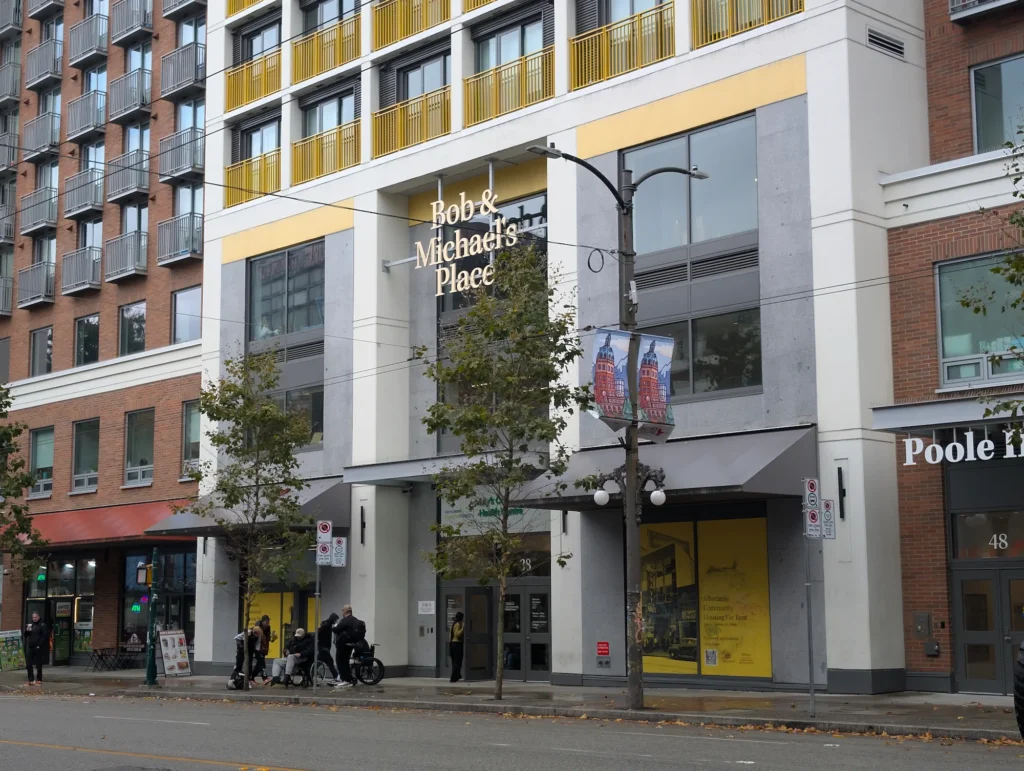
In August 2016, Vancouver mayor Gregor Robertson signed a promise that left little room to bargain over the rent. Every home at 58 West Hastings was to rent at welfare or pension rates, with the community in control. A tent city had brought the vacant Downtown Eastside lot back into Vancouver’s political life.
Bob & Michael’s Place eventually delivered 231 homes. Residents began moving in during June 2024, and the Vancouver Chinatown Foundation celebrated the grand opening this February. S.U.C.C.E.S.S., which manages the housing, identifies 120 suites for people on pensions or income assistance. The development has given residents a home they value. It has also left a substantial distance between the original promise and the offer to applicants.
The terms continued changing after people moved in. In July, the council authorised the removal of an affordability requirement for the portion outside the shelter- and senior-rate homes. Staff argued that the change would help keep the project financially sustainable and allow tenants to stay as their circumstances improved. A building created to answer the neighbourhood’s demand for housing is now working through a second question: how much of that obligation follows it into the future.
The value of getting in
For Hossein Ghahghahani, finding a home at Bob & Michael’s Place brought relief from the insecurity he had experienced after moving to Canada from Iran. In Sarah Jones’s March report for CityNews, he described the anxiety of trying to cover rent when work was uncertain. The safety of his new home was central to his account. He wanted others to have the same chance.
His relief brings the dispute over access into focus. People still seeking a home want precisely the security he describes. A project can improve its residents’ lives while leaving campaigners dissatisfied with the number of neighbours it reaches.
The foundation presents Bob & Michael’s Place as a model for social housing elsewhere in Canada. Its accommodation ranges from micro suites to two-bedroom apartments, with shared amenities including a garden and a children’s play area. Its published micro-suite rent is $1,150 a month, subject to change. The subsidized homes follow shelter-allowance pricing. Those offers serve different household budgets, even when both appear under the heading “affordable housing”.
What the promise became
The demand had been sustained through years of pressure. The Downtown Eastside Women’s Centre identifies its Power of Women group with the Indigenous women and elders who led the 2010 Olympic tent city at the site. Another encampment followed in 2016.
Robertson’s signed pledge that August included community control as well as cheap rents, as Travis Lupick recorded in the Georgia Straight at the time. By September, council’s formal commitment was more conditional. Its released decision offered the foundation a proposed 99-year land lease, extended from 60 years, in exchange for a minimum of half of the homes at assistance or seniors’ pension rates. Staff were to seek additional government funding, working with Our Homes Can’t Wait and other community members, to reach 100 per cent. The ambition depended on obtaining that money.
The distinction was already visible before construction. For campaigners, every home affordable to a person on assistance was the commitment. Council had established a minimum and an effort to secure more. Its accompanying staff report warned that deeper affordability required ongoing subsidies as well as construction funding. The proposed land lease was at a nominal rate, so public land was already part of the contribution. Some financial estimates were redacted from the released report, leaving the public unable to inspect the full price attached to the promise.
The Women’s Centre’s January 2018 account of the campaign makes clear why that gap mattered. Robin Raweater described needing adequate housing to regain care of her children while facing the possibility of homelessness herself. Her experience put a family’s ability to live together inside a debate about rental categories. In a later letter, Power of Women coordinator Harsha Walia called for self-contained homes at welfare rates, suitable for women and their children.
By 2021, the project had substantial public backing. BC Housing announced $33.6 million in provincial capital support and an operating subsidy of up to $1.8 million annually for 60 years. Federal financing totalled $45.8 million, including a repayable loan, while the foundation was raising $30 million. The partnership produced a mixed-income building. It did not fulfil the campaign’s demand that every home be available at welfare or pension rates.
The application became part of the dispute
When the homes began opening in 2024, the argument moved from the promised rents to the process of obtaining a tenancy. Our Homes Can’t Wait said members were applying without getting in. In Angela Bower’s July reporting for CityNews, coalition member Nate Crompton described barriers that the group said included identity documents, credit and criminal-record checks, and three references.
S.U.C.C.E.S.S. defended the need to establish identity and B.C. residency, pointing to its responsibilities as a landlord and to the safety of incoming tenants. BC Housing said the operator matched applicants with available homes and supports. The operator’s assessment has consequences beyond the rent. A person may need a subsidized apartment and still fail the operator’s suitability assessment for this particular building.
The current application instructions direct people through S.U.C.C.E.S.S., a foundation expression of interest and, for subsidized homes, BC Housing’s registry. In-person help is available at the housing office at 32 West Hastings. The process now offers applicants an alternative to completing the forms online alone.
A more consequential condition remains explicit: residents must be capable of independent living. The housing operator does not provide medical or physical support. Neighbourhood ties receive priority, but living or working in the DTES does not by itself secure admission. Bob & Michael’s Place is therefore a specific housing option within a neighbourhood that includes people with very different support needs. A low rent cannot help an applicant whose support needs fall outside the building’s offer.
July’s change to affordability
The original 2019 Housing Agreement tied the homes outside the shelter and senior categories to BC Housing’s Housing Income Limits, or HILs. It governed eligible incomes and maximum rents for those homes. The deeply affordable minimum was set at a combined 50 per cent, split approximately 33 per cent for shelter-rate units and 17 per cent for seniors’ units.
On July 29, council enacted a bylaw authorising a different rental-mix clause. The attached amendment keeps the shelter and senior minimum. The obligation that the remaining homes be HILs units disappears from that clause.
The staff report supporting the change gives a reason that deserves serious attention: tenants should be able to stay when their financial circumstances improve. A home acquired during a period of hardship can become the place from which someone returns to work or earns more. Requiring a move when income has risen would disrupt the stability the project is meant to provide. Staff also cited financial sustainability and alignment with senior-government funding requirements.
There are limits to what this decision establishes. Staff identify additional affordability requirements in the ground lease, and the legal documents contemplate corresponding lease changes. The report does not set out the full rent and income terms of the revised lease. Council’s authorisation alone cannot establish that rents have risen or that half the building has become unrestricted market housing.
A community upstairs, health care below
The foundation’s work since move-in gives the building a life beyond the rental dispute. Its 2025–26 impact report describes a programme involving 40 local organisations, with activities including gardening and financial-literacy workshops. It also reports a peer-support desk offering guidance and referrals. These are practical efforts to make living in the building less isolating and to help residents use services.
Resident Neena, speaking in the foundation’s impact report, describes the effect of having dignified housing: “It’s changed my life.” The foundation selected her account for its own publication. Even so, preserving the home she values, and the relationships being built around it, gives substance to the case for letting residents stay as their lives change.
Below the apartments is Lily’s Community Health Centre, at 38 West Hastings. The hospital foundation’s March opening announcement describes a 50,000-square-foot facility that consolidates services from Pender, Heatley, and part of Robert and Lily Lee, with expanded space for care. Primary care, mental health, and substance use services are among the programmes being brought together. The new premises also house services that already worked in the neighbourhood.
A clinic downstairs does not turn the apartments above into a residential complex care facility. The housing’s independent-living requirement and the health centre’s clinical services are distinct. Nor does that requirement establish that a tenant cannot receive separately arranged health care. The building combines housing, community programming and a neighbourhood clinic, each with different responsibilities. Calling the whole arrangement a model is most useful when those differences remain visible.
The next household
S.U.C.C.E.S.S. cites a high volume of applications and says it will contact only applicants who meet the eligibility criteria. Ghahghahani hoped other people would get the chance he had. For those still applying, that chance depends on the conditions attached to an available apartment.
Keeping an existing resident housed after an income increase is a different decision from setting the rent at the next vacancy. July’s authorised amendment preserves the shelter- and senior-rate minimum. For the other homes, it removes the HILs condition while the lease carries additional affordability protections.
For a household seeking one of those homes, the next vacancy will carry its own rent and eligibility conditions. Those conditions will determine how much of the promise remains available to someone who has yet to receive a key.

Denise is a long-time advocate for affordable and dignified housing in the Downtown Eastside. Having lived in SROs and volunteered in homeless shelters, she brings a personal understanding of the housing crisis and its impact on the community. Her work reflects years of lived experience, frontline work, and commitment to creating better living conditions for DTES residents.





Leave a Comment