
When residents described what they missed on Hastings, they remembered somewhere to sit as well as somewhere to buy. Lost + Found Café had offered food, art, and book launches. They noted the loss of laundromats. For some groceries, particularly fish and meat, they travelled outside the neighbourhood.
Those accounts appear in Nathanel Eguale’s January 2025 Dignity and Agency study, which examined unmet goods and services along the Hastings corridor. Its participants wanted more choice, including food they could pay for. They described a neighbourhood in which being a customer could mean leaving it.
Vancouver is working to attract businesses to vacant Downtown Eastside properties, and Hastings Crossing’s vacancy rate has fallen. The next stage of that work concerns what the new tenants sell, who can afford to buy it and how the business stays open. A low-cost grocery, a laundromat and an affordable café each need premises, but the financial arrangements that sustain them can be quite different. COPE’s proposed public groceries and municipal food purchasing would add another approach to a street already served by private and non-profit operators.
What comes back when a space fills
The City’s 2026 storefront inventory records fifteen businesses filling vacant units in Hastings Crossing. Six other vacant units were demolished to make way for development. Both changes contributed to a vacancy rate of 19.2 per cent. The first supplied new businesses; the second reduced the number of empty premises remaining in the inventory.
The inventory tracks the use of ground-floor commercial space. It groups businesses into broad categories, with convenience goods including groceries, pharmacies, liquor, and cannabis. Those categories reveal the mix of tenants without establishing the price or selection on their shelves. A resident looking for an affordable place to buy food needs more detail than the count supplies.
At Woodward’s, a replacement tenant has brought activity back to the former London Drugs premises through a different use. The Vancouver Police Department opened its training academy there in September. The space has a new institutional purpose. The pharmacy and household shopping once available there have not returned with it. This is the retail loss within the building’s larger change of direction.
For the residents in Eguale’s research, a neighbourhood business could also provide a social setting. The Exchange Inner City focus group’s memory of Lost + Found joined affordable food to events and company. The study drew on stakeholder interviews, a resident focus group and a Binners’ Project survey, each a limited group with its own perspective. Among their requests were places to obtain essentials and places to spend time without a large purchase.
Different ways to buy the groceries
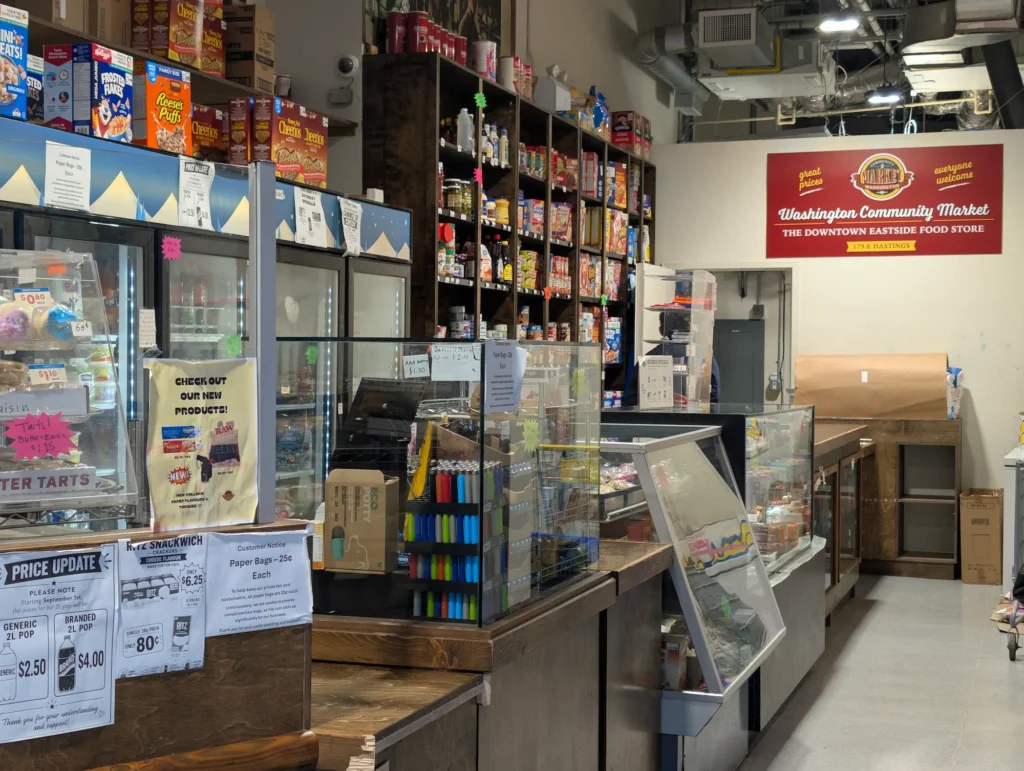
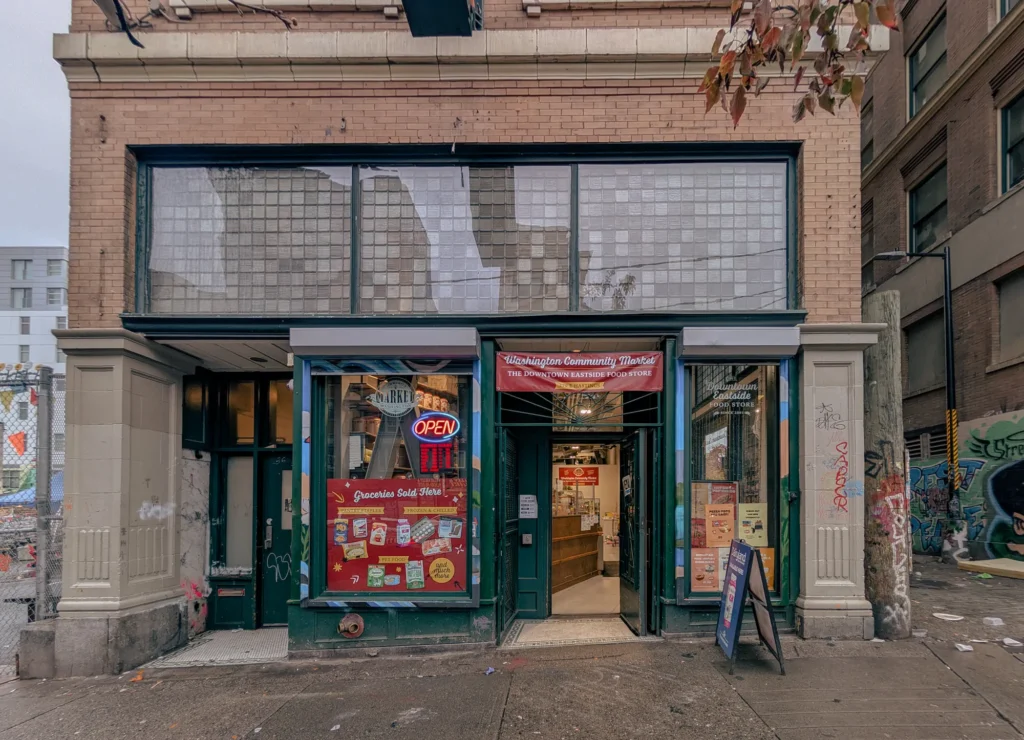
Food retail already takes several forms in and around the corridor. Washington Community Market at 179 East Hastings sells some goods in small quantities, shaped by customer requests. Quest’s market at 637 East Hastings offers shopping through a client-card system. Sunrise Market, nearby at Gore and Powell, became the subject of debate about preserving an established low-cost private grocer after its business was listed for sale.
In Katie Hyslop’s January reporting for The Tyee, Chinatown housing advocate Mike Tan recalled shopping at Sunrise with his great-aunt. He described seniors returning every few days for affordable produce. At that point, the business was for sale, and the land was not. The concern was about what might replace a familiar source of groceries, with no confirmed closure. Tan supported considering public or co-operative ownership and suggested assistance for long-standing businesses important to their communities.
Quest serves a more defined clientele. Its published access arrangements allow people facing economic barriers to obtain a referral from a supporting person or organisation and receive a client card. People with a current food-bank card or documentation of income assistance can also obtain one with matching photo identification. Shopping on someone else’s behalf requires the person making the purchase to have a card as well.
For someone obtaining groceries for a relative or neighbour, these arrangements affect how the errand can be done. At an ordinary public-facing grocer, the shopper needs the money for the purchase. At Quest, the person carrying out that task must also hold a client card.
The small purchase and the shop’s bills
Washington Market makes one part of affordability tangible. A customer can buy a small amount of cat litter, sugar or cereal instead of finding the cash for a larger package. Its staff says they scout specials at bigger chains and bring discounted goods into the neighbourhood. Small portions and local availability can make a purchase possible even when a larger package offers a better unit price.
The shop also seeks larger orders from housing providers, health organisations and other businesses. Its purchasing information describes those orders as helping to sustain the stock of small portions offered to residents. Vancouver Neighbourhood Food Networks reported in April that it already served 48 organisations and approximately 1,000 individual patrons weekly, alongside continuing CIRES support.
Keeping that service going involves support beyond individual sales. Community Impact Real Estate Society, the operator, recorded $247,250 in net market expenditure for the year ended March 31, 2025, compared with $128,477 the previous year. These are net programme expenses, with no separate store sales-and-cost breakdown in the statement. CIRES reported a $272,561 surplus for the organisation after accounting for the market and its other spending.
A lease is the beginning
LOCO BC’s January 2025 research for the Hastings Crossing BIA went beyond advertised rents to address the business problem. Two recent tenants were happy with the rental deals they had negotiated. One retailer was concerned about a lack of business. A service operator was doing well but worried that increases over the five-year lease would make the space unaffordable.
The consultation included fifteen business responses or interviews and six from landlords. Both groups raised safety and cleanliness. Businesses also wanted operational support and help attracting customers; landlords placed greater emphasis on investment incentives and securing tenants. Their interests met at the empty storefront, then diverged over what would make the tenancy succeed.
Vancouver’s temporary occupancy permit pilot addresses the first stage. Launched in January 2026, it allows eligible ground-floor spaces to operate for up to 24 months through a simplified process, with a free inspection and staff assistance. The permitted uses include retail, some personal services, and offices. Permanent occupancy requires the regular approval process and any necessary upgrades.
The pilot can make it easier to test an operation, but the range of uses leaves the eventual retail mix open. An office can take up space without providing groceries or a place to do laundry. For a business that does meet a neighbourhood need, the trial period offers time to build trade before deciding what a longer tenancy will require.
The Crossing Collective is working on that longer path from another direction. In October, RADIUS’s Miranda Eng described an engagement and feasibility study with Hastings Crossing BIA and Hessey Consulting + Architecture. The proposed incubator would support Indigenous, Black, migrant, refugee, and other equity-deserving food entrepreneurs who are entering vacant commercial premises through leasing assistance and partnerships. The partners were still conducting the engagement and feasibility work to design the incubator, its physical space, and the leasing support.
City Hall as a buyer
The public-grocery debate would give the City a further role in shaping what residents can buy. On March 11, Sean Orr sought an inventory of City-owned spaces in food-priority areas, beginning with the DTES, and options for at least one publicly owned or community-operated grocery. The motion also requested tools to protect affordable and culturally significant food retailers. It was defeated before a store budget or operating arrangement had been developed through that process.
COPE’s 2026 platform returns to a public grocery pilot and promises to reinstate Food System Planner roles. It also proposes using municipal purchasing power to buy in bulk from local farmers and distribute food at a discount to community grocers, non-profits, public grocers and school meal programmes. That could reach customers through existing outlets as well as a new store.
In Josh Kozelj’s October 29 reporting for The Tyee, councillor-elect Chloe Leslie identified the Downtown Eastside among the priority areas for testing public groceries through City-owned premises and buying power. She intended to press for food security in November’s budget. The platform’s food section leaves the pilot’s budget and operating model unspecified.
Discounted procurement could support several outlets at once, but the choice of products and the terms offered to participating grocers would determine its usefulness. Community markets already organise buying at different scales. In its April account, Vancouver Neighbourhood Food Networks argued for more support to those existing operations, alongside its support for public groceries.
These proposals now sit beside businesses that must make next month’s purchases and pay next month’s bills. Their effects would be felt through particular transactions: a household obtaining groceries through Quest, a small purchase at Washington, or a new operator testing a retail idea in a formerly vacant unit. None can stand in for the whole range of places residents asked to have nearby.

Denise is a long-time advocate for affordable and dignified housing in the Downtown Eastside. Having lived in SROs and volunteered in homeless shelters, she brings a personal understanding of the housing crisis and its impact on the community. Her work reflects years of lived experience, frontline work, and commitment to creating better living conditions for DTES residents.



Leave a Comment