
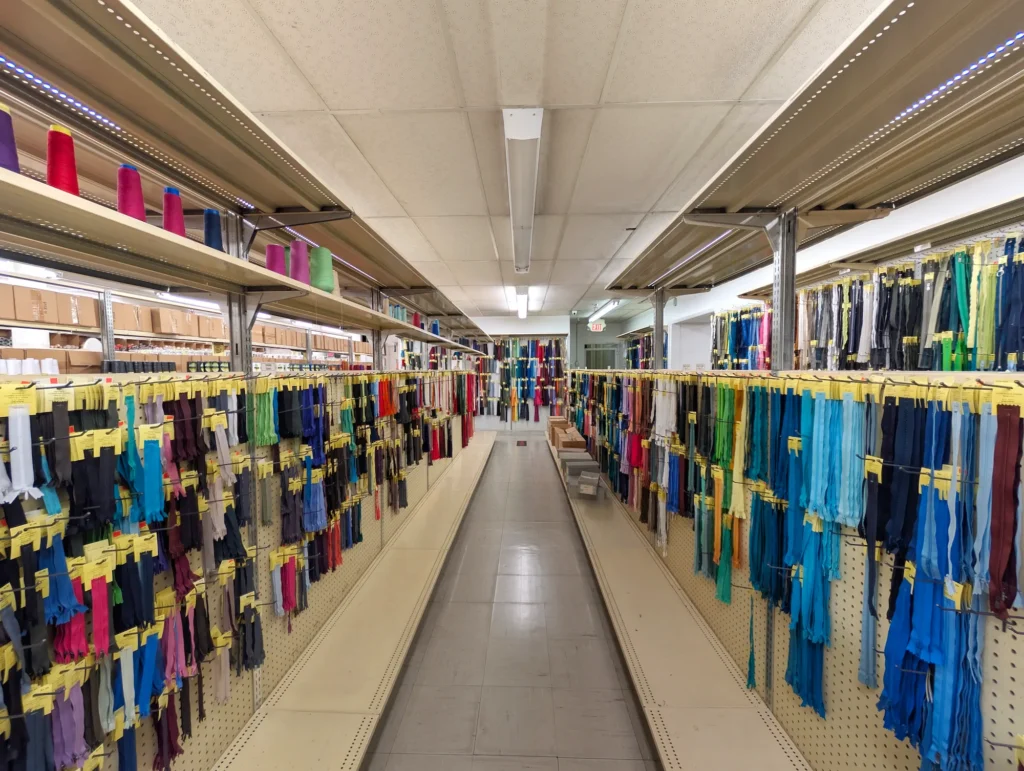
Everything at Dressew Supply is 20 per cent off the lowest marked price, in the store and online, until the store closes on May 1, 2027. The owners have not said why. In an Instagram post on November 17, Dressew told customers it could not yet explain, which it called “super frustrating,” and that whatever lay behind the closing had been going on “behind the scenes for about seven years.”
For 66 years Dressew has been where Vancouver goes when nowhere else has the exact thing: the zipper in the right green, the button to match an old coat, a metre of sequins. In 1989 a Vancouver Sun fashion column told readers that gold was the colour of the season and sent them to 337 West Hastings Street for gold lamé at $9.99 a metre. Cut in half lengthwise and hemmed, one metre made an evening halter and a sarong.
The family that owns the store has sold the building and says Dressew will not move. To see what is going, start in 1961, with a 19-year-old on Cordova Street and a borrowed stock of hats.
Dressew bought entire stocks from closing companies

Roger McKie opened Dressmakers’ and Milliners’ Supply House at 320 West Cordova Street on February 1, 1961. His uncle’s millinery store in Toronto, where he had worked, lent him the first inventory, and by his own count 90 per cent of it was hats, because “everyone wore a hat” then, he told the Vancouver Courier in 2011.
Fashion moved on and so did the stock. By 2012, BCBusiness reported, Dressew sold dress material and costumes, and Roger and his son David, now the store’s president, were competing to buy entire inventories from companies that were shutting down, whether the lot held a million children’s paintbrush sets or hundreds of leather jackets.
Taking a whole inventory means taking all of it, with no picking and choosing. That is how the family ended up with the paintbrush sets, and gave thousands of them to local schools, because teachers shopped at the store and paid for classroom supplies themselves. Roger McKie summed it up: with orders, you take “the good with the bad.”
The good reached the shelves at prices that sent word around the city. Ski and hiking pants made in Vancouver, still tagged at up to $200, were $2.99 a pair. Large bags of corks were $5, and so were five pounds of chocolate. Prices that low meant the store rarely held sales.
The store was as unhurried as its prices were low. In 2011 it had no website and no public email address, and callers heard a recorded message of the hours that ended by reminding them that calling back would bring the same message. The doors closed at 5:15 p.m., which let customers finish their orders and got everyone out by 5:30, because Roger McKie valued family time.
Halloween lines ran around the corner

Halloween was the store’s great day. Framed panoramic photographs on the wall behind Roger McKie’s upstairs desk showed hundreds of costume hunters strung along West Hastings Street and around the corner in the days before October 31, one picture for each year from 2007 to 2010. The only lineup of that size came in February 2011, for the 50th anniversary, when Dressew held one of the few sales in its history: 50 per cent off much of its already cheap stock. Customers lined up around the block, and each left with six sets of paintbrushes.
The customers ranged from design students to burlesque dancers and drag queens, CBC reported in 2019, along with home sewers. The family counted eight or nine thousand kinds of zipper and 15,000 kinds of button. Flight attendants, it had heard, planned layovers in Vancouver around a stop at Dressew.
Burlesque performer Vava Vunderbust, who asked the Courier not to use her real name because she has a day job, called the store “a real Mecca of the city.” It had the fringe, wigs, sequins and appliqué a show needed, she said.
When Dressew announced in 2024 that it would sell its building, fashion designer Iryna Stellar, whose studio Briiskie Bobbins is about two minutes away, told Global News that she relies on the store for everything she designs. “There is no other shop that has such a variety of options,” she said.
Behind the tills were people who stayed. In 2011 Ornella Bombino had worked at the store for 24 years, and David McKie said three generations of employees from the same family had worked there over the decades.
Dressew has traded on Hastings since 1981

The store moved from Cordova Street to West Pender Street in 1971 and to 337 West Hastings Street in 1981. Every address was in a 300 block, a point of pride for Roger McKie in 2011, when his neighbours were the New Amsterdam Cafe and the B.C. Marijuana Party’s office on one side and upscale shops and offices on the other.
Staying put meant staying through whatever came down the street. In September 1988 the Vancouver Sun reported that Roger McKie had gone to B.C. Supreme Court, through his lawyer, to stop the City from issuing film-location permits, alleging that film companies had diverted traffic from his store between March 4 and July 23 that year. By 1995 the City’s film office kept a sheet of sensitive locations, and the Sun found the block on it: no filming of any kind would be authorized in or around it, and McKie had threatened to sue if crews disrupted his business.
Then the pandemic emptied downtown. In early 2020 Dressew covered its windows with plywood, and the plywood was painted. The store reopened in October 2020 behind it. David McKie told the Sun in 2022 that before the pandemic the store had probably had a broken window once every four or five years, but that when the boards could have come down, so many smashed windows stood around them that the family decided, “We can’t.” He estimated the boards had cost sales, because customers were still surprised to hear the store was open.
Records show the building sold for $6 million

The building was the family’s edge: owning it was the secret of Dressew’s success, and without it Vancouver’s real estate prices might have driven the store out of downtown.
On Saturday, August 24, 2024, Dressew told its customers that circumstances beyond its control meant it could no longer operate as before. The building and warehouses would be sold and the store would eventually close, and Halloween 2024 would be the last season for costumes. It hoped to reopen one day in a different form and space.
Dressew stands at Hastings and Homer streets, which columnist Marsha Lederman placed on the edge of the Downtown Eastside. Many commenters assumed the neighbourhood was behind the closing. David McKie told Lederman the decision had “very little” to do with the location. The store later said vandalism, graffiti, crime and “our neighbourhood falling apart around us” were a reason the store would not relocate downtown, but not the reason it was closing.
The building has now sold for $6 million, according to records retrieved by Daily Hive Urbanized. BC Assessment’s roll as of July 1, 2025 valued the property at $7.68 million, of which $7.65 million was land.
Dressew confirmed the sale on May 25, 2026, after almost two years of waiting. A yellow SOLD was stamped across the For Sale sign, and below it the plywood over the windows still carried its painted flowers. The store had signed a one-year lease with the new owner, and its last day would be May 1, 2027. What came after was still to be determined by factors outside its control, and the family hoped Dressew might yet find a new home. For now it had no closing sale planned and would keep restocking fabric and notions.
By the fall the plan had changed. Dressew will not move. The family, David McKie said, “did everything we could” over the last few years to try to save the business.
The closing sale runs until May 1

The 20 per cent comes with conditions: special orders are excluded, it cannot be combined with other offers, and online orders need a minimum of $20. Online shoppers also have the shorter window, because the website will close before the store, on a date not yet set. The cheapest place to start is the clearance fabric, marked at $2, $3, $4 and $5 a metre.
For sewers the closing leaves a thinner map. In February 2025 Vancouver Sun columnist Jane Macdougall listed the fabric stores that once filled the city, Gold’s, Elegance, Gala, Fabricana, Saba Brothers and Robson’s among them, and noted that Elegance now sold only by catalogue and Fabricana was down to one outlet, in Coquitlam. Her question for readers was where you would go now for a zipper.
The store is open Tuesday to Saturday, 9 a.m. to 5 p.m., and closed Sundays, Mondays and statutory holidays. In May it asked anyone holding a gift card to spend it. David McKie’s farewell ends with thanks “for all your support since 1961.” The last day is Saturday, May 1, 2027.
See more of our reporting in Google’s Top Stories.


Teresa is a dedicated storyteller rooted in the Downtown Eastside, reporting on local art, cultural events, and community initiatives. Her work highlights the creativity and resilience of the neighbourhood, amplifying voices that often go unheard. Believing in the power of art to connect and inspire, Teresa focuses on the people and projects that shape the vibrant DTES community.



Leave a Comment