
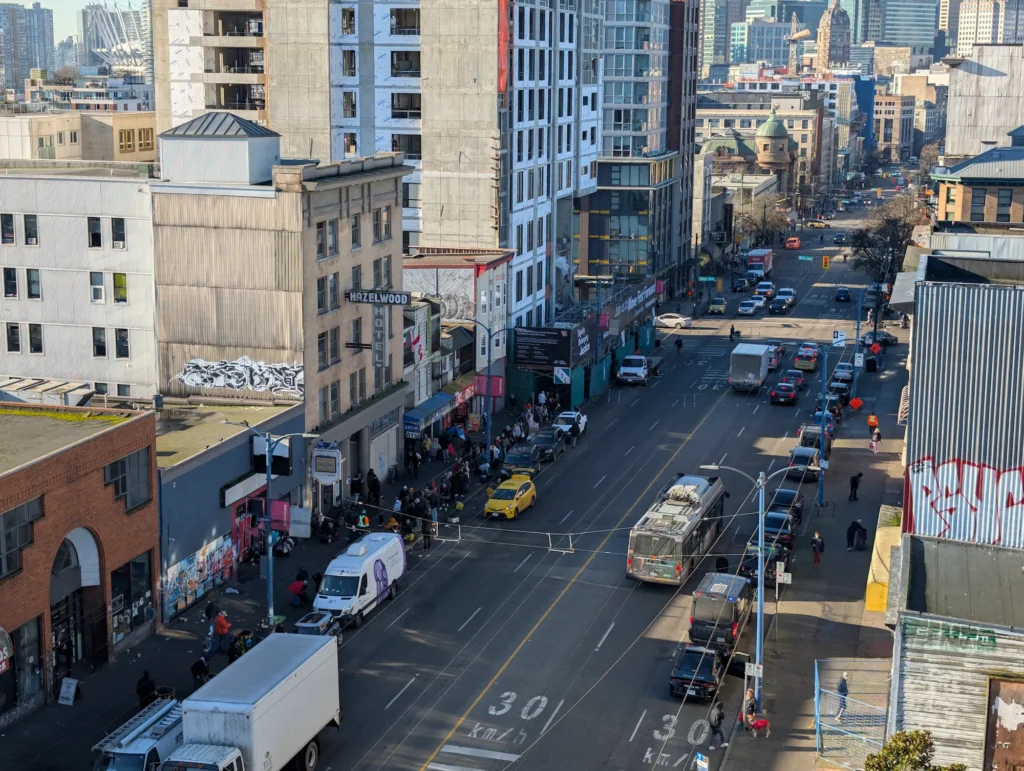
Vancouver has elected a new council and given it a public-safety demand it cannot reasonably file away. About 68 per cent of people answering yes or no to each plebiscite question backed stronger laws against open-air hard drug use and a request for a secure care facility. The parties now dominant at City Hall opposed holding the vote. They will govern the City that answered yes.
For people living and working in the Downtown Eastside, the useful question is what their answer will change. A restriction on public drug use needs to be enforceable. An offer of care needs somewhere to lead. The neighbourhood has an interest in both, whatever party proposed the questions and whatever parties now choose the response.
The election gives the incoming council the authority to pursue its own approach. The plebiscite gives residents grounds to ask how that approach addresses what they supported. That leaves Pete Fry and his colleagues considerable freedom, with an obligation to explain their choices in terms people can recognize on their own streets.
The Electorate Overlaps
There is a tempting account of the result in which progressive voters elected a new council while a different Vancouver demanded tougher drug policies. The arithmetic rules out a clean division.
Fry received 98,748 votes. The first question received 137,178 yes votes. With 209,711 ballots cast across the election, at least 26,215 people must have voted both for Fry and for stronger public-use laws. That is a minimum calculated from the official results, rather than a survey of individual ballots; the overlap could be larger. It establishes no motive. It does establish that the mayor’s electorate includes a substantial number of the people whose answer his government must consider.
A person could support more housing and still want restrictions on public drug use. Someone could reject Ken Sim’s administration and support asking the Province for secure care. Those choices are coherent. The supposed contradiction belongs largely to a political argument that expects voters to select an entire package of beliefs when they choose a mayor.
The limits apply to the plebiscite as well. Broad questions leave room for agreement among people who would disagree about the methods. A yes vote on stronger laws does not settle which powers should change. Support for a secure facility leaves its location and operation to be worked out. Council should respect the answers at that level of specificity, then take responsibility for the decisions the ballot left open.
The Response Council Can Choose
Fry has already offered the beginnings of an answer. After the results, he told CTV that addressing public drug use was a priority. His proposals include supportive housing, regulated overdose-prevention locations, and outreach. The voters who wanted stricter public-space rules are entitled to ask how these measures would change what happens outside their doors.
A response built around services still has to address the words on the ballot. The first question asked about stronger laws. If council believes its approach would reduce public drug use without the proposed legal changes, it should say which changes it rejects and why. Invoking a shared concern for safety would leave that disagreement unresolved. An elected government can defend a different course; residents need enough detail to assess it.
His party’s platform proposes a round-the-clock Community Response Outreach Workers team for non-emergency calls, along with daytime spaces and licensing and zoning arrangements for health services. Council can bring these proposals forward on their own merits. They need operating details that allow residents to distinguish a promised response from one they can actually obtain.
The outreach team is expressly non-police and non-medical. Its value would lie in responding to situations that fit those limits and connecting people to services. It cannot supply emergency psychiatric assessment or turn an unavailable treatment place into an available one. Its arrangements need to explain when it responds, when a clinical or police response is necessary, and who accepts the referral afterward.
Providing people with alternatives also creates obligations for the City as the host. An indoor service needs a location and hours that make it usable. Neighbours need a reliable response when activity outside their property interferes with their use of the street. The people using the service need access that does not depend on being repeatedly moved along. These requirements should be settled together, rather than leaving each group to argue that the other is the obstacle.
Housing is part of that work. As this site’s examination of the supportive-housing backlog explains, reversing Vancouver’s pause would reopen municipal contributions to projects; it would leave further funding and delivery decisions pending. Council should account for the homes its policy helps produce and the provision available to people while they wait. Repeal alone cannot accommodate someone tonight.
The Rules Already on the Street
The yes vote on the first question supports strengthening City laws. It leaves it to the council to identify the change and explain why existing measures are insufficient. Vancouver’s Health By-law already defines smoking broadly enough to include burning substances in a pipe and restricts it in specified places, including within six metres of building openings. Those provisions are narrower than a citywide prohibition on every form of drug consumption.
ABC’s Vote Yes explanation proposed adapting that by-law to allow tickets and immediate drug seizures, followed, after an unspecified number of tickets, by a wellness check and assessment for voluntary or involuntary care. The proposal’s proponents still owe an account of how those encounters would reach appropriate help. Winning support for a broad proposition does not establish that the proposed sequence will work.
The campaign overstates the constraints on police when it suggests they can intervene only through arrest and a lengthy criminal process. Under section 10.2 of the federal drug law, officers must consider taking no further action, issuing a warning or, with consent, making a referral before laying an information for simple possession. These options do not guarantee treatment. They do mean a new municipal mechanism should explain what it adds.
Council’s choice is more demanding than declaring itself for enforcement or for care. It needs to establish how public-space rules will be applied, alongside the assistance available to someone approached under them. A person who declines voluntary help may still be ineligible for involuntary admission. Neither a ticket nor a referral disposes of that difficulty. The response needs to account for the person and for the people sharing the block.
Residents should also be able to distinguish an unanswered service need from a rule that is going unenforced. Calling both a health issue would not describe the action required. Calling both a policing problem would place responsibility for care they cannot provide on officers. A clear division of responsibilities matters most when the first intervention has failed to resolve the situation.
A Vote Cannot Decide an Admission
The second question sought a formal request for a facility providing acute voluntary care and hundred-plus involuntary care beds for people at serious risk because of severe substance-use and mental-health disorders. It allowed the old St. Paul’s Hospital or a similar site.
Voluntary care was part of the proposition, too.
A large yes vote gives council political grounds to pursue that request. It cannot determine whether any particular person should be held. B.C.’s Mental Health Act sets admission criteria involving mental disorder, a need for treatment in a designated facility, and the need to prevent substantial deterioration or protect the person or others, with voluntary admission unsuitable. Drug use observed on a sidewalk does not by itself establish all those conditions. A ticket count cannot substitute for them.
People admitted involuntarily can also seek a review of their detention. A facility’s operating plan needs to account for that safeguard alongside clinical care.
These limits protect the people subject to the proposal. They also protect the public from being sold a clinical service as a general solution to unwanted behaviour. A person may need help, disturb others, and still be ineligible for detention under the Act. Government needs a response for that person as well.
The care request also reaches beyond City Hall’s power to deliver it. The Province would have to agree to the service and provide for its operation. Council can advocate for capacity and help assemble a local proposal. Its responsibility is to be explicit about what it is asking Victoria to provide, including the people the service is intended to admit. “Secure care” cannot stand for every kind of help missing from a neighbourhood.
The Care Being Built
Vancouver is not waiting for its first treatment commitment. The new St. Paul’s Hospital and the withdrawal-management development at Clark Drive and East First Avenue are among the projects Fry has cited. Their schedules and purposes matter to anyone deciding what additional care the City should seek.
At Clark Drive, the Province’s construction announcement describes 51 medically supervised detox beds, 20 sobering beds and 20 short-term transitional beds. The centre will replace the existing Vancouver Detox Centre. Its construction was estimated to finish in 2028. These are different services, and replacement capacity cannot all be counted as an addition.
The transitional beds are intended for people who have completed withdrawal management and are waiting for further treatment or recovery accommodation. The project explicitly makes room for the wait after detox. Someone can have received the first service they need and still be waiting for the next one. A political promise that ends with admission leaves out that person’s next day.
The old St. Paul’s site presents a separate problem. Providence sold the Burrard Street property to Concord Pacific in 2020, while arranging to continue hospital operations until the replacement opens. Providence’s published schedule puts that opening in 2027. The plebiscite has therefore named a privately owned, still-operating hospital as one possible location. A conversion would need an agreement over the property and a defined service to put inside it. Its history as a hospital supplies neither automatically.
Elsewhere, the Province has put a more definite commitment behind secure care. Construction has begun on a 60-bed Surrey facility with involuntary admission capacity, with an anticipated spring 2028 opening. Its approved project budget is up to $57 million. It is intended to serve people in the Fraser Health region, rather than constituting a reserved allocation for Vancouver.
That project gives the demand for a hundred-plus beds some financial and practical context. Its project budget is not a measure of the continuing resources needed to operate the service. A Vancouver proposal needs its own cost and timetable. Scaling Surrey’s budget by the number of beds would conceal differences in the buildings and care involved. Counting Surrey’s places as Vancouver’s answer would conceal geography.
First Nations Health Authority chief medical officer Dr. Nel Wieman made the case for a broader service mix in opposing the Helmcken overdose-prevention site’s cancellation. She called for care extending across harm reduction, treatment and continuing support, including housing. The local response should explain how someone can access the next appropriate service, including after a stay in secure care. Opening a facility would begin that responsibility.
A Decision Residents Can Follow
Mike Klassen, the sole returning ABC councillor, told CTV he wanted council to state its position and work toward a solution. There is room for agreement on a provincial request even where councillors differ over street enforcement. Council can also explain a decision to pursue a different care proposal. Residents should be able to see the choice and the reasons for it.
Vancouver’s Clerk estimated the extra election cost at $400,000 to $550,000. The result is advisory and does not automatically change the law. Council takes office on 2 November. Its first public-safety decisions should establish whether it will make the requested approach to Victoria and when residents will see its proposals for public drug use. Fry has promised a tangible difference. The next date to watch should be one his council sets.

Kris has been at the forefront of Downtown Eastside initiatives for over 15 years, working to improve the neighbourhood. As a consultant to several organizations, he played a key role in shaping harm reduction strategies and drug policies. A strong proponent of decisive action, Kris’s work focuses on driving tangible change and advocating for solutions that address the complex challenges facing the community.



Leave a Comment