
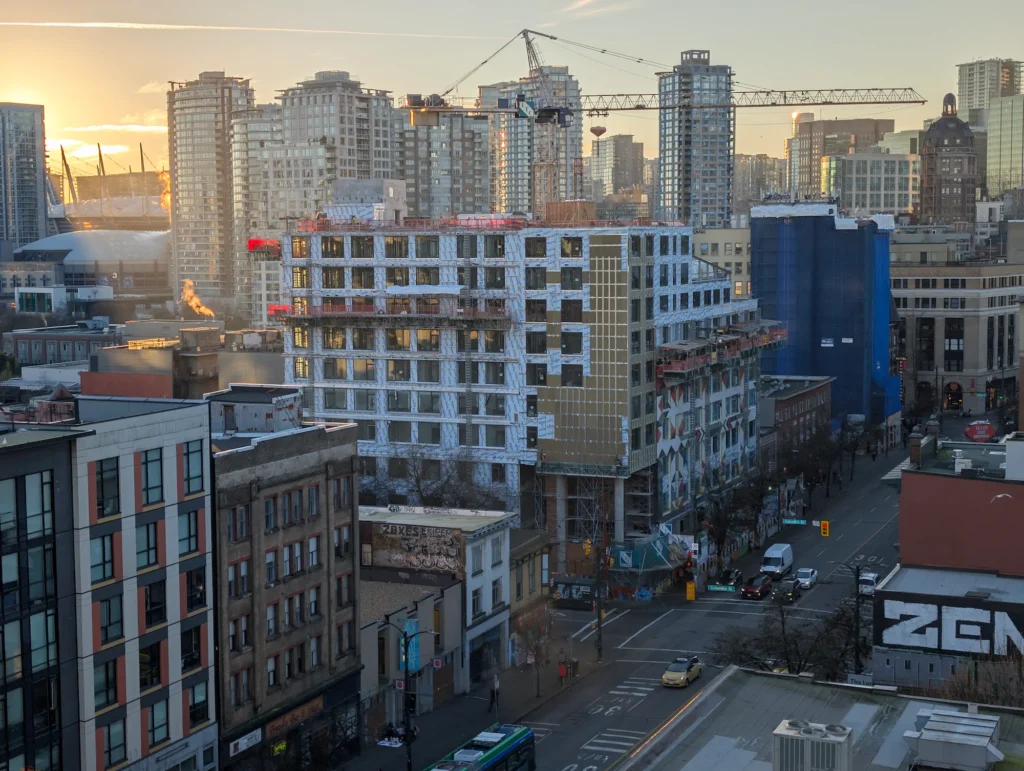
At 301 East Hastings Street, Vancouver has a housing promise old enough to outlast another mayor. The Province announced housing and a health centre for the site in January 2018. This July, Downtown Eastside residents gathered at the empty lot to demand delivery. The incoming council can reverse Ken Sim’s supportive-housing pause, but the promises that predate it expose a longer failure to get homes built.
Ryan Donnelly, a tenant of the Lugaat supportive-housing building, described what the Hastings project could have meant: “Could have done a lot of good for a lot of people.” Katie Hyslop reported the gathering for The Tyee. In its response to the outlet, the housing ministry said planning and design were continuing. It supplied no timeline.
Repeal would restore a municipal contribution that matters: access to City land and money for new projects outside the policy’s exceptions. It would also leave the new council responsible for explaining why developments already allowed to proceed still take years to reach tenants. Downtown Eastside residents have already waited through announcements by governments willing to build. At Hastings, the new council inherits the years those announcements have accumulated.
What the Next Vote Can Change
Vancouver’s new mayor, Pete Fry, takes office alongside the incoming council on 2 November. His Green Party platform promises to reverse the supportive-housing ban and attach occupancy requirements for good conditions. Sean Orr also identified repeal as an early priority in The Georgia Straight’s election coverage. Those are commitments to act, with the vote and its financial consequences still ahead.
The policy they inherit is narrower than a citywide prohibition on supportive housing. Council adopted it on 26 February 2025, temporarily withholding City land or funding from new low-barrier supportive housing while seeking more provision elsewhere in the region. Replacement projects remained eligible. So did developments already in progress or with confirmed government funding, alongside exceptions for health-related housing and specified populations, including seniors and women.
Staff subsequently made clear that the motion changed neither zoning nor development regulations. A project proceeding without City land or money could still be processed. The restriction mattered because the City had supplied land and grants while senior governments paid construction and operating costs. Withdrawing one partner’s contribution can leave the others with a more expensive project to assemble.
Ending that withdrawal would give Vancouver another way to bring housing forward. It would not restore a cancelled provincial funding round or settle the construction budget of an existing development. Its first housing commitments will need an address and a funded municipal contribution. Otherwise, the old projects will still be waiting while the new ones enter the announcement stage.
There is already a failed attempt to reverse the policy. A repeal motion was defeated on 1 April 2026. That defeat kept the restriction in place through the election. Reversal would reopen the municipal partnership to projects that could not qualify under it.
The Homes That Were Already Allowed
The strongest reason to look beyond repeal comes from the City’s own implementation work. Staff published a list of eight projects outside the pause. Those developments already had permission to continue under the policy. Their schedules show how much waiting can remain after a political obstacle has been cleared.
At 1406–1410 East King Edward Avenue, BC Housing’s published history begins in February 2021. Rezoning followed in June 2022 and development-permit approval that December. The agency’s schedule estimates a construction start in fall 2026 and opening in fall 2028 for 109 studios with support services, operated by BC Indigenous Housing Society.
That puts the estimated opening more than seven years after the announcement. Most of that history predates Sim’s pause. Removing the restriction cannot recover those years, and an approved permit has plainly been insufficient to produce an occupied building within them.
The sequence at 2540 South Grandview Highway is similar. Announced in February 2022 and rezoned a year later, the 64-home development has an estimated spring 2028 opening. BC Housing’s online schedules were frozen on September 22 for the provincial election, so their construction dates remain published estimates. They still describe waits extending well into the next council’s term.
There is movement elsewhere in that exempt group. BC Housing records a September 2025 construction start at 8302 Beatrice Street, with an estimated summer 2027 opening. Its 72 homes include 48 supportive homes and 24 complex-care homes. The exception allowed that project to advance while the broader restriction remained in place.
These histories make a demand for faster delivery more exacting. Council will inherit projects at different stages, each needing a different next decision. A development awaiting construction has little to gain from being announced again as newly permissible.
An Approval That Repeal Cannot Restore
Arbutus and Seventh presents a different problem. In May 2025, the City acknowledged a procedural flaw in the 2022 public hearing for the proposed 13-storey, 129-home building. It agreed to enter a consent order quashing the rezoning and the resulting development permit, and said it would work with the Province and BC Housing on next steps.
The project had appeared in the earlier list of developments outside the pause. Its subsequent difficulty concerned the validity of its approvals. Repealing the general funding restriction would not itself replace those approvals. The City has responsibility here that cannot be transferred to a provincial budget or explained away through a dispute over regional housing shares.
For tenants waiting for housing, the distinctions between an invalid approval and a missing contribution bring no immediate relief. For a council promising delivery, they identify different work. Treating every unfinished development as a casualty of the pause would allow older municipal failures to disappear inside the story of its reversal.
What Delivery Looks Like on Hastings
The Downtown Eastside also has evidence that the partnership can produce housing. On 22 May, the Province announced the opening of Ho’-kee-melh Kloshe Lum at 1015 East Hastings Street, an Indigenous-focused development operated in part by the Vancouver Aboriginal Friendship Centre Society.
Its composition matters. The building contains 87 affordable homes, 56 market rentals, and 25 supportive homes, along with 80 shelter spaces. The supportive homes are held at the shelter rate. They account for only part of the development’s housing supply.
The Province also committed approximately $4.4 million in annual operating funding for the shelter and supportive homes together. That continuing payment belongs beside the construction announcement: the services have to be financed after the building opens. The development demonstrates a funded partnership reaching delivery during the pause, through a project exempt from it. It offers no basis for treating the restriction as harmless, or for treating its removal as sufficient.
At 301 East Hastings, the partnership has yet to reach the same point. The expanded plan announced in July 2024 brought four lots into a proposal combining affordable and supportive housing with health services. The Province described an initial 2018 plan for 75 units on one lot. By the time residents gathered there this July, eight years had passed since the original announcement.
Interim use requires its own approval. The City issued a permit for a temporary Navigation Hub at the address in July 2025, expiring in August 2027 unless extended. It authorizes outdoor use with no buildings proposed. That approval provides for services on the site while the housing proposal remains in planning.
The neighbourhood has encountered this dependency before. The Hogan’s Alley housing proposal remains tied to another public decision: the City’s agreement with the Society states that redevelopment requires the removal of the viaducts. In both cases, public support for housing has left another decision outstanding before it can be built. At Hastings, residents are still waiting for the permanent homes announced before the pause.
The Money City Hall Cannot Restore
Beyond Vancouver, the provincial funding dispute changes what a willing council can bring to its partners. On 13 October, the Urban Development Institute and Housing Central said that more than 5,000 affordable rental homes had been deferred through the Community Housing Fund and the Indigenous Housing Fund. The signatories include non-profit, Indigenous and co-operative housing representatives, alongside market developers. They are participants seeking restored investment, and their provincewide estimate is not a count of supportive homes cancelled in Vancouver.
Their case still reaches the centre of the incoming council’s promise. Non-profit projects can have land identified and design work paid for, yet lack the public investment needed to proceed. Reopening access to a municipal contribution would help assemble a partnership. It would leave the provincial contribution to be negotiated.
The Province’s 2026 budget describes nearly $1.4 billion being reallocated across its fiscal plan, with more than $900 million reinvested in existing housing services and programs. Those allocations include increased funding for housing operators. The government is slowing the pace of new projects while paying more to sustain existing provision and support other housing programs. Describing the entire sum as money removed from housing would conceal that choice; describing continuing services would not answer providers waiting for capital funding.
A separate federal-provincial initiative offers new investment with its own limits. The February agreement proposes at least 700 supportive and transitional homes across B.C., with construction to start within 12 months. Ottawa announced $170 million in capital funding and the Province up to $200 million. The funding backgrounder specifies $27 million a year in provincial operating subsidies for at least a decade.
The initiative supplies neither a guaranteed Vancouver allocation nor a promise that the homes will be completed within a year. Federal funding is subject to a signed contribution agreement, and provincial projects require approvals. The new council can pursue a share. It cannot book the provincial total as local housing delivered, or use it to settle the separate argument about deferred affordable rentals.
Regional Fairness Has Its Own Timetable
Sim’s motion rested on a legitimate regional issue. Vancouver’s April homelessness report describes a heavy concentration of supportive housing and shelter provision in the city. Asking other municipalities to provide more housing is compatible with continuing to house people in Vancouver. A restriction on Vancouver’s contribution needs a further justification: how withholding it brings the regional provision closer.
The District of North Vancouver illustrates the timing problem. At 1234 East Keith Road, a Lu’ma project proposes 60 supportive homes and five complex-care homes. It was announced in September 2023 and rezoned in February 2024, before Vancouver adopted its pause. BC Housing estimates a fall 2028 opening. Regional provision was already being pursued; the development’s history cannot be credited to Vancouver’s later restriction.
Nor does an approval in North Vancouver offer immediate accommodation to someone waiting on Hastings. The city’s March 2025 point-in-time count found 2,715 people experiencing homelessness, including 763 without shelter. That count captures one period and misses some people. It also occurred just 12 days after the policy vote, too soon to make it an account of the pause’s effects.
City staff reported no supportive-housing approvals and no supportive-housing openings in 2025. Those outcomes belong to a development history that extends beyond a single council motion. The next council inherits the whole of it, including the work needed to open projects already approved.
The Vacancy Beyond Supportive Housing
The wait for new construction also puts pressure on the homes Vancouver already has. The Community Housing Fund does not pay for support services or residential care. Its affordable rentals nevertheless matter to residents who want to leave supportive housing and are ready to move into a home with greater independence. City staff identified the shortage of affordable places to move to as a major obstacle to that transition.
In 2025, the City’s homelessness outreach staff helped 21 people move into affordable housing through STEP, its supportive-housing transition program. Those moves created an opportunity for existing supportive homes to become available to other people. The figure covers the City team’s work, not every transition across the sector.
For the next STEP tenants, council will need to secure affordable homes beyond the supportive buildings it wants to help construct. That gives the provincial affordable-rental funding dispute a direct place in Vancouver’s promise to make more supportive homes available.

Denise is a long-time advocate for affordable and dignified housing in the Downtown Eastside. Having lived in SROs and volunteered in homeless shelters, she brings a personal understanding of the housing crisis and its impact on the community. Her work reflects years of lived experience, frontline work, and commitment to creating better living conditions for DTES residents.


Leave a Comment