
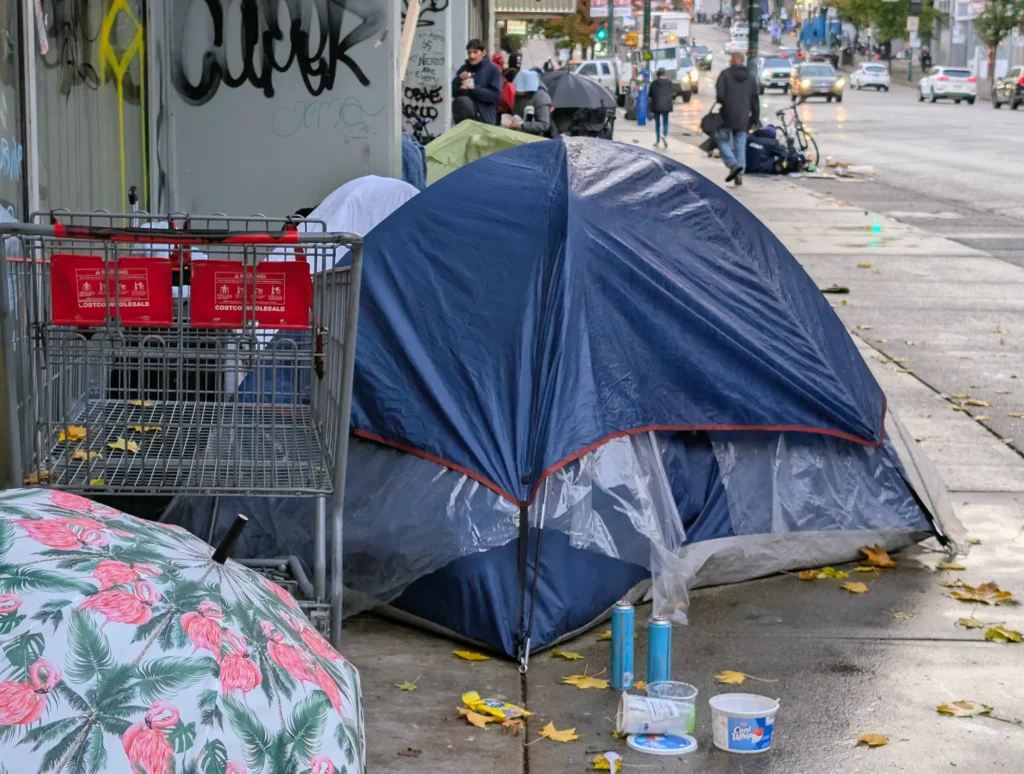
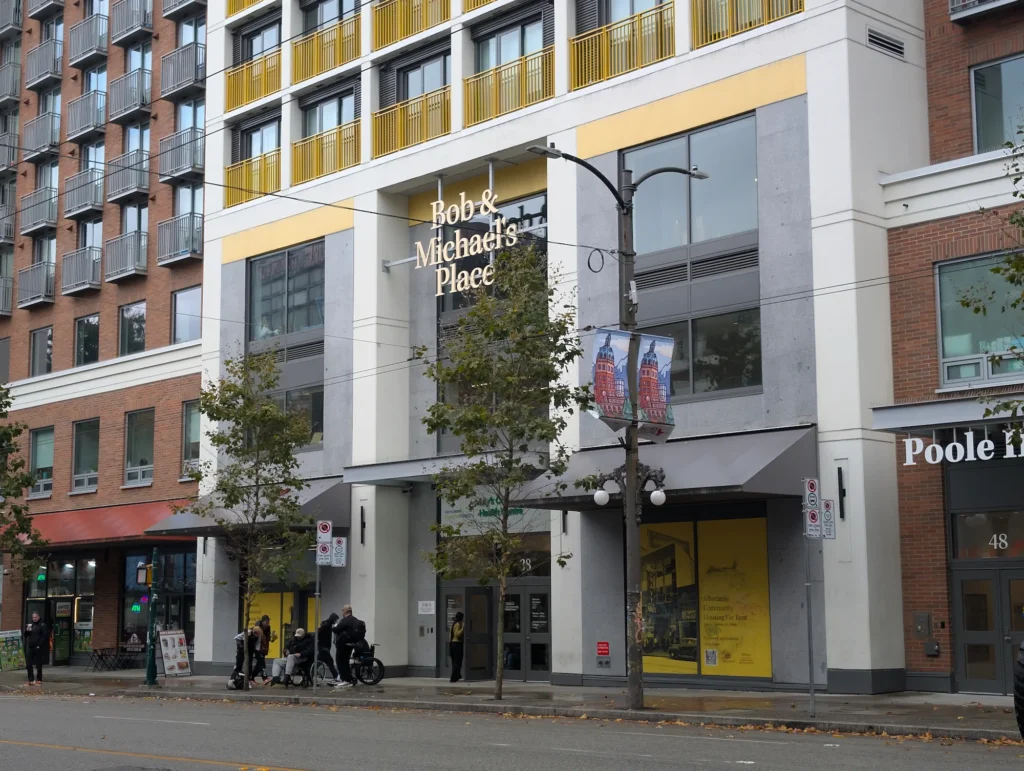
The Vancouver Aboriginal Friendship Centre Society spent 18 years working toward the building at 1015 East Hastings, according to its executive director, Susan Tatoosh (Tii Thul’p), when the Province announced the project on May 22, 2026. Ottawa set itself a deadline of 2027-28 for a far larger job: cutting chronic homelessness in half.
One of those clocks has produced 248 homes and shelter spaces. The other has produced a May 2024 finding by the Parliamentary Budget Officer that the federal program was not on track to meet its targets and that reaching the goal would take an additional $3.5 billion a year on top of the roughly $561 million Infrastructure Canada was spending or planning to spend, about a seven-fold increase. The federal budget arrives on Thursday, November 5.
Three days before it, former Toronto mayor John Tory, who chairs the WoodGreen Foundation, and Dani Saad, WoodGreen’s vice-president of policy and development and a former adviser in the Prime Minister’s Office, argued in a Globe and Mail opinion piece that ending homelessness must become a nation-building project led from the top, with measurable targets and federal money tied to agreements with the provinces. They call for measurable targets but name none, and the piece puts no dollar figure on the effort. The federal government’s last homelessness target, and what became of it, shows what a new one would have to say about cost, deadline, and measurement.
A deadline with little accountability
The Auditor General of Canada examined the goal first. In November 2022, the audit found minimal federal accountability for the commitment to halve chronic homelessness by 2027-28, as the House of Commons Public Accounts Committee summarized it, and the minister, according to the committee’s report, pointed to a lack of adequate data. Reaching Home, the program that carries most of the federal effort, was then a $3.4 billion, nine-year commitment.
The Budget Officer priced the target eighteen months later. The May 2024 report found that the count of people experiencing homelessness had risen 20 percent from 2018, to 34,270, across enumerations carried out between March 2020 and December 2022, a rise this site noted in November 2024 in Canada Faces Tough Questions on National Housing Day, when the strategy’s 50 percent promise sat beside a national increase.
The cost finding carries the weight. The additional $3.5 billion a year was calculated against current program designs, and a single year of it exceeds the entire nine-year budget the Auditor General attached to Reaching Home in 2022, a comparison of programs with different scopes, though it shows the size of the gap. The report also notes that the government has since committed to ending chronic homelessness by 2030, a broader goal on a longer timeline.
Any new national target would inherit that history, along with a second problem the op-ed does not describe: the count it would be judged by has not moved the way its authors say.
The count doubled, then stopped climbing
The doubling Tory and Saad cite holds up in the federal data, within limits. The federal Everyone Counts 2024 report followed the same 56 communities across three enumerations and recorded an 11 percent rise in the total between 2018 and the 2020-22 round, then a 79 percent rise to 2024; compounded, the two rounds add up to a gain of about 99 percent. The unsheltered count rose 303 percent over the six years. The report itself warns that the one-night counts were moved to the fall, that Quebec was absent, and that methodological changes may affect comparability, which makes the figure a reliable indicator of direction of travel but an uncertain census.
Yet the direction changed. Everyone Counts 2025 counted more than 65,000 people across 75 communities and found that, in the 72 communities that could be compared with the previous round, the total was relatively stable, down 2.6 percent, while remaining 59 percent above the 2020-22 level. The report describes the situation as stabilized and notes that about 24 percent of communities reported reduced coverage of unsheltered people and that asylum claims fell by 34 percent, suggesting the plateau reflects a pause in the count and leaving open whether fewer people are without a home.
The op-ed holds that, outside a few places with localized decline, homelessness continues to rise. The most recent federal count does not say that. The defensible reading is a surge that has stopped growing in the national figures, at a level far above where it began, and the distinction matters for any target, because a number set against a rising line and a number set against a flat one commit Ottawa to different things.
Vancouver’s own count, taken on March 10 and 11, 2025, found 2,715 people, 1,952 of them sheltered and 763 unsheltered, which the City described as 12 percent above the 2023 count. The city and federal counts use different methods and dates and cannot be added together, yet the local figure was still rising in 2025 while the federal comparison found the national total steady, a gap a national target would have to be able to see. That count sits beside a backlog of more than 5,000 deferred affordable rentals, according to a 13 October statement from the Urban Development Institute and Housing Central, as this site reported in Vancouver Can Lift Its Housing Pause. The Backlog Will Still Be There.
A flat line in the national count says little about the people inside it, and that is where the op-ed and the federal target part company.
What the op-ed leaves out
The authors’ diagnosis is specific where their prescription is not. They describe Reaching Home as the entire federal strategy, say supportive housing models remain hard to scale, and ask for a new national strategy with measurable targets, a prime-ministerial lead, and conditions on federal funding, to be delivered in the upcoming budget or shortly after. They do not say how many homes, at what cost, by which year, or which count would show whether the effort worked.
Those omissions matter because the federal target and the op-ed’s headline figure measure different things. The target concerned chronic homelessness, meaning people who have been without housing for long stretches, while the counts the op-ed relies on tally everyone found on a single night, sheltered or not. A mission measured only by the second could register progress while people who have been outside the longest remain there, and a new target has to say which of the two populations it counts.
The Auditor General’s complaint about the last target was a lack of accountability and data, and a mission without these four answers would repeat that gap in a larger frame. The op-ed offers no such conversion, and the Budget Officer’s $3.5 billion describes what the existing model would cost to reach one earlier goal, not what a new strategy would cost to reach another. The nearest public record of what a home costs and how long it takes is on East Hastings.
About $340,000 a home, and years of waiting
The Province’s May 22, 2026 release describes 248 homes and shelter spaces at 1015 East Hastings: 87 affordable rentals, 56 market rentals, 25 supportive homes renting at the shelter rate, and 80 shelter spaces, operated by the Friendship Centre Society. It lists $40.1 million from the Province, more than $19.2 million from the federal Affordable Housing Fund, about $4.6 million from the City, $3 million from Indigenous Services Canada, and $17.1 million from the federal Unsheltered Homelessness and Encampments Initiative, with $4.4 million a year in provincial operating funding for the shelter and supportive homes.
Adding the capital figures yields $84.0 million, or about $338,700 per home or shelter space, and about $392,300 once the City’s land, valued at roughly $13.3 million, is included. Those are sums of the amounts the release lists, and they blend four kinds of housing, only 25 of them supportive, so neither is the price of a supportive home. At least $39.3 million of the capital, about 47 percent, came from federal programs. The release also records Tatoosh saying that future partnerships and funding remain uncertain, which describes a project that opened with its capital in place and its operating future still open.
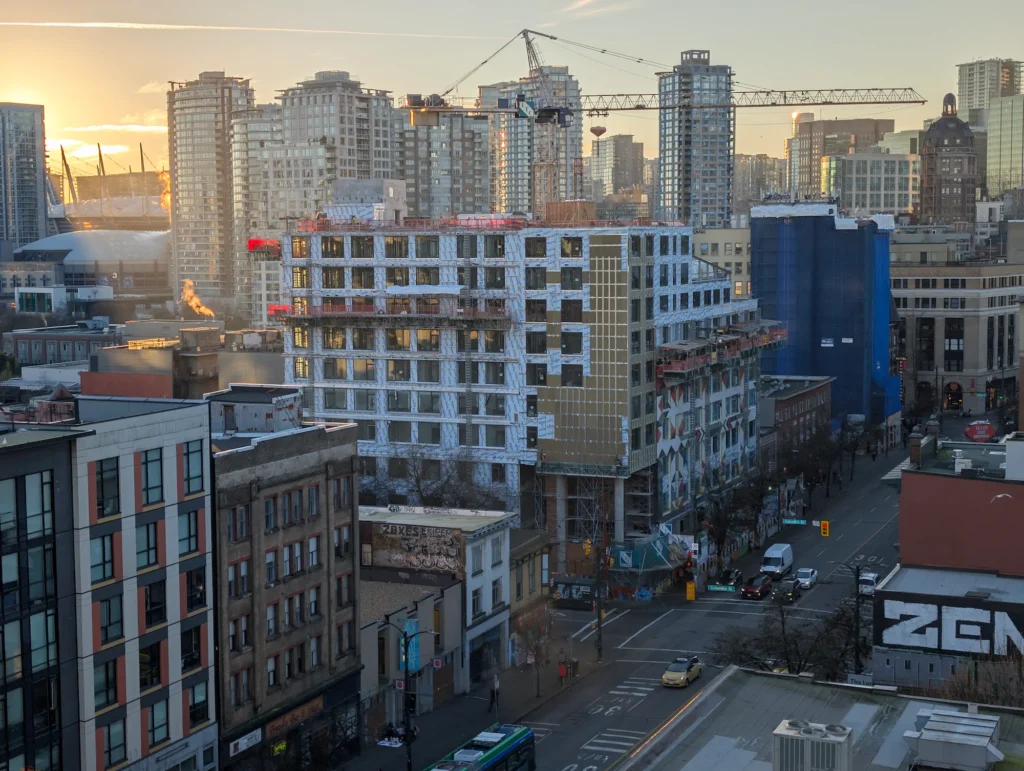
The clock on neighbouring projects is longer than the price. In January 2018, the Province announced plans for about 450 affordable rental homes across four Downtown Eastside projects, for about $83 million, including 301 East Hastings. By July 2024, the Province described that site as initially planned in 2018 for 75 units on a single lot and since expanded to four lots, up to eight storeys, with health services on the ground floor. A proposal announced in February 2021 for 1406 and 1410 East King Edward, about 90 studios, was estimated to open in late 2023 or early 2024; the City rezoned the site in June 2022 for 109 studios with construction expected to start in the second quarter of 2023, and our reporting on the housing pause cited BC Housing for a construction start this fall and an opening in fall 2028.
Harbour Light shows how much of the cost can sit outside a headline figure. The Province’s July 2024 release put its equity contribution to the Salvation Army’s Harbour Light redevelopment at $29.6 million for 57 supportive homes, which works out to about $519,000 a home, though that is only the Province’s share, within a 300-unit project the release expected to finish in 2026.
The agreement announced on February 18, 2026 sets out to shorten that clock. It combines $170 million in federal money through Build Canada Homes with up to $200 million in provincial capital and up to $27 million a year in operating subsidies for at least 10 years, for more than 700 supportive and transitional homes, with projects to be construction-ready within 12 months and the release expecting its DASH approvals process to cut the timeline from three years to one. The release gives no locations or per-home figures and does not say which costs the federal money covers. Whether three years becomes one can only be tested by buildings that have not yet been approved.
What Thursday can settle
Finance Minister François-Philippe Champagne tables the budget on November 5. Tory and Saad allowed for a slower answer by asking for action shortly after it, so Thursday may settle only whether the government intends to name a target at all.
The sixth national count is under way this October and November, and its results will not inform a budget that arrives in days.
The Budget Officer’s costing rests on a 2027-28 target year that begins on 1 April, five months away. The question the budget leaves open is which count Ottawa would use to say whether a new target had been met, since the 2024 and 2025 reports compare different sets of communities, and since the existing federal target was measured on chronic homelessness while the counts that frame the debate measure everyone found on one night.

Denise is a long-time advocate for affordable and dignified housing in the Downtown Eastside. Having lived in SROs and volunteered in homeless shelters, she brings a personal understanding of the housing crisis and its impact on the community. Her work reflects years of lived experience, frontline work, and commitment to creating better living conditions for DTES residents.


Leave a Comment