
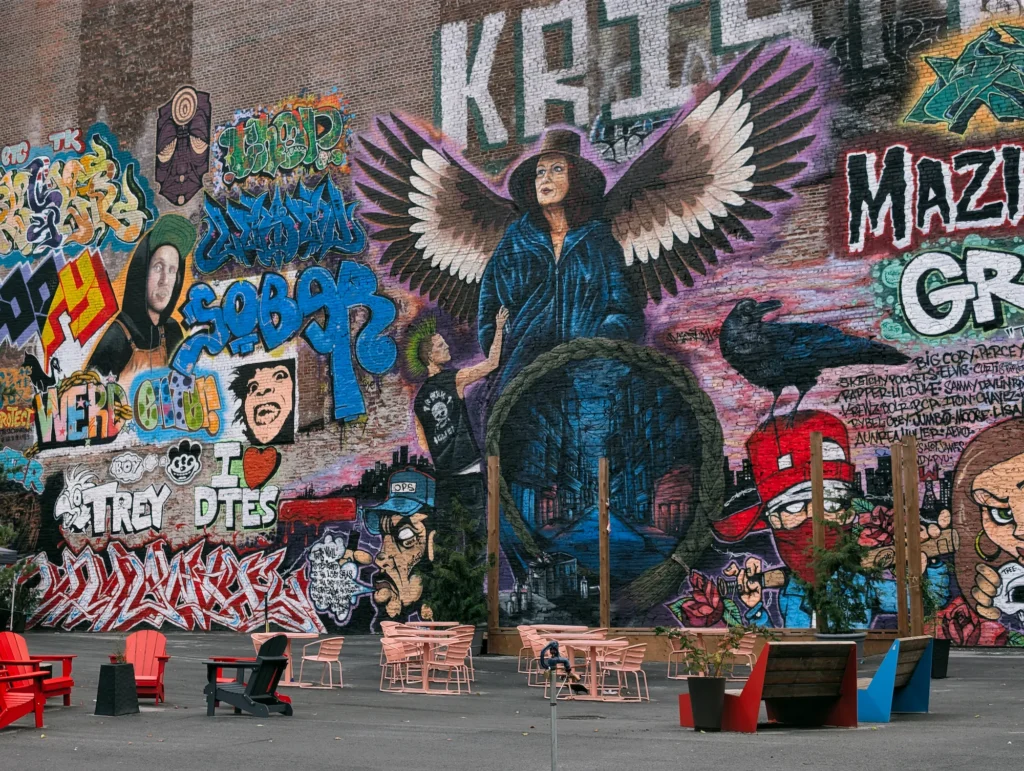
Trey Helten’s raised hand grips a spray can against the blue of Angel Gates’s coat. He reaches up from the lower left of the wall, in a black skull T-shirt and a green mohawk, his face turned toward her. Gates stands above him in a wide-brimmed hat and a zip-up coat, her feathered wings spread against a purple glow. A braided green wreath rings a street at night below her, and to her right a black raven perches on a cartoon figure in a red cap. The mural shows Helten painting the portrait of Gates he had planned to paint himself.
It covers the lower part of a brick wall on the side of the Maple Hotel at 177 East Hastings Street. Above it, the bare brick runs on, with faded lettering from an older sign still showing through. Around the two figures, friends’ names and tags crowd the wall: a cartoon face in an Overdose Prevention Society cap at the lower left, rows of small lettering beneath the tags on the right.
The wall looks out onto a lot where the nine-storey Balmoral Hotel stood for more than a century, until demolition was completed in 2024. Gates died in 2022, and Helten in 2025, and the artists who put them on this wall knew them both.
To see why the wall is here, and why these two people are on it, start with the hotel next door.
The hotel that stood next door
The Balmoral opened at 159 East Hastings Street in 1911 to 1912 as a Chicago-style hotel with Edwardian details, and the City formally recognized it as a heritage building in 1994. By then it had become one of the Downtown Eastside’s single-room hotels, some of the cheapest housing in Vancouver. For many people in the neighbourhood its story is the story of the people who lived there and of the home they lost as the building decayed around them.
The decay had a long paper trail. Hundreds of maintenance and fire-bylaw violations piled up against the Balmoral and the Regent Hotel across the street, which held 332 rooms between them, and on June 2, 2017, the City ordered the Balmoral closed and gave tenants until June 12 to leave. By the City’s count about 143 people lived in its 171 rooms, and staff said they had lined up more than 150 housing vacancies for them.
The Balmoral never reopened. The Regent closed the following year, and in November 2019 council voted to expropriate both hotels for $1 each, the City’s first expropriation for housing, after valuing each building at about $3.2 million. The owners went to court, and in December 2020 the City settled with them rather than face a judicial review. Both hotels passed into public ownership, and the mayor of the day promised that residents would help decide what came next.
What came next was a demolition order in 2022. The Balmoral’s sign came down that June, demolition began in November 2023, and by 2024 the last of the building was gone.
The woman who walked into the Balmoral
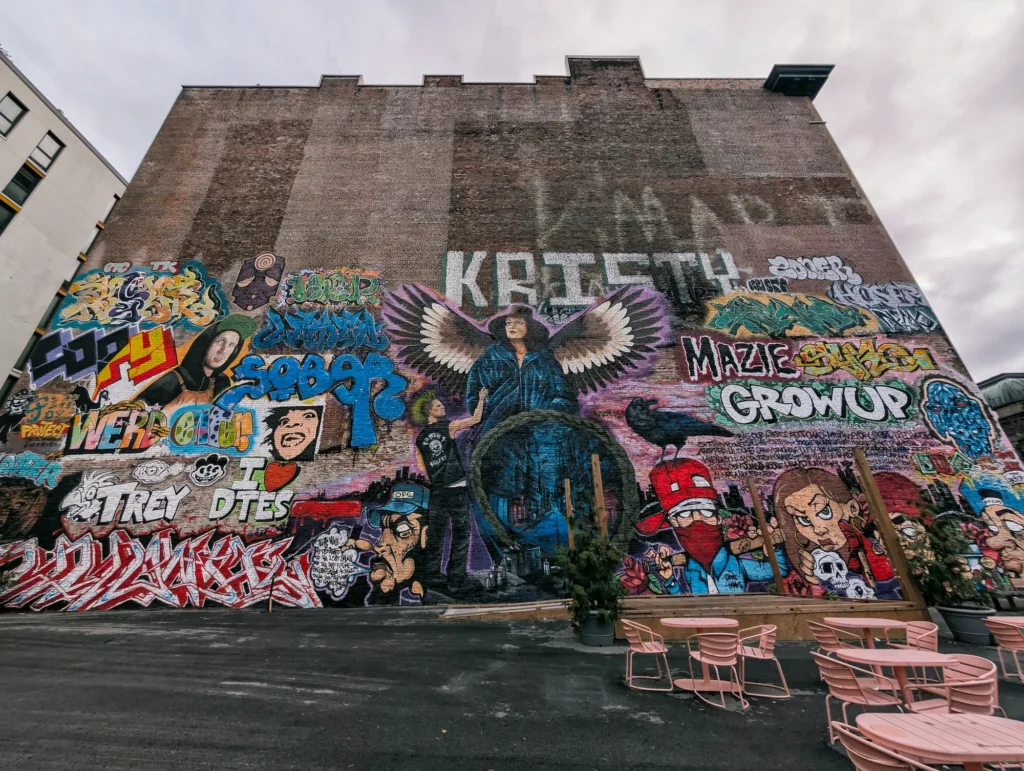
Ten years before the last of it came down, the Balmoral gave its name to a film. In Balmoral Hotel, made in 2014, Angel Gates dances along East Hastings Street, and as dusk falls at the end she walks into the hotel. For her, and for many other women in the neighbourhood, it was a touchstone of both belonging and abuse.
Gates, who was Haida, did not come to the film as a bystander. The filmmaker Wayne Wapeemukwa had approached her to help keep it accurate, and she insisted he cast her. He went on to make three films with her, and her performances earned two Leo Award nominations, which honour British Columbia film and television. He called her “one of the most powerful people I’ve ever met in my life,” and said she gave him confidence in his own Indigenous identity.
Off screen, she told her own story to live audiences, speaking openly about being Haida and a survivor of trauma and abuse, and she stood up for people she felt were being misrepresented. At a 2019 CBC town hall she spoke of losing 75 friends and acquaintances to toxic drugs and of the need for overdose prevention sites that stay open around the clock. In her last Facebook Live, on September 1, 2022, she thought of the people who had paved the way for safe supply and decriminalization. “I don’t want their deaths to be in vain,” she said.
Housing ran through her story as well. A documentary about her follows her eviction from an apartment when she could not find the $600 in rent, and, months later, a place at Woodward’s, a new supportive housing building in the neighbourhood. Her cousin Bernie Williams called her “a true warrior.” Gates died suddenly over Labour Day weekend. Helten, the man who planned to paint her, died less than three years later.
The man with the spray cans
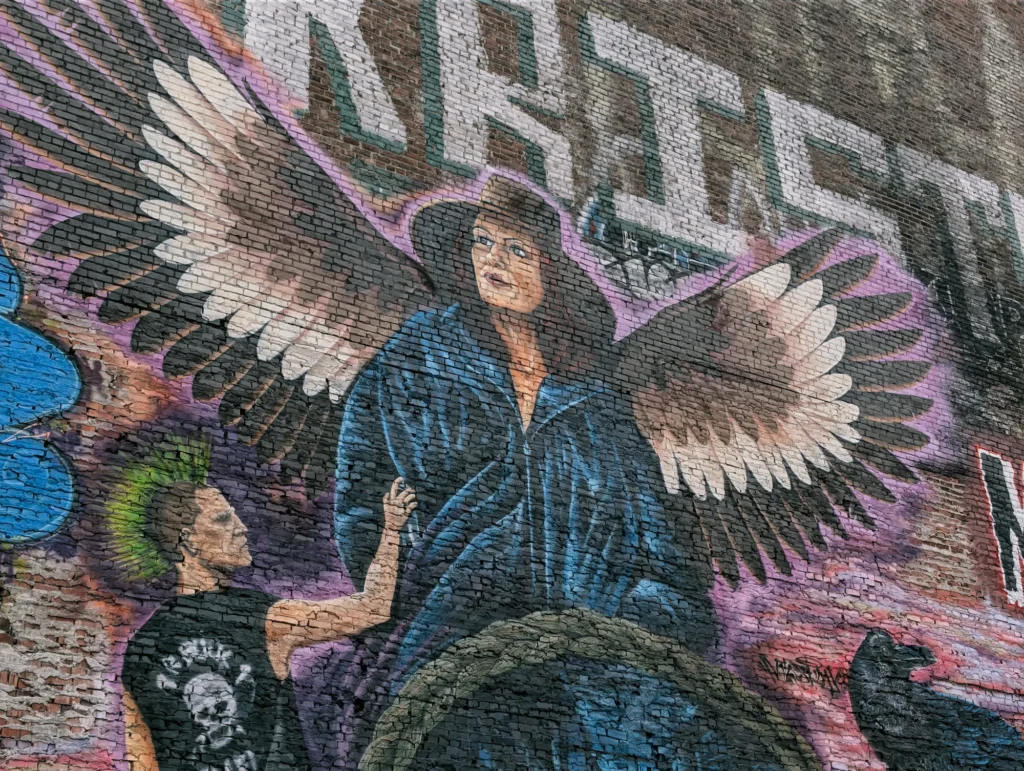
Helten grew up in Richmond and came to East Vancouver as a teenager, a punk rocker with a colourful mohawk and spray cans clinking in his backpack. He played in local bands, and for most of his last decade he worked at the Overdose Prevention Society (OPS), where he rose to manager, reversed hundreds of overdoses and trained others to do the same. When someone told him they had had enough of dope, he would find them a place and drive them to detox in his 1957 Chevy. His dog, Zelda, could sense an overdose and go for help.
Art came after he got clean in 2016. A therapist and friends told him to find something to focus on, and he told Daily Hive in 2021 that “when I got clean, I had to learn how to be a contributing member of society all over again.” By the summer of 2019 he was part of a mural called Time Flies Chasing Dragons in the alley behind OPS, where he also painted a drunken Daffy Duck who, he joked, had probably come from the pub at the end of the lane.
Bigger walls followed. He gathered artists for the six-storey Land Back mural at 99 West Pender Street and spent thousands of his own dollars on supplies for those who could not afford them. He worked with the Vancouver Native Housing Society on a pilot for Vancouver’s first legal graffiti wall, in the alley between Hastings and Pender Streets, and in May 2025, a month after he died, council voted unanimously to rename that alley Ashtrey Alley.
The wall he wanted most was the one beside the Balmoral. He dreamed of painting a community mural there, and he was 42 when he died. Hundreds came to his memorial, and a little over a year later the friends who knew his plan began to paint it.
The friends who carried the idea
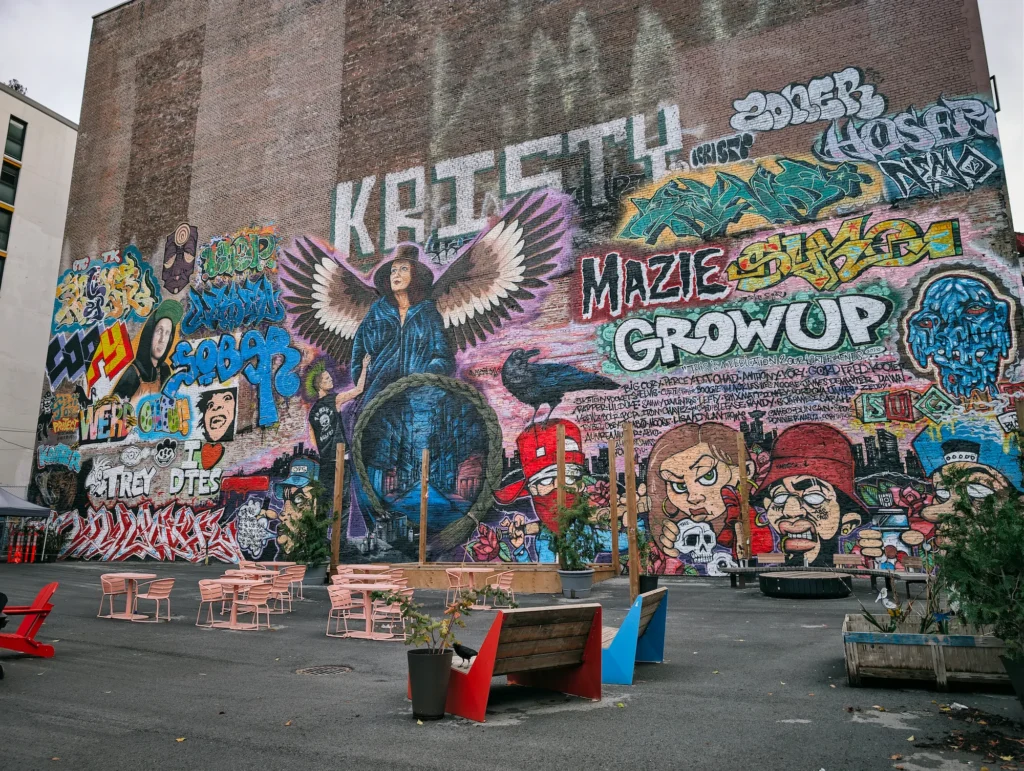
The mural Helten envisioned changed in one way after his death. The new design puts him in the picture, painting Gates, as a tribute to them both. The lead artists are Kyle Shipman and Jesse Gouchey, joined by James Hardy, who paints as Smokey Devil, and by community artists including Ken Foster, Edgar Alan Rossetti, Girl 23, Sugar, Copy and Lesen. Gouchey is a self-taught Cree Métis muralist who paints large works in spray paint, teaches mural workshops in Indigenous communities and has made stop-motion films from his own murals. Shipman helped Helten found the annual Never Grow Up Graffiti Jam in Ashtrey Alley.
Smokey Devil has painted graffiti since 1990 and has painted memorial portraits for years. In 2023 he told The Tyee they were “for everybody to know that it happened, and that they’re gone, and a way to respect them.” That spring he was painting a memorial to a young skateboarder, with Helten lettering “Rest in Peace” above him, and he turned to Helten to ask whether the portrait looked like the man. This summer he was set to paint the bottom of Helten’s own wall.
It took longer to get there than any of them wanted. OPS executive director Sarah Blyth and Helten began the project a few years ago, and once the hotel was gone they started contacting the City and other stakeholders about the site. At one point, Blyth said, Helten wanted to jump the fence and start painting. In July 2025 the City’s plan for the lot expected the mural that summer, subject to permits, and said the City was consulting Carnegie’s Indigenous Elders Advisory Committee on the design. Paint went on the wall in August 2026, with about a dozen artists and a month planned. The City supplied the site and the paint, OPS raised donations for the rest, and Blyth put the wait down to bureaucracy.
For Shipman, the wall is “our way of finally getting to mourn the loss of our friends and get a little bit of closure.” Gouchey called it a chance to give back to Helten.
A lot in use, with homes planned
Down on the lot, pink chairs and tables sit on the asphalt beside a low wooden platform and a few planters. In October 2024 council approved about two years of outdoor programming there, and since 2025 the Carnegie Community Centre has run the site as a temporary community space with the City and BC Housing. The City describes it as a culturally safe space, including for families and survivors of missing and murdered Indigenous women, girls, and two-spirit people.
The lot at 159 East Hastings Street is intended to be used for housing. The City-led project, run with BC Housing, went to Henriquez Partners, who are working with Rory Richards of NUQO Modular, and the architects say it will hold more than 130 homes built around support, inclusivity and reconciliation. It was expected to be paid for through the province’s Community Housing Fund. The City now calls it a priority project and says the province is identifying other funding sources.
Until the homes arrive, the pink chairs face the wall. On its right side, in white block letters, is Helten’s own tag: Grow Up.
See more of our reporting in Google’s Top Stories.


Teresa is a dedicated storyteller rooted in the Downtown Eastside, reporting on local art, cultural events, and community initiatives. Her work highlights the creativity and resilience of the neighbourhood, amplifying voices that often go unheard. Believing in the power of art to connect and inspire, Teresa focuses on the people and projects that shape the vibrant DTES community.



Leave a Comment