
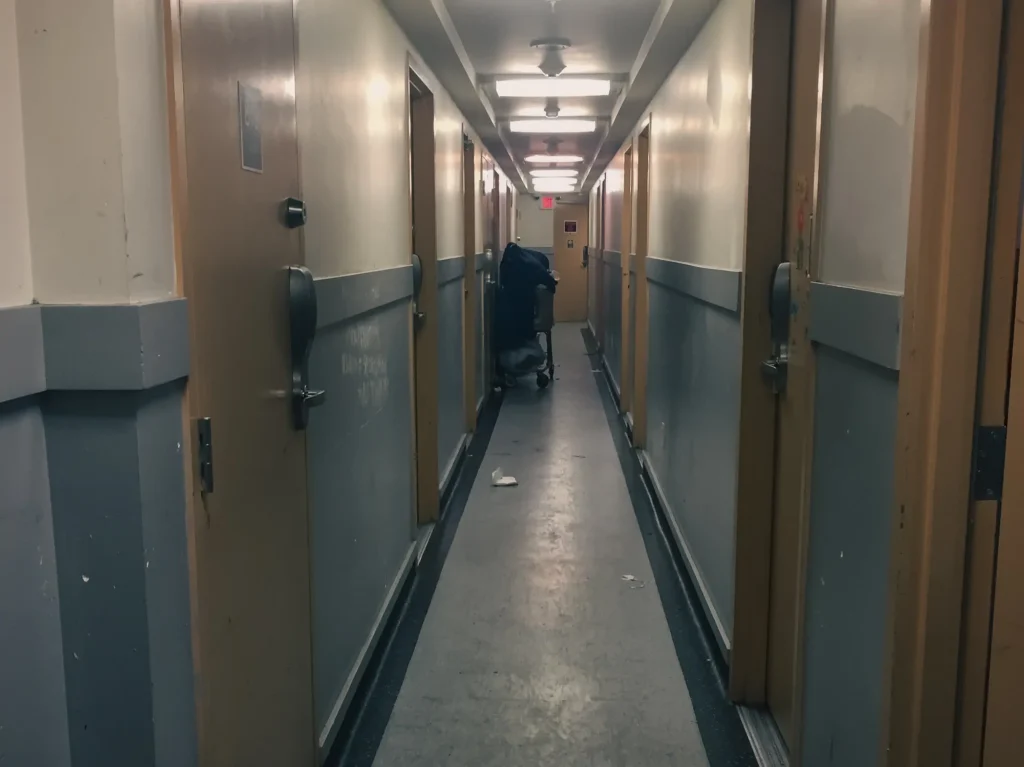
In November 2021, Jamie Sinclair realized that staff had not seen one of the residents of the single-room hotel she managed in 24 hours. She was not worried. The resident, a harm reduction worker who, Sinclair said, had saved hundreds of lives in the Downtown Eastside, “used smart.” But when Sinclair knocked on the door, nobody answered. It was a check she had made before, on dozens of residents who had died of an overdose. This woman had died of one too.
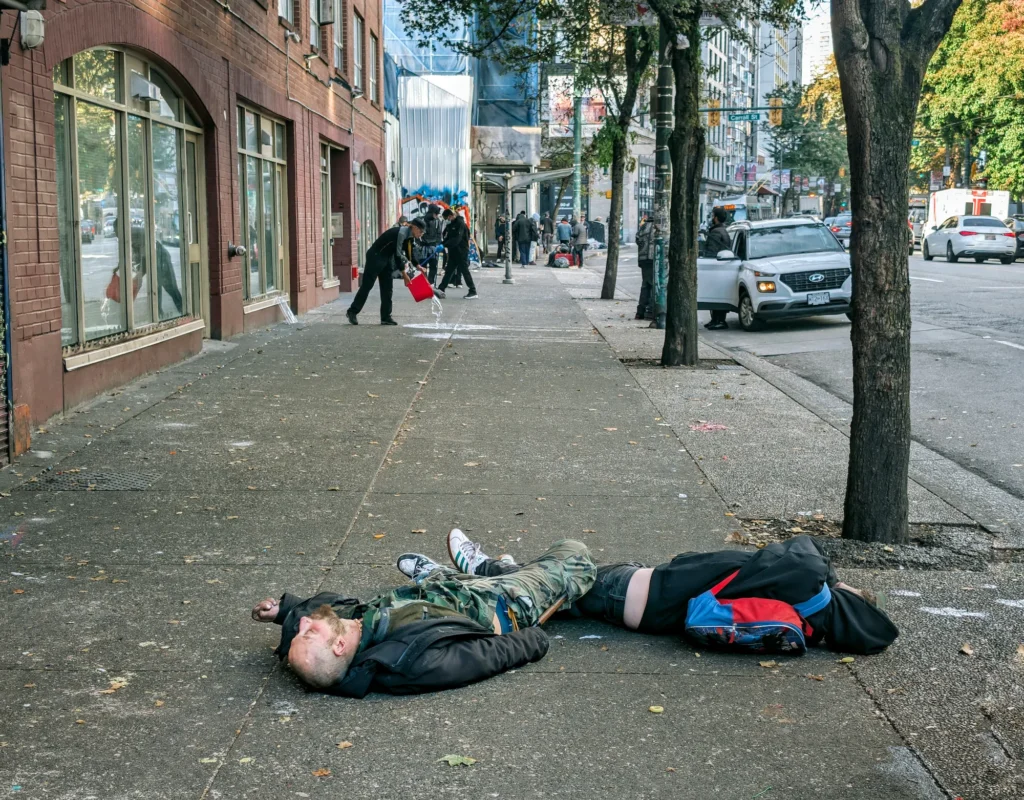
On November 10, the BC Coroners Service reported 1,143 deaths from suspected unregulated drug toxicity from January through September, 133 of them in September. Of the 1,143, 78 per cent happened inside and 20 per cent outside, on sidewalks, streets, in vehicles and in parks. The Coroners’ monthly count puts half of all the deaths, 575, in private residences, and another 288 in what it calls other residences, a category that takes in hotels, motels, rooming houses, single-room hotels, shelters and social and supportive housing.
Two of this year’s public decisions on drugs, one by the Province and one by Vancouver council, were about the street. The Province ended its decriminalization pilot on January 31 amid concerns about public drug use. On May 5, council voted for the mayor’s motion to use all available tools against a new downtown overdose prevention site, and by May 27 the health minister had said the site would not open.
The Coroners’ count points somewhere else: nearly four deaths in five took place indoors, and it does not record whether anyone was there. Naloxone can reverse an opioid overdose and 911 can bring a paramedic, but only if someone is there to give the one and make the other. A Coroners review of deaths through July 2021 found that more than half of the people who died had used alone.
In Vancouver Coastal, other residences come first
The pattern is older than this year’s count. When the Coroners studied 872 completed overdose investigations from 2016 and 2017, they found that 63 per cent of the people who died had overdosed in a private residence and 10 per cent outside. Vancouver Coastal Health, the region that includes the Downtown Eastside, already looked different: there, 45 per cent of the deaths were in private residences and 33 per cent in social, supportive or single-room housing.
What has changed since is the street. About one death in 10 was outside then, and about one in five is now, though the two counts were built differently and the comparison is rough. Since 2023 the outdoor share has held between 19 and 21 per cent in every year.
Vancouver Coastal still sits apart. Through September, 139 of its 298 deaths, 47 per cent, happened in other residences, against 77, or 26 per cent, in private ones. Other residences have led in every year since 2023, when they held 53 per cent. The region extends well beyond the Downtown Eastside, so the figure is regional, not a neighbourhood count.
Across the province, many of those doors lead to someone’s home: the Coroners’ count of young people who died between 2019 and 2023 puts 73 per cent of them in a private residence. In both categories, the count records where a person was and nothing about who else was there. The Coroners’ own reviews of the people who died describe a person alone, or in company that did not know.
Most had used alone
The Coroners’ 2022 review of deaths from August 2017 to July 2021 found that 52 per cent of the people who died had used alone, and the share rose to 61 per cent after COVID-19 restrictions began in April 2020. Alone is not the whole picture, though. An earlier panel review, published in 2018, found that a quarter of the people who died had used with others. The investigators’ notes describe companions who did not recognize the signs of an overdose, gave CPR or naloxone but delayed calling 9-1-1, were too impaired to help, or called for help and left.
The same panel found that many of the people who died lived with a family member, friend or roommate. In some cases that person was in the residence at the time and did not know about the drug use, or thought the person was clean and sober. Somebody in the next room is not the same as somebody who is watching.
Knowing the rules did not settle it. The woman in Sinclair’s hotel had “used smart,” and in 2017 Lorna Bird, then president of the Vancouver Area Network of Drug Users, remembered Lori, who had sat on the steering committee of the BC Association for People on Methadone. Lori “knew the rules, to not use by yourself,” Bird told the Globe and Mail. She used by herself anyway, and the people who knew her were shocked by her death.
A 2024 study in the International Journal of Drug Policy, of 30 people who use drugs in Vancouver single-room hotels, offers one account of why a person might. Some participants described using alone time in their rooms as a way to claim privacy and minimize the risks of surveillance and punitive policies. They called it safer because it reduced risks tied to the place itself. The privacy that makes a room feel safe leaves no one in it to call for help. Whether anyone can reach that room is a rule the building sets.
A mother at the front desk
In the spring of 2020, as COVID-19 restrictions took hold, Atira Women’s Resource Society restricted visitors to its buildings. Erica Grant last saw her son on Friday, April 3. The next morning she called him, and his phone’s battery had run out. On April 5 she went to the front desk of the Atira-run single-room hotel where he lived, and staff did not let her in.
On April 7 she reached a staff member by phone and learned that her son had been found dead in his room, of a suspected overdose. Grant told The Tyee that, under the guest policy, none of the tenants’ relatives could be sure the people they loved were all right.
Janice Abbott, Atira’s chief executive, said staff had physically checked on him, though she could not say on which day or how many times. She said the society had seen no uptick in deaths after it put the visitor restrictions in place, though it had begun to see one in the couple of months before she spoke. An Atira survey of tenants found that 32 per cent of those who use opioids were more likely to use alone under the restrictions, against 17 per cent who said they were more likely to use with someone present.
The survey recorded what tenants said they were more likely to do, not what happened in any room, and nothing in the record shows what the visitor rule did in the building where Grant’s son lived. Atira and the family read the rule differently. Some measures do not depend on who is let through the door, because they watch the room itself.
Rooms where someone is watching
The first watchers were the buildings’ own staff. In 2016, PHS Community Services Society intervened in 2,026 overdoses in the 19 buildings it operated, around 500 more than Insite, Vancouver’s supervised injection site, the Globe and Mail reported in April 2017. By then Atira had turned a suite in each of about 18 of its buildings into a shared using room, Abbott said.
Where a person is watched, deaths are rare. The Province’s April 13 backgrounder counts 32,997 overdoses responded to and survived at overdose prevention and supervised consumption sites from January 2017 to the end of January 2026, and two deaths. The Coroners’ monthly count, which includes only people who died on site at an overdose prevention site, lists three, one each in 2022, 2024 and 2026. Those are rooms with a person in them whose job is to notice.
Yet the Coroners found evidence of smoking in 67 per cent of this year’s deaths and of injection in eight per cent, and the 2022 review noted that many overdose prevention and supervised consumption sites did not offer inhalation. A 2025 study in the Canadian Journal of Public Health, which monitored a room beside the front desk of a Vancouver housing and shelter building, found the same limit. The room was for injecting or snorting, and people who smoked went to the front steps, the alley, and the washrooms. There must be a way “to offer people a safe place to smoke as well,” one resident told the researchers.
The city moved on that gap last year. A June 2025 report to council counted seven overdose prevention sites in Vancouver: five offering supervised inhalation outdoors and none indoors. On June 17, council approved, in principle, amendments to the Health By-law to allow indoor supervised inhalation at two addresses. One was the supervised consumption site at 611 Powell Street. The other was a supportive housing building at 220 Princess Avenue, where a booth for residents would run as a pilot for 6 to 12 months.
Watching a room from outside
Not every watcher has to be staff. In 2018 the City of Vancouver paid for a six-month pilot that hired 18 tenant overdose response organizers in 10 privately owned single-room hotels with the highest overdose rates. Researchers at the BC Centre on Substance Use found that it was effective in reaching socially isolated people who use drugs.
The National Overdose Response Service watches from further away. It is a toll-free phone line, 1-888-688-6677, led and operated by people with lived, living or shared experience of drug use. Callers stay on the line while they use, and the operator calls emergency services if they stop responding. Between December 2020 and February 2022 it monitored 2,172 calls, and 53 of them needed an emergency response; the Canadian Medical Association Journal study recorded no deaths among those 53.
For the room itself there is hardware. LifeguardLite is a wall-mounted box on which a resident sets a timer of one to six minutes before using. When the timer goes off the resident has to answer it. If there is no answer, the box sounds a loud alarm and sends staff to check, and if the alarm is still sounding after that, it calls 911 and tells first responders where it is. In July 2023 it was being installed in more than 2,000 single-room hotel and supportive housing units, about 1,400 of them in PHS buildings, according to Sinclair.
Sinclair was by then manager of supportive housing at Lifeguard Digital Health, which designed and makes the box, and she said she believed “10,000 per cent” that the woman she found would be alive if it had been in her room. Julie Roberts, executive director of Community Builders, a non-profit that runs about 800 units of shelter and supportive housing, said the boxes give residents who use alone more privacy and autonomy. At one of her buildings eight were in use and none had yet led to a 911 call, and she hoped to get funding to put them in all of the organization’s buildings, at an average cost of $350 each. Both said the counts of alarms and 911 calls they were gathering did not show the whole effect of the devices.
That July, the Ministry of Mental Health and Addictions would not say whether the province planned to pay for the devices in all public housing units. By March 2024 BC Housing had put $1 million into a fund, administered by the BC Non-Profit Housing Association, for devices in supportive housing, emergency shelters and transition houses. Each installed device came with three years of free service, after which the housing society pays. The society must also ensure that on-duty staff have working phones or tablets to receive alerts, and that the fund does not pay for them. Staff answer an alert under the society’s own overdose protocols, and the program’s operations guide does not say whether anyone is on duty overnight. The provincial backgrounder credits Lifeguard applications, including LifeguardLite, with saving 316 lives.
Each of these puts a watcher in a room only if the person agrees to be watched. A timer must be set, a call must be placed, a button must be pressed.
The count cannot tell one building from another
Most of these measures need a building with someone running it. That fits the 288 deaths in other residences, a quarter of the total, and not the 575 in private homes, where only the phone line reaches the person.
For those 288, the Coroners’ monthly count cannot show whether the measures work. It files hotels, shelters and supportive housing under one heading, other residences, and does not say which building or which operator. A building where staff knock on every door and one where no one does are the same line.
The Coroners can count by address. In December 2019 the Georgia Straight used freedom of information to count more than 330 deaths at 90 addresses run by four non-profit operators between January 2016 and May 2019, and reported that neither BC Housing nor the Coroners kept statistics on deaths inside them. In 2020 a freedom-of-information request for the same four operators’ housing, PHS, Atira, Lookout and RainCity, came back from the Coroners as a table by building and year to August 2020, for buildings the requester listed.
Catharine Hume, co-executive director of RainCity Housing, said in 2019 that the buildings were mitigating deaths every day, “and that information is invisible.”
Until deaths are counted by building and published, whether a staff check or a box on the wall keeps a person alive is something only the operators and the Coroners can say.
See more of our reporting in Google’s Top Stories.


Denise is a long-time advocate for affordable and dignified housing in the Downtown Eastside. Having lived in SROs and volunteered in homeless shelters, she brings a personal understanding of the housing crisis and its impact on the community. Her work reflects years of lived experience, frontline work, and commitment to creating better living conditions for DTES residents.



Leave a Comment