
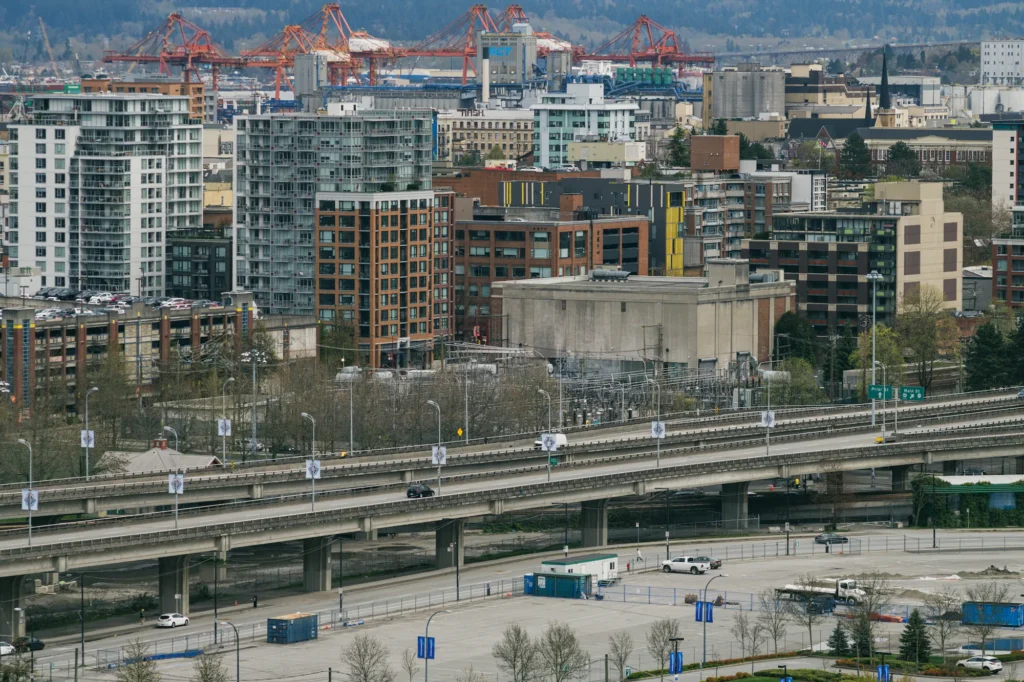
In October 2015, Vancouver city council voted unanimously to take down the Georgia and Dunsmuir viaducts, a job staff priced at $180 to $200 million and said development revenue would pay for. The plan scheduled deconstruction for 2018 to 2020. The structures were built in the 1970s across what had been Hogan’s Alley, Vancouver’s historic Black neighbourhood. Eleven years and two mayors later, the viaducts still carry about 40,000 vehicles a day, and on 2 October 2026 the City closed the Georgia Viaduct’s Main Street off-ramp to replace expansion joints, repairs to a structure it has no date to demolish.
Supporters of removal have started to press the issue. A coalition of businesses and residents that includes the Hastings Crossing Business Improvement Association wants the viaducts made an election issue, and Petros Kusmu, a board member of the Hogan’s Alley Society, has said now is the time to act. The City describes the delay differently. In a statement to CBC in September, it said the Northeast False Creek plan depends to a significant degree on money generated by development on land owned by several landowners, that the development did not move forward after the condo market changed, and that construction costs “escalated dramatically.” Both accounts leave the same gap because neither names the payer.
This article follows the 2015 funding promise through the estimates that replaced it, the money that has reached the project since, the block the Society is waiting to build on, and the answers the candidates for mayor and council have put on the record.
A Removal Plan Built on Developer Money
The staff report council took up in 2015 priced removal and replacement at $180 to $200 million, with a 35 percent contingency built in, against $50 to $65 million to upgrade the structures for an earthquake. It said the work “will be funded through development-related revenues” and asked the Director of Finance to report back on “a viable funding strategy.” Four councillors opposed the plan at committee, and the full council approved it on 27 October, according to the minutes. The motion set aside up to $21 million for planning through 2017, asked for consultation with Vancouver’s Black community, and called for monitoring of the effects on low-income residents in Chinatown and the Downtown Eastside. It also carried a condition that matters more in hindsight: removal “will not commence until such time as staff report back within 18 months or less.”
By January 2018 the plan had a new name and a larger number. A staff report put “the viaducts removal and street network reconfiguration project” at $360 million, including about $24 million already approved, and described it as “self-funding through ongoing negotiations with landowners and partners” rather than paid by taxpayers. The City’s published description of the street network still holds that the cost “can be fully funded by” contributions from new and existing developments “that we know will be eventually occurring in this area” and by sales or leases of City land no longer needed for the viaducts. That description is the 2015 premise, unchanged. The City’s own statement last month says the premise has not held.
Estimates That Moved Before Anything Came Down
The same January report priced the alternatives. Retrofitting the viaducts would cost about $90 million for another 50 years of service, or $1.8 million a year, and building new ones about $120 million for 100 years, or $1.2 million a year. Set against the $360 million for removal, keeping a crossing costs a quarter to a third as much, although the $360 million also pays for a new street network and the retrofit and replacement figures do not.
The number kept climbing after the choice was made. A June 2018 presentation to council put the Northeast False Creek infrastructure subtotal at $438 million, comprising $413 million for construction and $25 million for design, compared with $340 million and $20 million in January. That is an increase of $78 million, or 22 percent, in five months, and $73 million of it sits in construction. The step from $200 million in 2015 to $360 million in 2018 cannot be read as a like-for-like rise, because the two reports describe the work in different words. The step from $360 million to $438 million can. CBC reports that the City put the cost of the entire Northeast False Creek plan at $1.73 billion in 2018, and now says the construction cost has “escalated dramatically.”
The Money That Has Arrived
Four kinds of money have reached the viaduct file since 2015, and only one has been described as paying for removal. Planning money came first: $21 million approved in October 2015, and about $24 million by January 2018. Concord Pacific’s came next. When the City announced a land agreement with the developer in February 2023, it said the City would receive “$110 million in cash contributions that could be used or allocated to fund the new street network.” Concord says it is “pleased that the City chose to allocate our $110M contribution for the removal of viaducts.” The City’s announcement used wider wording. Even on Concord’s reading, $110 million covers about a quarter of the $438 million subtotal.
The larger sums went to housing. In December 2025, the City confirmed funding for three False Creek North projects: a 283-home building at 95 Nelson Street, due in 2029, with about $47.2 million from the City and $44.8 million from the Province, plus 450 Pacific Street (2028) and 1010 Expo Boulevard (2029). Concord puts the federal share for those last two at $195.9 million for 390 homes, about $502,000 per home, a sum that falls within the $180 to $200 million range the City gave for removal in 2015. The Province holds a stake of another kind. Geoff Meggs has written in The Tyee that Concord owes the Province a participation mortgage tied to density, with payments restricted to contaminated soil, and Daily Hive reported in January 2026 that City planners are discussing that model, along with Canada Infrastructure Bank financing, to pay for the viaduct work up front. Neither is a commitment. The only money going into the structure now is for repairs, and the City says the joint replacement on the Georgia Viaduct, which runs to spring 2027, has TransLink’s support.
The Block Under the Viaducts
For the Hogan’s Alley Society, the delay has a specific address. The streets around Union, Main, Jackson and Prior in Strathcona were home to Vancouver’s largest Black community until the viaducts displaced it, and the City now describes the block at 898 Main Street as “formerly home to Vancouver’s largest Black and African diaspora community.” In 2022, council approved an agreement with the Society that envisions a long-term lease, leaves the terms to “further discussions and negotiations,” and makes the Society responsible for the costs of design, construction, programming, and operation. The City’s agreement also states that redevelopment “will require the removal of the viaducts,” which it calls “still several years away.”
The Society’s goals have been consistent. The January 2018 report set a target of 300 units of social housing and a Hogan’s Alley Cultural Centre, both of which it counted among outcomes that were not possible while the off-ramps stood. Stephanie Allen, an affordable-housing developer and Society member, told The Walrus in 2023 that the Society wanted affordable rental and co-op housing, and a cultural centre that Black residents could afford to reach, and that the government is ultimately responsible for redress. Kusmu put it more plainly to CBC: “we just want to build affordable housing, we want to build really attractive community spaces, parks and areas for legacy businesses to thrive.” He added that the area is an opportunity to work with its Black, Indigenous and Chinese communities. Redress now waits on a demolition with no date.
A Date That Keeps Moving
The 2015 plan promised deconstruction from 2018 to 2020. The City’s description of the project still tells readers, “We plan to start in late 2018,” with construction taking three years. By November 2022, the earliest the work could begin was 2027, and Pete Fry, then a Green councillor, told Global News: “nobody’s really got the cheque in their hand.” Developers have their own reasons to want the structures gone. Concord’s 2025 plan for about 5,000 homes depends on the viaducts coming down, and the City’s general manager of engineering, Lon LaClaire, has called them “two-kilometre structures that are very expensive to maintain.”
Yet the City now describes the timeline for removal as “still uncertain,” and Landon Hoyt, executive director of the Hastings Crossing Business Improvement Association, told CBC that “the longer we wait, the more expensive it’s going to be.” The City’s own statement agrees with Hoyt on the direction of costs. The 2015 council asked for a funding strategy before work began, and the strategy that followed, self-funding through landowners, is the one the City says stalled when the condo market changed.
What the Candidates Say
OneCity’s platform pledges to “prioritize securing funding with higher-level governments to remove the viaducts and redevelop Hogan’s Alley.” The Vancouver Liberals’ platform calls for “the provincial government’s involvement to speed up the demolition of the Dunsmuir and Georgia viaducts,” Daily Hive reported in September. Liberal mayoral candidate Kareem Allam told CBC that the Northeast False Creek plan has to be re-costed, sincet there will be significant cost escalations, as you can imagine over the course of the last 10 years,” and suggested the City look to the provincial disaster mitigation fund or federal seismic and disaster funds. Fry, who leads the unofficial count for mayor, said he is “committed to making sure that this happens” but that “we have to come up with a new financial model, with who’s going to pay for this, and how, and what the phasing and staging would look like.” CBC sought comment from the ABC, TEAM and VOTE mayoral candidates and did not receive a response by its deadline.
The answers on the record share a direction. OneCity, the Liberals and Allam look to the Province or Ottawa, the City’s statement lists funding from senior levels of government among its options, and Fry describes a model that has yet to be built. Each points above City Hall for the money the 2015 plan expected from developers.
The Funding Question the 2015 Vote Left Open
Council took the vote in 2015 and left the payment to a later report. Eleven years on, the Society’s agreement already states that its block cannot be redeveloped without removing the viaducts, and it makes the Society responsible for what happens on the land afterward.
Fry has named the missing piece himself: who pays, and how the work is phased and staged. If the official count due on 21 October confirms the unofficial result, he will be asking council for that model from the mayor’s chair on 2 November, the day the new council is inaugurated.

Denise is a long-time advocate for affordable and dignified housing in the Downtown Eastside. Having lived in SROs and volunteered in homeless shelters, she brings a personal understanding of the housing crisis and its impact on the community. Her work reflects years of lived experience, frontline work, and commitment to creating better living conditions for DTES residents.

Leave a Comment