
In Trail in January, frontline workers were finding about 20 people unconscious every night, lying outdoors in the cold, Interior Health medical health officer Dr. Karin Goodison told the Canadian Press. Workers with years on the front line called it the worst they had seen. Goodison said the people affected “are acting very oddly,” that some had lost memory after overdoses, and that workers had no medication to reverse what was happening to them.
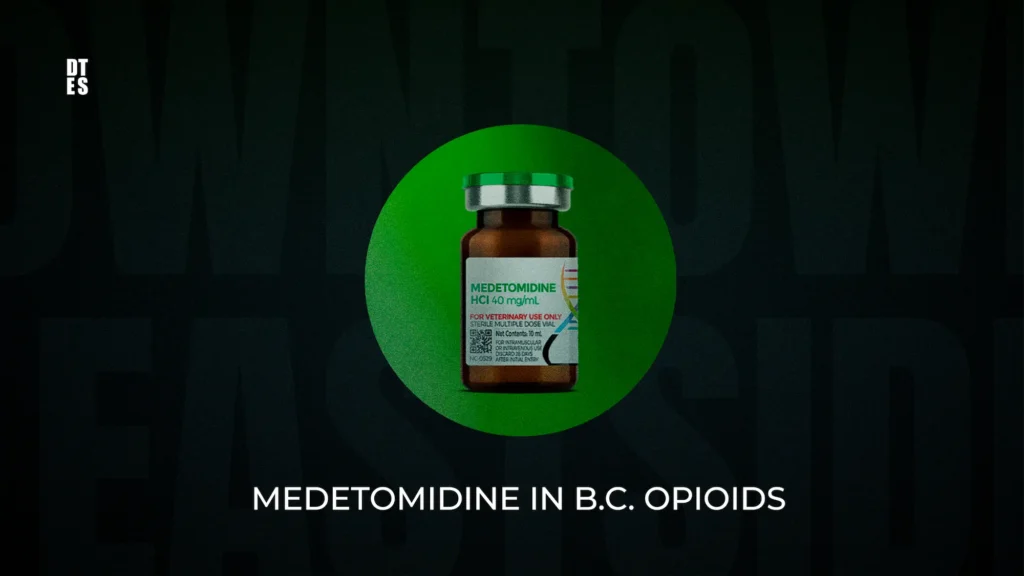
The suspected cause was medetomidine, a veterinary sedative that the BC Centre for Disease Control warned about in a rare provincewide alert on January 26. Paramedics had answered a record 256 drug-poisoning calls on January 21, and in Victoria police responded to 15 non-fatal overdoses linked to the drug in a single 24-hour period. Naloxone does not reverse the drug. Page 40 of Vancouver Coastal Health’s April 2026 manual for overdose prevention sites says medetomidine “is not an opioid and does not respond to naloxone, but in B.C. it is almost always found in unregulated opioids,” and then tells staff to give naloxone anyway when a person’s heart rate falls to 50 beats a minute or less.
Deaths are not what rose. B.C.’s drug deaths have fallen steadily since peaking at 2,589 in 2023, the Canadian Press reported, and the BCCDC called the climb in non-fatal poisonings “a cause for serious concern.” The Downtown Eastside’s overdose sites work with the same supply, which the BCCDC describes as provincewide.
Why a veterinary sedative is in street opioids
Medetomidine is a synthetic sedative that veterinarians use in surgery. It is not approved for people, and its effects on them have not been well studied. Fentanyl’s effect lasts about half as long as heroin’s, and adulterants such as medetomidine are taken to extend it. Dr. Alexis Crabtree, the BCCDC’s medical lead for harm reduction and substance use services, told the Canadian Press that it is unclear why the drug is spreading. One theory she offered is that it produces a longer experience than fentanyl. Another is that it may be cheaper for producers.
A year earlier, Crabtree said, medetomidine was rarely seen. The BC Centre on Substance Use found it in about 38 per cent of the opioid samples checked in November 2025, a share she called “quite high,” and Fraser Health reported 52.2 per cent in its samples. Health Canada’s drug analysis service found it in 48 of 262 B.C. opioid samples in the first quarter of 2026, or 18.3 per cent, up from 2.3 per cent in 2024, according to the CCSA’s June report. Substance, the University of Victoria’s drug-checking service, found it in 52 of 289 samples sold as down in September, or 18.0 per cent, at a median concentration of 1.3 per cent.
A median of 1.3 per cent sounds like a trace. Officials describe the sedative as 200 times stronger than xylazine, the animal tranquilizer, so a small share by weight still counts.
Why staff still give naloxone
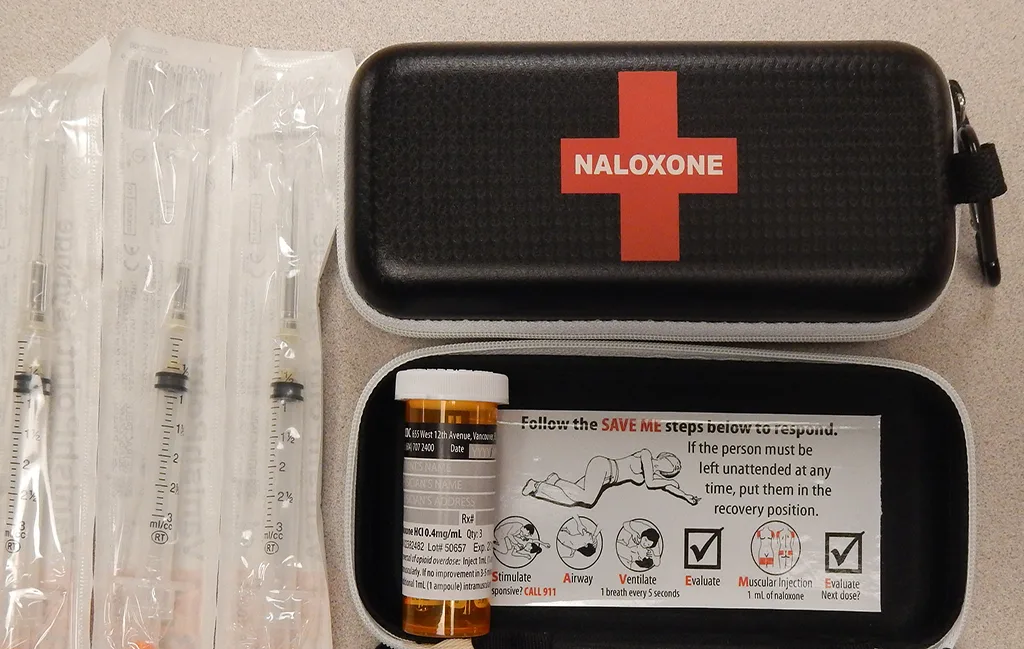
Naloxone takes an opioid’s place on the receptors in the brain, which restores breathing. It does nothing for a sedative that is not an opioid. Interior Health’s January alert for Cranbrook put the rule in one line: the drug “does not respond to naloxone, although naloxone should still be administered when opioid involvement is suspected.” The Philadelphia group Substance Use Philly is more straightforward about it: watch whether the person is breathing, and do not wait for them to respond.
Vancouver Coastal Health’s December 2025 update for physicians and nurse practitioners says bradycardia is “a prominent feature” and that a person “may remain sedated despite restoration of breathing.” The BCCDC adds low heart rate, changes in blood pressure and prolonged sedation, which is the description Goodison’s workers were looking at on a Trail street. Goodison said the behaviour is hard on people nearby and dangerous for the person affected. The site manual turns it into routine. Staff monitor a person for at least 30 minutes after naloxone, a window that matters because, as the Globe’s primer notes, a revived person can overdose again when the opioid takes effect 30 to 90 minutes later. Someone who is breathing normally but cannot be woken at all means a call to 911. Someone who is breathing normally and can be woken may sleep at the site, and staff checks on that person every 15 minutes. A heart rate that remains low after naloxone and rescue breaths also warrants a call to 911.
The manual defines prolonged sedation as a person who is unresponsive and cannot be woken for an extended time, “usually a few hours,” after the poisoning has been reversed and breathing is normal. Sleeping on site comes with a condition: the site must have sufficient space and staff to safely monitor the person. At one check every 15 minutes, each hour of sleep is four visits from staff. At closing time, sleeping people who are still too sedated to leave alone mean a call to 911, which the manual advises making 30 to 60 minutes beforehand so that paramedics arrive before the site closes.
The dose is a second judgment staff makes under that pressure. The December update advises the lowest dose of naloxone needed to reverse a breathing problem, to avoid pushing a person into withdrawal, and the CCSA records that overly aggressive dosing can do the same. According to the CCSA, Alberta has seen higher naloxone doses and longer hospital stays.
A sedation problem the Downtown Eastside knows
The neighbourhood has been here before. In 2019, sedatives of the benzodiazepine family, among them etizolam, were turning up cut into heroin and fentanyl and leaving people unwoken after naloxone. Sarah Blyth, executive director of the Overdose Prevention Society, estimated 25 to 30 overdoses at her site in two weeks, including five at once, and said it was hard to tell whether staff had truly brought people out of them. Dr. Keith Ahamad, medical director of Vancouver Coastal Health’s regional addiction program, said patients at St. Paul’s Hospital took hours to wake.
Medetomidine arrives in that same setting with a stronger sedative and less time to react. CBC, citing a Canadian Centre on Substance Use and Addiction presentation, reported that nurses at overdose prevention sites in B.C. and Montreal are worried about people with very low heart rates who become dizzy and unresponsive for hours. Those changes can arrive later than with earlier adulterants, so regular checks of pulse, heart rate, and oxygen now matter more.
The sites that carry that work are few, and the Province has cancelled a new one. Its plan to open an overdose prevention site in the 900 block of Helmcken Street will not proceed. The BCCDC’s January warning that medetomidine mixed with opioids could cause prolonged sedation was earlier described in our October 23 piece on what the neighbourhood is owed.
When withdrawal reaches the emergency room
Researchers in Philadelphia, where the additive is common, described a “novel withdrawal syndrome” this fall, according to a CBC report on emergency rooms struggling with medetomidine patients: a severely elevated heartbeat, vomiting, hypertension, agitated delirium and reports of organ damage. The Ontario Poison Centre’s March brief says it can begin as early as four to six hours after last use and describes heart rates above 170 beats a minute and systolic pressures above 240. Routine toxicology tests may not detect the drug, the brief adds, so staff recognize it by how a patient presents.
Dr. Sahil Gupta, an emergency physician in Toronto, told CBC that these patients need hospitalization or intensive care medications because their breathing and consciousness must be watched longer than in opioid withdrawal, and that the strain brings longer waits and crowding. Dr. Monty Ghosh, an addictions physician in Calgary, described complications such as heart attacks and strokes driven by blood pressure, and said the drug has “skewed our management strategies.” The CCSA’s summary of B.C. reports the same pressures in the province’s emergency departments: bradycardia as a major concern, the need for extended monitoring, and growing concern about intensive care capacity and staff burnout. Clonidine is the first-line treatment for severe withdrawal, the CCSA says, and vomiting makes it hard to give by mouth.
Dr. Raghu Venugopal, a Toronto emergency physician, told CBC that supervised sites could assess people who arrive comatose and give oxygen or a small dose of naloxone so they avoid full withdrawal. A 2026 report by Gillian Kolla and Tara Gomes, CBC says, suggests that without the sites, people who would have been revived there now go to emergency. Ontario’s health ministry answered that it is spending $560 million on 29 treatment hubs “replacing the failed approach of drug injection sites.”
The antidote misses one, the strips miss another
On November 3, Vancouver Coastal Health issued a second alert, for a beige powder in the Downtown Eastside that tested positive for N-propionitrile brorphine, which it called a novel orphine analog. The alert says orphines can typically be reversed by naloxone. It also says fentanyl test strips do not detect them.
Set the two substances side by side and the neighbourhood’s two basic tools each cover half the problem. Naloxone cannot undo medetomidine. A fentanyl test strip cannot see the orphine, and a negative strip says nothing about it.
The Globe recorded what an unwakeable sedation looks like from the floor of an overdose prevention site in 2019. Dana MacInnis told the paper that he had taken what he believed was ordinary fentanyl with a little heroin in it. He felt the drug, then an unusual tiredness and drowsiness, and then, he said, he “lost a chunk of time.” Security footage from the Overdose Prevention Society shows him stumbling, with friends helping him walk, before he collapsed. Staff revived him, and he was unconscious for about 45 minutes. Watching the footage afterward, he said, was embarrassing, and he was thankful his friends had been there.
See more of our reporting in Google’s Top Stories.


Kris has been at the forefront of Downtown Eastside initiatives for over 15 years, working to improve the neighbourhood. As a consultant to several organizations, he played a key role in shaping harm reduction strategies and drug policies. A strong proponent of decisive action, Kris’s work focuses on driving tangible change and advocating for solutions that address the complex challenges facing the community.




Leave a Comment