
On January 14, Health Minister Josie Osborne announced that British Columbia would not ask Ottawa to renew its drug decriminalization exemption. The pilot, she told reporters, “hasn’t delivered the results we hoped for.” She added that it was difficult to attribute changes to it, including the number of people who sought treatment. The exemption ended on January 31.
Eight months later, a controlled study in the Canadian Medical Association Journal put numbers on the pilot. Police-recorded drug possession incidents in B.C. fell 39 per cent against their earlier trend, then rose 68 per cent after public drug use was recriminalized in May 2024. Overdose deaths in B.C. moved the same way as deaths in Alberta and Ontario, where drug laws had not changed.
The pilot was announced as a way to keep people alive. It was judged on deaths, ended amid concerns about public drug use that no agency measured, and left open the question of how often police still took drugs from people without arresting them. Lorne Doerkson’s Conservatives, who won a majority on October 24, have promised more police and prosecutors.
A promise made about survival
On January 31, 2023, adults in B.C. became free to carry up to 2.5 grams of opioids, crack and powder cocaine, methamphetamine and MDMA without being arrested, charged or having the drugs seized. Police were directed to provide information about social supports and treatment referrals if a person asked. Provincial health officer Dr. Bonnie Henry called the exemption “a vital step to keeping people alive.”
The province’s own early-outcomes dashboard set a narrower expectation. A commentary published alongside the study, by Alexis Crabtree and Alissa Greer, said the government expected decriminalization to reduce stigma, encourage people to seek help and improve access to health services. Fewer hospitalizations and deaths were expected to follow “as an indirect consequence.” Crabtree works for the Provincial Health Services Authority, which the province funds, and the journal says her employer had no editorial oversight of the commentary.
The design gave people few ways into care. B.C. removed penalties without building a structured referral pathway, Crabtree and Greer wrote, and without administrative penalties that give people a reason to take up services. Portugal’s model, which they hold up as the contrast, sends people found with drugs to multidisciplinary commissions that connect them with treatment, and fines can be avoided by engaging voluntarily. In B.C., the commentary says the province may have removed a barrier to care without ensuring accessible care existed.
Dr. Daniel Myran, the study’s senior author, told the National Post that the problem was the size of the promise. People were told to expect criminal-justice benefits and major health benefits together, he said, and officials who promise too much risk losing public trust. He warned of a “real risk of over-promising simple solutions.”
Deaths fell elsewhere in Canada too
The study compared monthly rates in B.C. with the rest of Canada between August 2020 and March 2025. In B.C., the average monthly death rate from drug toxicity was 4.05 per 100,000 people aged 12 and older before the pilot, 4.27 during it and 3.37 after public drug use was recriminalized in May 2024. The raw average rose slightly during the pilot. Measured against the earlier trend, the study put B.C.’s death rate 19 per cent lower and Ontario’s 25 per cent lower. The ranges around both figures show no change, and B.C. did not differ from Ontario or Alberta.
Myran said every effect visible in B.C. was also happening in Ontario. Deaths fell during partial recriminalization too, in step with the rest of the country. The authors point to the drug supply and its toxicity as the likelier cause.
The commentary names what changed outside the pilot. China restricted exports of fentanyl precursors, which partly reflects falling opioid deaths in Canada and the United States, according to a January 9, 2026 study in Science. Fewer young people starting opioid use may have contributed, and so may the expansion of take-home naloxone. Opioid agonist treatment did not contribute substantially to the decline in Canada, Crabtree and Greer wrote.
The BC Coroners Service counted 109 deaths in May 2026, the fewest in any month since February 2020, and a preliminary 133 in September. The province has recorded 1,143 deaths so far in 2026, 298 of them in Vancouver Coastal Health, the region that includes Vancouver.
What the police counted
The one outcome the policy controlled did change. The study counted police-reported drug possession incidents, which are occurrences police recorded whether or not charges followed. They are incidents, not arrests. From August 2020 to March 2025, the authors recorded 97,630 possession incidents and 75,485 trafficking incidents across the regions studied. In B.C., there were 18,755 in the 30 months before the pilot, 2,821 in its 15 months, and 3,361 in the 11 months after the May 2024 amendment.
Per 100,000 people aged 12 and older, the monthly rate went from 13.34 to 3.78 to 8.26. The 39 per cent figure is the model’s estimate against the earlier trend. In the rest of Canada, it stayed between 5.70 and 6.50. The authors compared B.C. with the rest of Canada, where possession laws did not change, across the same period. Trafficking incidents, which the pilot never touched, did not change in B.C. or elsewhere. The authors wrote that the policy “worked as intended” on possession.
The Vancouver Police Department reported its own version in March 2024. Its release said officers made no possession seizures under 2.5 grams in the pilot’s first nine months and that all possession seizures, of any weight, were down 76 per cent against the previous four-year average. Insp. Phil Heard, who oversees the department’s drug unit, said the VPD did not support “putting people in jail simply because they use drugs.” The VPD’s figures end at the pilot’s ninth month, and the study’s data end in March 2025, ten months before the pilot did.
What people on the street reported
A second study asked people who use drugs the same question from the other side. Researchers at Simon Fraser University, the BC Centre on Substance Use, VANDU, P.O.W.E.R. and Pivot Legal Society drew on interviews with 490 people who inject drugs, collected between March 2022 and February 2024. Of the 490, 67.1 per cent lived in the Downtown Eastside. Participants who had had police contact were asked whether officers had taken their drugs without arresting or charging them in the past month.
The share who said yes ran from 0.8 to 2.1 per cent a quarter before the pilot and 1.1 to 4.1 per cent during it. The upward trend during the pilot narrowly meets the threshold for statistical significance (adjusted odds ratio 1.66, range 1.01 to 2.73). Many participants were homeless, which can mean more police contact than the general population has, and they were not asked how many times they were stopped.
The VPD counts a “possession seizure” only when possession was the most serious offence the officer recorded. The province’s own report to Health Canada counted 27 possession seizures under 2.5 grams and 61 of any weight across B.C. from February 2023 to April 2024. A BC Centre for Disease Control survey taken between December 2023 and March 2024 found 32 per cent of people who use drugs saying police had seized their drugs in some form in the previous three months. Kanna Hayashi, the study’s corresponding author, said each dataset is “incomplete on its own” and more useful together. Separately, The Maple reported in February 2024 that small seizures had risen 34 per cent, using police records obtained through freedom of information. Insp. Heard called such reports “patently false” and said the department’s data memo listed nine limitations.
A seizure can carry a cost the police tally does not show. In 1,112 interviews with 457 people who used drugs at least weekly, 57 (5.1 per cent) included a seizure without arrest in the previous six months. Interviews that reported a seizure carried 3.21 times the odds of a reported non-fatal overdose. Hayashi said losing a supply may push a person to replace it fast from an unknown source. The researchers describe the link as an association.
The researchers include VANDU members, a researcher from P.O.W.E.R., a lawyer from Pivot Legal Society, and university academics. They declare no competing interests, and public research councils in Canada and the United States funded the work.
What the interviews describe
A third study was conducted with people after the pilot had been narrowed. Twenty-one interviews, recruited by peers at P.O.W.E.R. between January and May 2025, asked people who use drugs about their dealings with Vancouver police in the months after public drug use was recriminalized. Twenty lived in the Downtown Eastside. Six of the 21 were First Nations, against about 1.4 per cent of the city’s population.
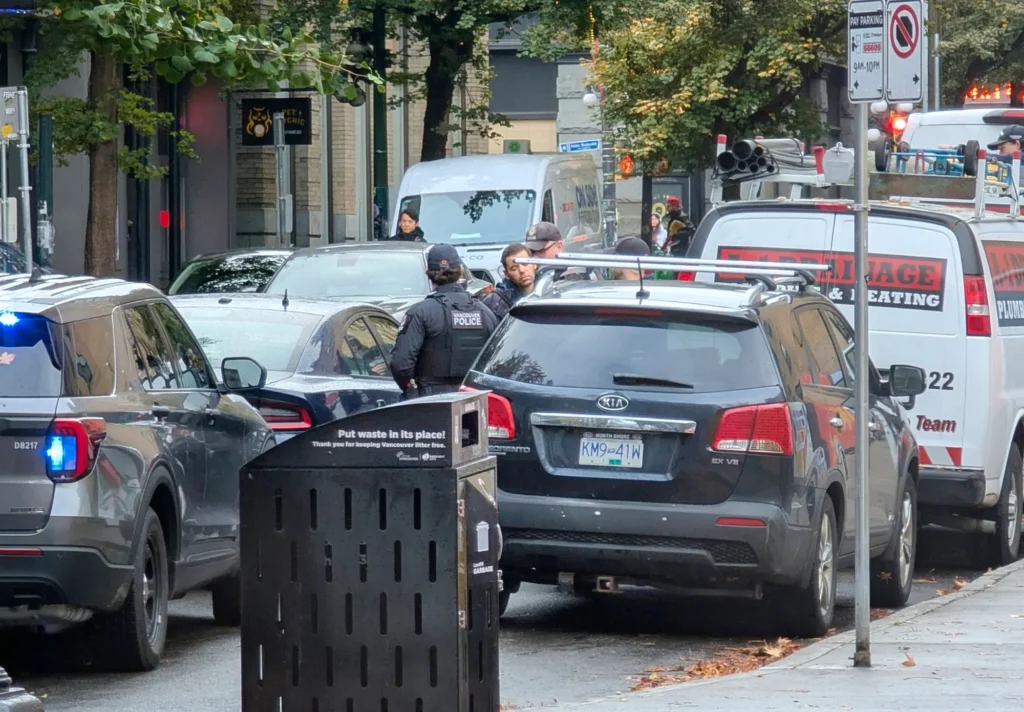
Most participants said they did not understand the policy. “They made it legal and illegal in the same year,” one said. Another said decriminalization “just didn’t do anything at all.” What they described was familiar. Police took phones, identification, cash, tools, mobility aids and pipes from them, participants said. One woman was released from holding cells without a charge, and officers had left her wheelchair on the sidewalk where she was arrested. She held onto a wall to walk to the bus stop.
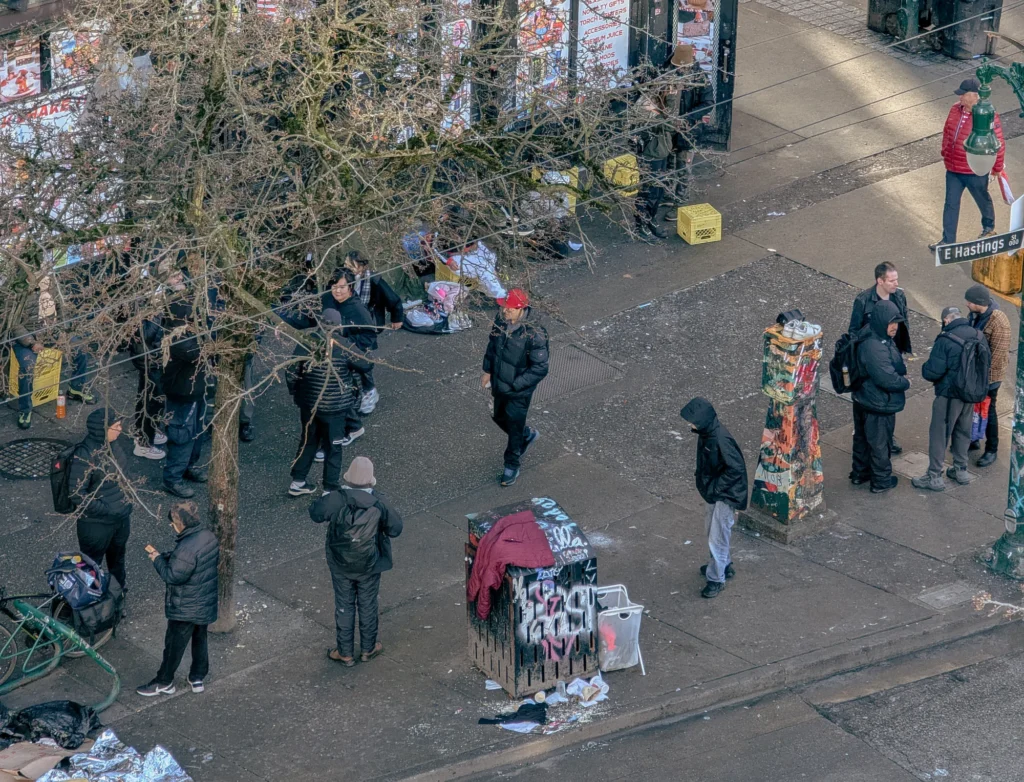
Their accounts describe policing after public drug use was recriminalized, with other enforcement measures running at the same time in the neighbourhood. A police unit focused solely on the Downtown Eastside, Task Force Barrage, received $5 million from the City in its first year, and daily street sweeps resumed in April 2023. On April 5 of that year, police and city workers removed about 80 structures from Hastings Street, and eight or fewer people were offered housing or other shelter. A participant who returned to a cleared camp said it “looked like we never existed.”
Public drug use has no systematic count
The decision to end the pilot followed concerns about public drug use. The commentary’s authors, Crabtree and Greer, wrote that no systematically collected data on the prevalence of public consumption are available. Whether decriminalization increased public drug use, or increased scrutiny of something already visible, “will remain unknown.” They add that decriminalization may have politicized drug use further, which works against its aim of reducing stigma. Insp. Heard said in 2024 that the VPD had seen a decrease in public complaints about consumption.
What was measured was opinion. Polling cited in the commentary shows opposition to the policy rising from 41 to 47 per cent between 2024 and 2025, and a decline in perceived community safety. The study’s authors write that the policy’s end “seemingly” followed concerns about public drug use, community safety and a perceived failure to reduce deaths. Deaths had a monthly count. Public drug use had polls.
Samona Marsh, secretary of the Vancouver Area Network of Drug Users, answered the province’s reasoning with a question. “Not working for who?” she told Filter. “It was working for us.” The BC Human Rights Commissioner’s office had said weeks earlier that curtailing the pilot “was based on unsubstantiated public perception that street disorder increased”. Chief Marilyn Slett of the Union of B.C. Indian Chiefs said on January 15 that ending it altogether would be “a serious lapse in judgement”.
Three groups of people sit outside the numbers behind the decision: people who used drugs in public, people whose drugs were taken without a record, and people who sought treatment, a number Osborne said was hard to attribute to the pilot.
What happens to possession now
Before the pilot, seizure without arrest already sat alongside charging as a way police handled possession. A Harm Reduction Journal study of people who use drugs daily in Vancouver reported that the VPD recommended 36 simple-possession charges to Crown counsel in 2019. Participants reported at least 35 drug seizures without arrest in the six months before their interviews. The authors caution that charges and seizures are distinct practices that cannot be compared directly, and conclude that seizures without arrests occur more often than charges.
Possession is a criminal offence again. The commentary’s authors wrote that “police officers and prosecutors maintain discretion in their work” and encouraged a sustained health-based approach under existing laws. Doerkson’s platform adds 250 police officers through the Justice Institute and 50 Crown prosecutors. The VPD’s academy at 351 Abbott Street opened in September with 40 recruits, and our October 25 piece on the new government gives their scheduled start as working officers: June 25, 2027.
Scotty Archondous, a P.O.W.E.R. researcher and VANDU board member, told Simon Fraser University that the study matched what he heard from people during the pilot. Seizures, “often without charges or arrest,” put “our lives at higher risk of violence and harm,” he said, through “debts, desperation, and sometimes disrupted access to a trusted source.”
See more of our reporting in Google’s Top Stories.


Monika is a dedicated Downtown Eastside activist and youth counsellor with extensive experience working alongside British Columbia and California community organizations. Passionate about harm reduction and youth empowerment, Monika’s advocacy focuses on creating impactful programs, offering a voice to those often overlooked.


Leave a Comment