
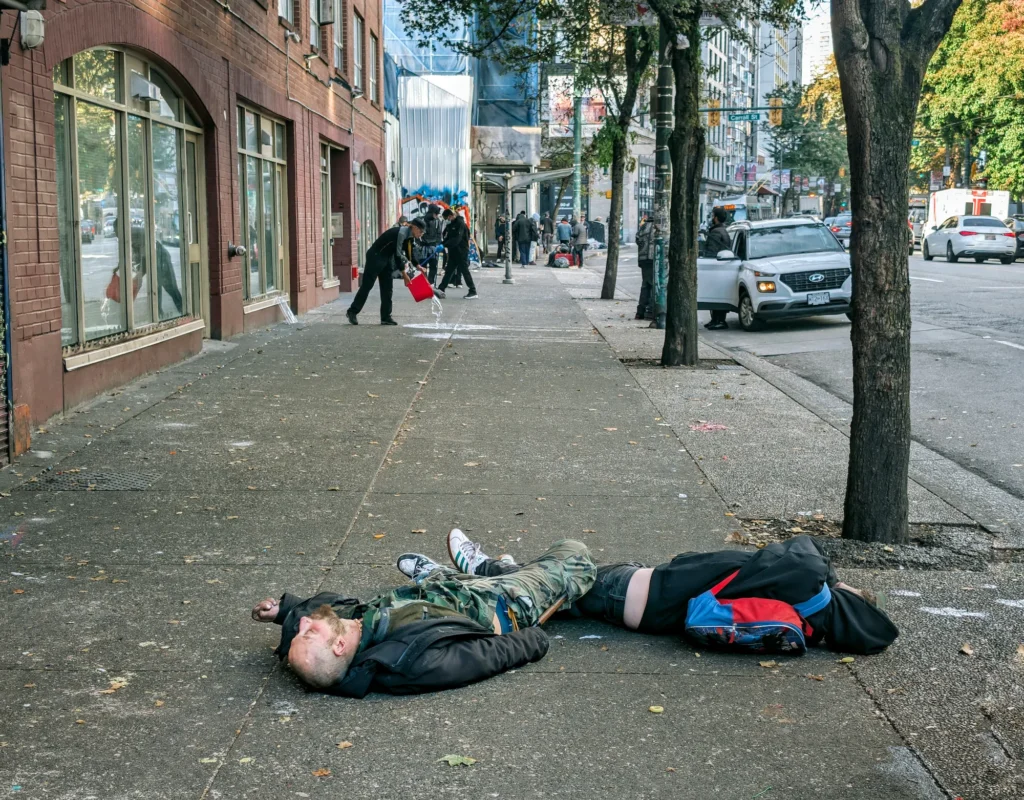
A friend broke down the door of Edwin Bergsson’s recording studio in Victoria about five years ago and found him unconscious. Bergsson had overdosed after taking what he believed was crystal meth. The friend saved his life, and the lack of oxygen left him with a brain injury.
Asked when it happened, Bergsson could not give a date. “Maybe almost five years ago now,” he told Canadian Press reporter Brieanna Charlebois in April, and added that it was at night. His short-term memory still gives him trouble. A long hospital stay led him into rehabilitation and to support from the Cridge Centre for the Family. Without that stay, he said, he would not have taken any of those steps.
He is one of many. Dr. Michael Krausz of the Centre for Advancing Health Outcomes estimates that overdose survivors outnumber deaths five to ten times over, and he says the health-care system is not prepared to take that seriously enough. Vancouver has a specialized rehabilitation program for people whose thinking has been affected by substance use. It accepts people who continue to use drugs, and a patient can approach it without a doctor’s referral. For people in the Downtown Eastside who need continuing help after an overdose, the route into care can still require memory, planning and persistence, the very abilities an injury may have affected.
An injury without a name
For harm-reduction writer Matthew Bonn, learning about overdose-related brain injury brought a new uncertainty about his own health. He had survived multiple overdoses. In a 2025 essay for Filter, he recalled a colleague giving him rescue breaths during one in Montreal and the long recovery that followed. Later, through his work, he began to wonder if he might be living with an injury. He took that concern to researchers he was interviewing.
Bonn had no diagnosis to report. His account describes the stage before a referral, when someone is trying to decide what a change in their thinking might mean. An opioid overdose can suppress breathing and deprive the brain of oxygen, with effects that can include memory and attention problems. Symptoms may appear after the immediate emergency has passed.
A 2021 systematic review led by Erin Winstanley examined 79 articles about cognitive impairment and brain abnormalities after opioid overdoses. Many concerned individual cases or small case series, with differing injuries and follow-up periods. Bias in the studies limited what could be concluded about how often survivors were affected. The accounts included lasting disability and people who recovered, some partially and others fully.
The BCCDC’s February 2025 analysis followed recorded diagnoses over 2015–2021, including people with fatal and non-fatal poisonings. Milder difficulties and events outside the health system could go unrecorded. Among 10,413 people with recorded drug-poisoning events, 225 had encephalopathy, a category of brain dysfunction. Adjusting for age, sex, and mental disorder, the researchers found encephalopathy was 19.5 times as prevalent among people with a recorded poisoning as among those without one.
Rehabilitation while substance use continues
In May 2023, the province announced that Vancouver Coastal Health’s Cognitive Assessment and Rehabilitation for Substance Use program, CARSU, had served more than 40 people. Its team included psychiatry, neuropsychology and occupational therapy. Assessment was intended to help people understand their cognitive abilities and take part in mental-health and substance-use care, with rehabilitation support suited to their needs.
Karen Barclay, then VCH’s director of mental health and substance use in Richmond, described the assessment as useful to both the person with the injury and those caring for them. The announcement allowed people in the VCH region to seek a referral from a health professional or contact intake themselves. The current HealthLink BC listing retains both routes.
CARSU’s offer is broader than a service for people who have stopped using drugs. The Pathways service directory says abstinence is unnecessary, and describes outreach and in-person care in Vancouver and Richmond, with virtual services for the wider VCH region. Staff work with the person and their supporters to understand cognitive difficulties, develop strategies for daily life and connect with other help.
That approach makes room for rehabilitation during an unsettled period of someone’s life. A person does not have to complete substance-use treatment before seeking help with the thinking skills that treatment itself may demand. For a Downtown Eastside resident, outreach also offers an alternative to organizing every contact around a trip to a clinic.
CARSU was selected for an evaluation announced by VCH’s research institute in June 2023. Occupational therapist and team lead Melissa Medeiros’ proposed study would examine client and health-care outcomes, bringing client and provider perspectives into the work.
Before anyone makes the referral
At a 2022 BC Consensus on Brain Injury gathering, addiction physician Dr. Elizabeth Plant described people who appeared to be functioning normally but had cognitive difficulties and continued using substances. Connecting them to support was hard even for her. The published proceedings record her concern about treatment that relies on developing insight when an injury may interfere with participation. She also described the competing demands of living on the street, including keeping possessions safe and finding somewhere to sleep.
A 2026 University of Victoria study recruited survivors through harm-reduction agencies on Vancouver Island. In that small, predominantly white male sample, most did not know brain-injury care was an option. Only one reported trying to obtain it, for an injury unrelated to overdose. Some had been told about further services they could pursue; no overdose-specific follow-up care was reported in their accounts.
A provider interviewed for the study described another obstacle: reminder texts and emails were of little use to clients without a cell phone plan. Short-term memory difficulties made keeping appointments hard, while life on the street could put the usual reminders out of reach.
Self-referral starts with a person knowing there is something to ask for. In the Island interviews, that knowledge was often missing. Plant described the difficulty from the other side of the consultation, as a physician trying to find suitable support for someone who was still using.
There are existing workers positioned to make connections. VCH’s Overdose Outreach Team helps people who have recently overdosed, or are at high risk, reach substance-use care and other services. HealthLink lists self-referral and referrals from health professionals. Its remit begins with overdose risk, while CARSU’s begins with cognitive difficulties. A survivor may need help from both, alongside housing and ordinary medical care.
The work after admission
By the time of his April interview, Bergsson had moved through a recovery house to independent living. He was working two days a week at the Second Chance Cafe in Saanich, which the Cridge Centre runs and where brain-injury survivors work. The centre has offered brain-injury services since 1991. Bergsson suspects that many people in his position get none of that support and fall into what he called a big gap.
Its community support service describes what some of the everyday assistance involves. Workers help with medical appointments and phone calls, set up calendars and routines, and assist with benefits forms. The work takes place one-to-one in people’s homes.
Entry to that Island service requires referral and registration with Island Health’s brain-injury program. Its conditions include medical evidence of an acquired injury, Island residency, and limited access to other funding. A survivor seeking help with appointments and paperwork must first get through the referral and establish eligibility. The worker who could help organize those tasks may enter the picture only afterwards.
A low barrier still leaves a queue. Kix Citton, executive director of the Nanaimo Brain Injury Society, told the Canadian Press that the society is purposefully low-barrier and asks for no formal diagnosis. It is also “at capacity and slammed,” with a three-week waitlist, and funding has not kept pace with demand.
Falling between service mandates
In the Interior, a January 2026 draft report by Interior Health and UBC Okanagan describes people with brain injuries struggling to fit service mandates. Participants had injuries from different causes. Providers described restrictions involving diagnosis and co-occurring needs; people with overlapping needs could fall outside a program’s mandate. Staff stretched their own services to cover gaps elsewhere.
One participant described being refused help despite having a diagnosed brain injury and needing home care and transport. They recalled being told they had “too much ability.” A provider described another frustration: knowing what a client needed but being unable to provide it within the service’s rules and resources.
The report’s recommendations include coordinated intake and peer assistance with obtaining services. One provider described what coordination might look like: a single form containing the person’s history and medical information, shared among the agencies involved. The person would supply their history once, and the form would carry it from there. Bergsson, asked in April for the date of his overdose, said he did not have the details.
See more of our reporting in Google’s Top Stories.


Glenn is dedicated to scrutinizing government actions affecting the Downtown Eastside and holding those in power accountable for their commitments. With a focus on transparency and policy analysis, his writing aims to expose gaps between promises and outcomes, pushing for meaningful changes that benefit the community.


Leave a Comment