
“We’re not putting up with this out here,” Sgt. Steve Addison told two men in Chinatown on a Vancouver Police Department video. He said he understood their situation. Then he asked them to take their drugs to the overdose prevention site in the alley. They agreed. “Oh, I don’t blame (you),” one of the men said. “It looks bad, it looks bad on the city.”
In the Downtown Eastside, police now direct people to the nearest overdose prevention site, and the neighbourhood holds most of Vancouver Coastal Health’s sites. Another was due to open downtown in June, at 900 Helmcken Street. After residents and businesses pushed back, Health Minister Josie Osborne said on May 27 that it would not go ahead for now, and by August 24 the Province had cancelled it. The lease on the building, held by RainCity Housing, runs two years from June 1 at $179,000 a year.
Two months later, on October 24, voters gave the Conservatives a majority, and the new government takes office on November 20. Its platform promises to “stop forcing drug-friendly facilities on communities” and to review overdose prevention sites and injection and inhalation sites, aiming for fewer sites in better places. It sets no date for the review and no price.
Whoever carries out the review will find that no bill created the sites. A health minister did, with one sentence, signed on Friday, December 9, 2016, after activists had spent the autumn reversing overdoses in a tent in an alley, with no government money.
That sentence is still in force. A new health minister can repeal it or replace it with another. What a minister cannot do is declare the emergency over: the order runs only while the overdose emergency lasts, and that is not the minister’s call. Whether a given site stays open turns on its lease, its grant, its staff and, for a few, a federal permit. The order sets none of them.
The tent came before the order
The order was written after the fact. Provincial health officer Dr. Perry Kendall had declared a public health emergency over overdose deaths on April 14, 2016. Five months later, on September 21, Sarah Blyth and other activists pitched a tent facing an alley near East Hastings and Columbia streets. It ran mostly on small GoFundMe donations. Volunteers trained to use naloxone staffed it and handed out clean needles.
The health authority kept its distance. In November, a spokesperson said Vancouver Coastal Health did not support or condone services operating outside the law. By December, more than 300 overdoses had happened at the tent before the volunteers stopped counting. No one died.
Then the Province caught up. Health Minister Terry Lake signed the order. He said he had woken at four one morning thinking about the pop-up tent. On December 23 the health authority told Blyth it would supply equipment and pay a manager and staff to run the site 12 hours a day, seven days a week. A donated trailer on a city-owned lot at 62 East Hastings replaced the tent. Blyth said the group was grateful to be somewhere warm and dry.
Blyth now runs the Overdose Prevention Society, whose site at 141 East Hastings sees 400 to 600 visits a day, she says. Asked in June about police sending people to her site, she said it was the right thing to do: using with staff nearby is safer than using alone in an alley. In 2016 she had put it in fewer words: using alone can lead to dying alone.
The order names no site
The order Lake signed, Ministerial Order 488, is one sentence long. It directs BC Emergency Health Services and the regional health boards to provide overdose prevention services, as “ancillary health services,” anywhere the level of overdose illness and death shows a need, on the advice of the provincial health officer, for as long as the emergency Kendall declared lasts. The services it describes are watching people at risk of overdose and stepping in fast when they need it.
The order never uses the word site. It names no operator, sets no budget and draws no map. Three days after Lake signed, a Province release called it an extraordinary measure that would last for the duration of the emergency. Within two weeks, 18 sites were open across the province, five of them in the Downtown Eastside, and the Ministry of Health called them a “temporary measure.”
The emergency has not ended. In April, as it reached its tenth anniversary, provincial health officer Dr. Bonnie Henry said the crisis remains a public health emergency and that keeping the declaration in place lets the Province respond to the toxic drug supply. The temporary measure is in its eleventh year. Under the Public Health Act, the authority to act in a regional emergency ends when the provincial health officer issues a notice that the emergency has passed.
The minister’s power over the order comes from a short section of the Health Authorities Act. Section 7.1 requires a regional board to comply with any direction the minister gives by order, and the Emergency Health Services Act gives the minister the same power over the ambulance service. Neither section mentions a cabinet vote or the legislature. Under the Interpretation Act, a power to make a regulation includes the power to repeal or amend it, and the Act counts an order made under an Act as a regulation. Political columnist Rob Shaw read it the same way on November 10: shutting down overdose prevention sites is a ministerial order and needs no legislation.
Non-profit societies run the sites
Several societies run the sites. PHS Community Services Society, known as PHS, runs the Molson site in the alley off 166 East Hastings. The Overdose Prevention Society and partners staff the site at 141 East Hastings. Lookout Housing and Health Society runs Powell Street Getaway, where the health authority supplies clinical support and harm reduction supplies.
Vancouver Coastal Health paid PHS $18,289,308 in the year ended March 31, 2026, and RainCity Housing and Support Society $13,952,936, according to its schedule of payments to suppliers. The schedule lists payments by society, and the figures cover everything each society does for the health authority, not only overdose prevention.
A City of Vancouver report in December 2018, two years after the tent, put the cost at about $100,000 a building a year for overdose prevention in non-profit single-room-occupancy hotels. It recommended asking the Province for $355,000 a year to run an outdoor inhalation service in the Downtown Eastside. The Province’s own 2024 timeline lists $49 million over three years for existing harm reduction, including overdose prevention sites, drug checking, and naloxone kits.
The staff on the floor include peer workers, people with the same lived experience as the people a site serves. One of them said in 2023 that after seven years at PHS his starting rate had been $7.80 an hour, paid as a volunteer stipend. Stipends rose to between $15 and $20 an hour before a union drive. About 35 peers voted to unionize in 2021, and those covered by the agreement moved to a base wage of about $28. Roughly 100 others, classed as volunteers, stayed outside it. PHS chief executive Micheal Vonn said the peer programs are paid for with grants from health authorities, a limited pool, and that the raises left less for the volunteers.
The work changed with the pay. By December 2023, peers outside the bargaining unit had lost shifts, and at Molson those who once watched people use so they could step in during an overdose were typically limited to a window handing out supplies. PHS said it no longer had the money to offer the same work.
The Province’s own count shows what that work adds up to. From January 2017 to the end of January 2026 it records more than 6.6 million visits to overdose prevention and supervised consumption sites in B.C., 32,997 overdoses responded to and survived, and two deaths.
Communities heard it after the announcement
But the residents and businesses around Helmcken said they heard about the site only after it was announced. Osborne’s May 27 statement said that she and Terry Yung, the minister of state for community safety, had heard concerns from the city, local businesses and community partners after the Helmcken site was announced. Vancouver council had already voted to direct city staff to take every lawful step to stop it.
At a press conference the next day, business leaders said a pause was not enough. Jane Talbot, who leads the Downtown Vancouver Business Improvement Association, said the community had not been meaningfully consulted. She said Vancouver Coastal Health and RainCity had improved operations inside their walls but needed to work with neighbours on what happens once people leave. Ian Tostenson of the BC Restaurant and Food Services Association said business owners should not have to plead with the Province to collaborate. Laura Ballance of the Hospitality Vancouver Association wanted overdose prevention moved into hospitals.
Guy Felicella, a harm reduction and recovery advocate, answered that people were already using drugs across the street from the hotel. If a site were there, he said, he would send them into it. He asked whether the complaint was the disorder or a site, since no site stood there.
The First Nations Health Authority said it felt great disappointment when the cancellation was confirmed. Its chief medical officer, Dr. Nel Wieman, said First Nations communities across B.C. lose several hundred members to the drug crisis each year. In the Vancouver Coastal region in 2025, the authority counted 87 First Nations deaths from toxic drugs. First Nations people make up 2.1 per cent of the region’s population, and their death rate was 10.2 times that of other residents.
Ravi Kahlon had taken over the health portfolio on August 14. Shaw reported in a September 4 column that Kahlon had ordered Vancouver Coastal Health to stand down, and that he said the government had not explained well enough what overdose prevention is for and what it means for communities. He promised a reset: business and city leaders brought in before any new site is proposed.
The 2016 order has no consultation step. It sets need by a count of overdose illness and death, and the neighbours’ view never enters it. The platform’s remedy is a review conducted in consultation with local communities, but it does not specify who would conduct the consultation.
A site ends by lease, notice or budget
A site can also end without a minister. A landlord closed the Howe Street site on January 31, and Vancouver Coastal Health said the closure came at the property owner’s direction and discretion.
Ottawa’s rules ask little of a closure. Health Canada’s class exemption for urgent public health needs sites, in effect since June 17, covers sites that operate under an agreement with the provincial or territorial health minister and makes that minister responsible for running each site. If a site closes permanently, the minister has 48 hours to tell Ottawa. A notice is the only closing rule in the document. The Province said in 2025 that overdose prevention services do not need the federal exemption process at all.
Alberta used the budget. Travis Peddie, 41, used the supervised consumption sites in Calgary and Lethbridge for seven years. He said in an affidavit that staff saved him from overdoses again and again. In April he asked a court to keep the sites open while his Charter challenge was heard. Justice Jason Wilkins dismissed the application on June 16, writing that he was bound by the Alberta Court of Appeal’s dismissal of an earlier Red Deer application and that the issues before him required no fresh analysis.
Both sites closed on June 30. Calgary’s, at the Sheldon Chumir Health Centre, had been the province’s first, opening in October 2017. Lethbridge’s was a mobile service the province had run since August 2020. Public Safety Minister Mike Ellis said in March that the money would go to 30 to 40 withdrawal beds in Calgary, and to 10 more beds and an addiction medicine clinic in Lethbridge. People would not be left without support, he said. Three sites remain, two in Edmonton and one in Grande Prairie.
Ontario’s courts offered one reprieve. In March 2025 a temporary injunction kept the Kensington Market site open, a site that took no provincial money. The province’s ban on sites near schools and its funding cutoff closed or converted most of the rest. The one protection that has held was against Ottawa: in 2011 the Supreme Court of Canada ordered the federal health minister to grant Insite an exemption after he refused to renew it, calling the refusal arbitrary and grossly disproportionate. A province’s budget was not before the court.
Permanent exemptions require consultation
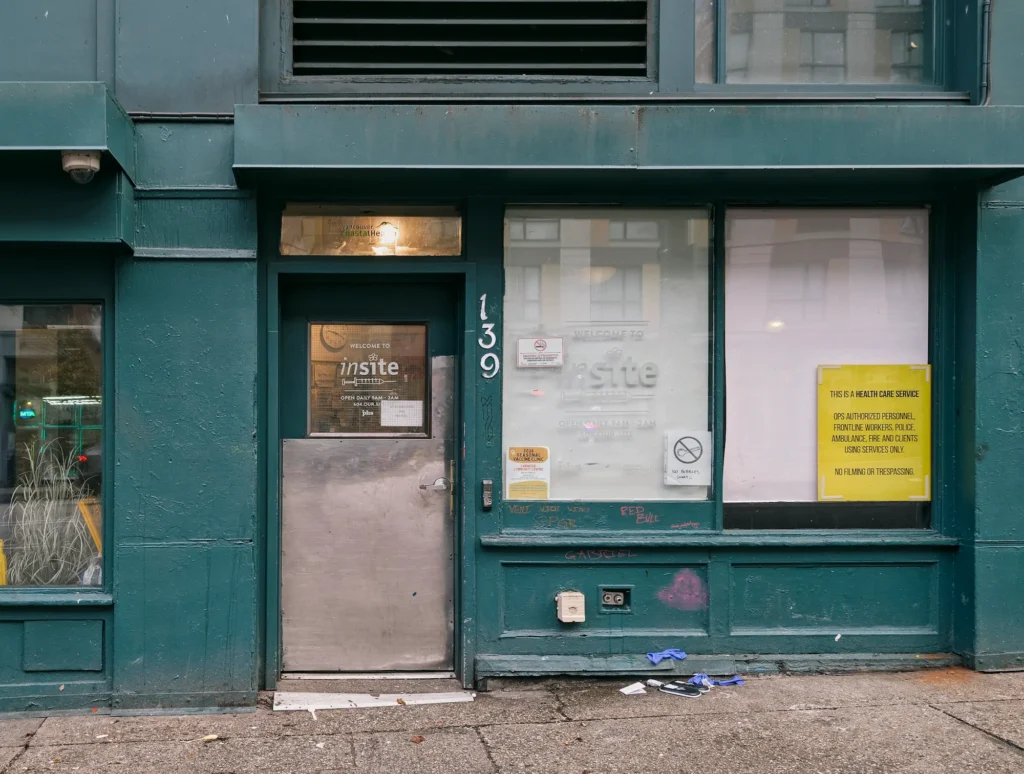
Insite’s exemption comes through the slower road that the Province’s December 2016 release pointed to. Health authorities, it said, were applying for permanent supervised consumption services to be integrated with other health and social care services. Health Canada’s list now shows six sites in the province with exemptions: Outreach Urban Health in Kelowna, SafePoint in Surrey, The Harbour in Victoria and three in Vancouver. The three are Insite at 139 East Hastings, which opened in 2003 as the first sanctioned supervised injection site in North America, Hope 2 Health at 611 Powell Street and the Dr. Peter Centre at 1110 Comox Street.
Ten years after that release, six sites hold exemptions. The order opened 18 in two weeks. The permanent road requires applicants to consult their communities before opening, and a site that holds an exemption must maintain that engagement for as long as the exemption lasts. Each exemption carries an expiry date: Kelowna’s falls on December 31, with its renewal application in, and Insite’s on April 30, 2027. The three Vancouver exemptions belong to Vancouver Coastal Health, the BC Centre for Excellence in HIV/AIDS and the Dr. Peter AIDS Foundation.
The platform’s review names injection and inhalation sites as well as overdose prevention sites. Injection and inhalation sites are the kind Ottawa’s exemptions cover, and the permanent road already requires the consultation the platform promises. A review run through it would answer the complaint that sites were forced on communities. It would also be slow, and it would not bind a province’s budget, which is how Alberta closed its sites.
A busy alley and a cancelled site
Tanya Fader, a director at PHS, said the Molson site has no indoor space for people who smoke their drugs. They smoke outside, in alleyways she described as very busy, and staff and peers have to work both inside and out. Many overdoses get overturned there, she said, and a nursing clinic at the back treats wounds.
A tent in an alley started the sites in 2016. Vancouver Coastal Health’s list still includes an inhalation tent at 141 East Hastings. Downtown, the Helmcken building has a lease and no site, and the health authority says it will work with the Ministry of Health and the City on treatment and recovery programming there.
Gary Demsey, who uses drugs, told Global News that he had been to his doctor on June 3 and was going for his first microdose of suboxone. He has been using for 35 years, he said. He has seven children. He is tired, and sick of the everyday cycle. The Helmcken building should be used to bring people inside, he said: “let’s get these guys indoors instead of on the street.”
See more of our reporting in Google’s Top Stories.


Glenn is dedicated to scrutinizing government actions affecting the Downtown Eastside and holding those in power accountable for their commitments. With a focus on transparency and policy analysis, his writing aims to expose gaps between promises and outcomes, pushing for meaningful changes that benefit the community.



Leave a Comment